Instead of watching an hour of Netflix, watch this 2-hour Stanford lecture, which will teach you more about how LLMs like ChatGPT and Claude are built than most people working at top AI companies learn in their entire careers.
🚨 Anthropic just showed a 27-minute workshop on how to actually do prompts for Claude.
Taught by the people who built it.
Free. No registration. No paywall.
I've seen $300 courses that don't cover what they teach in the first 8 minutes.
Watch the session
Anthropic just released a 4-hour course to getting a $500k AI engineering job:
00:15 - The right way to prompt Claude
33:21 - What makes Claude act dumber on your code
01:33:39 - How Anthropic use Claude every day
02:50:56 - The fix that makes Claude way smarter This
4-hour Anthropic free course replaces about 10 paid engineering courses.
Watch it today, then read the step-by-step guide on building loops below.
Most robotics books teach you theory.
This one teaches you how robots actually work.
📌 If you’re self-learning robotics, this is genuinely one to save for later!
It’s one of the few resources that brings mechanics, planning, and control into a single, unified framework.
Ladies, and gentlemen: Modern Robotics: Mechanics, planning & control.
If you understand basic physics, linear algebra, and a bit of coding, you can get through it.
Instead of abstract formulations, it uses screw theory to describe robot motion in a geometric and intuitive way.
Exercises at the end of each chapter, dedicated software, and video lectures all reinforce the same concepts from different angles.
Which is exactly what you need for something as multi-layered as robotics.
Here's the link to the full book: https://t.co/yCAOboJ9xR
~~
♻️ Join the weekly robotics newsletter, and never miss any news → https://t.co/GoA3ZuwoPB
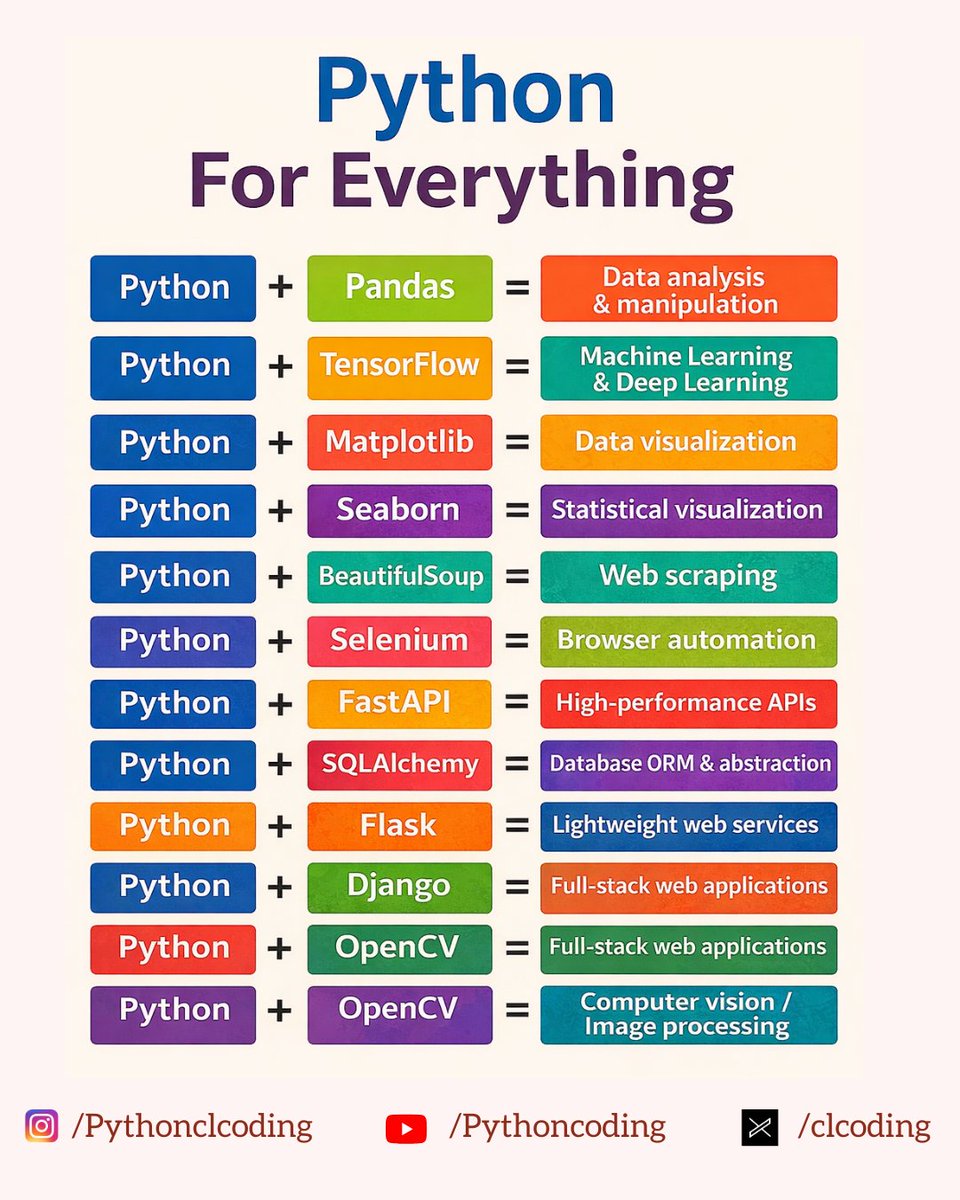
Python for Everything
🧠 Data & Analysis
Mastering Pandas with Python — A complete guide to using Pandas for data analysis, cleaning, visualization, and real-world projects.
https://t.co/I4U006m2TE
📊 Projects & Practice
100 Python Projects — From Beginner to Expert — Hands-on project book covering Flask, databases, data science with Pandas/Matplotlib, automation & more.
https://t.co/5HYO0pTbS3
800 Days Python Coding Challenges with Explanation — Massive collection of practice problems with solutions.
https://t.co/rGjte4FXjT
API in a nutshell 🧵
API (Application Programming Interface):
A set of rules and protocols that allow different software applications to communicate and interact with each other.
☘️ Types of APIs:
- RESTful API (Representational State Transfer):
Uses HTTP requests to perform CRUD (Create, Read, Update, Delete) operations on resources. It is based on a set of principles, including statelessness and the use of standard HTTP methods.
- SOAP API (Simple Object Access Protocol):
Uses XML as a message format and can operate over various transport protocols, including HTTP, SMTP, and more. Known for its strict standards and strong typing.
- GraphQL:
Allows clients to request only the data they need, reducing over-fetching or under-fetching of data. Clients define the shape of the response using a query language.
☘️ HTTP Methods (CRUD):
- GET: Retrieve data from the server.
- POST: Create new data on the server.
- PUT: Update existing data on the server.
- DELETE: Remove data from the server.
☘️ HTTP Status Codes:
- 200 OK: Successful request.
- 201 Created: Resource created successfully.
- 204 No Content: Successful request with no response body.
- 400 Bad Request: Invalid request.
- 401 Unauthorized: Authentication required.
- 403 Forbidden: Permission denied.
- 404 Not Found: Resource not found.
- 500 Internal Server Error: Server error.
☘️ Authentication Methods:
- API Key: A simple, often insecure method where an API key is included in the request header.
- OAuth 2.0: A more secure and flexible method for user authentication and authorization.
- Bearer Token: A token used to authenticate API requests.
The 6 Important Laws of Growth:
1. Speak less.
2. Listen more.
3. React less.
4. Observe more.
5. Complain less.
6. Appreciate more.
1. Let your results speak for you.
2. You can't learn if you don't listen.
3. The less you react, the better you can respond.
4. The more you observe, the clearer the situation.
5. The less you complain, the quicker you can act.
6. The more you express gratitude, the more it boosts your energy.
Serious question. I am not an expert. In international law, why is the Al Qaeda killing of innocents in NY and DC on September 11, 2001 considered an act of terrorism, but Putin's slaughter of innocents in Bucha, Kramatorsk, Chernihiv, or Mariupol is not terrorism?
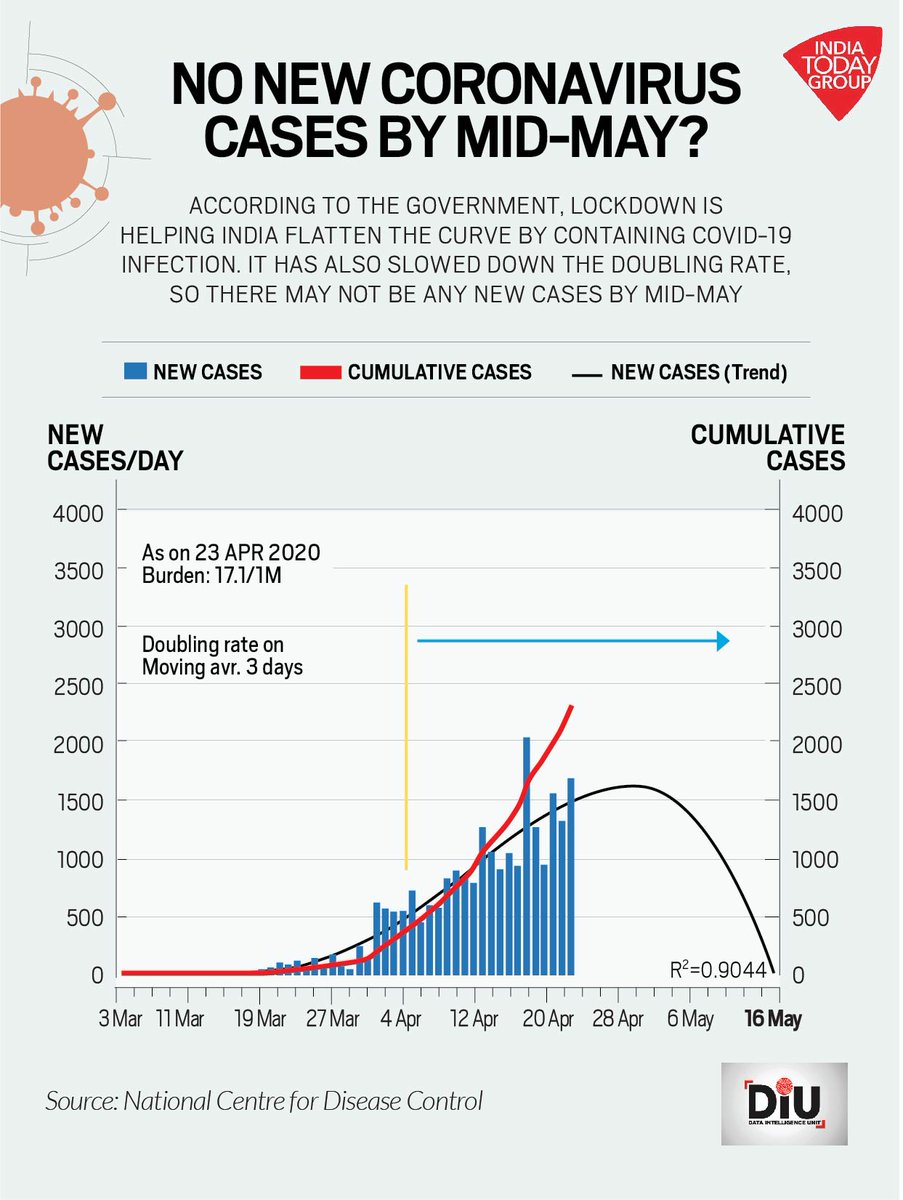
According to a latest press release by the government, the #lockdown is helping India flatten the curve. If this trend continues, the rate of infection could slow down so that there may not be any new #coronavirus cases by mid-May. #DIU
In Tamilnadu daily bulletin under patient details there is reference to "primary" and "contact". What does primary mean? Is that the source is not available?
@NHM_TN@Vijayabaskarofl@DrBeelaIAS