One thing that I have learnt after being in the software industry for almost 5 years now, is that change is the only constant in this field.
Back in 2021, when I just started actually building things, the MERN stack was the first thing that I got familiar with since everyone in my college was using it. Knowing syntaxes, shiny frameworks, different languages were considered to be a flex among us.
And now all those things have become obsolete, the only thing which matters now is how you think about overall systems from a business' perspective and how well you can communicate your thoughts to an entity which is clearly much better than you in handling the mundane and repetitive tasks. You think via first principles and if you have a good enough skill of how to read the code generated by the entity, question the approach it took at every turn and how it could've taken a better one, only then you can survive here. That is the only MOAT that we as software developers currently seem to have.
I think we don't appreciate Deepseek quite enough. The amount of api usage it gives us at such cheap pricing is genuinely unbelievable. And if you use it with a harness like CommandCode which has it's own taste model and has been optimized for Deepseek specifically, that's just the icing on the cake.
Got done with an insane amount of features yesterday at work and that too on a Friday while it consumed just 30% of my 5hr limits and I am on a 10$ plan in CommandCode, truly surreal fr.
Of course, it's still behind frontier models when it comes to thinking or navigating through complex architectural decisions. So for planning or designing complicated product flows, it is not the ideal model but if you specify proper instructions or have a bigger model map out the complex stuff, it is really quite efficient in following and implementing them systematically.
Would highly recommend using this model for implementation in your usual agentic orchestration.
One of my users who signed up today stayed and used my AI story app for 90 mins playing roughly around a 100 turns.
When you have been working tirelessly on your passion project post your 9-5 for almost six months, small things like these genuinely give you the motivation and the boost of confidence you need to keep building regardless of the quieter days when nothing seems to be happening and no one is using your app (which tbh is true for most of my days).
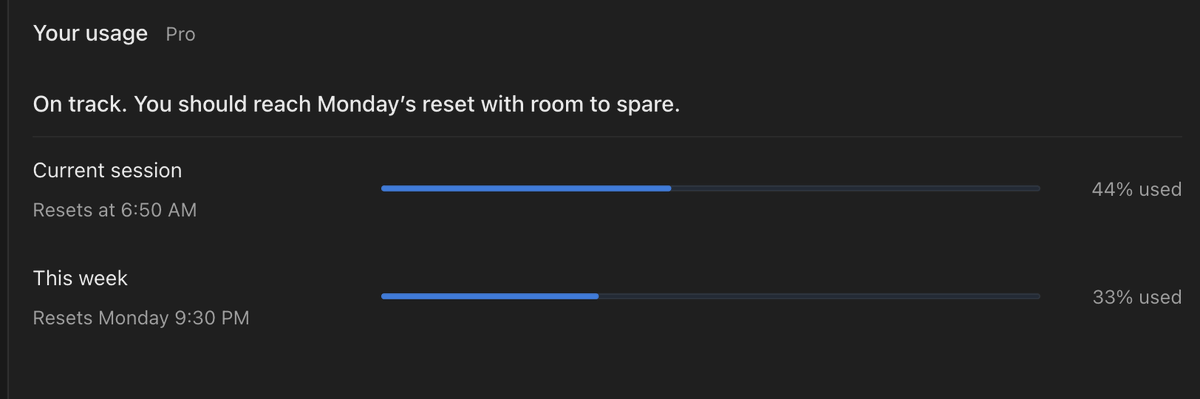
Claude limits seemed to have healed. Implemented a ton of features including a proper guest playthrough, onboarding overhaul, push notifications, reminder to continue your story once the app is reopened and much more.
For those wondering, how is it possible to still have usage left after such extensive tasks, it's all orchestration between several ai agents for specific tasks with opus 5.5 as the main planner(this same workflow would have blown past by 5hr window much faster last week)
@EbiThinks Depends on which subscription you take. Ten dollars plan for opencode and commandcode each should suffice easily for software developers at least
@omkarships No unique idea exists tbh. Building what you have in mind and improving existing products on that domain seems like the right way to go. So yeah, please build it 🙌
@burkov They usually reply and approve within a week. The first approval is the only time consuming process. Later updates go through in a day. But yeah currently,from what I heard, they are apparently dealing with a lot of slop apps so maybe that's why it's taking so much time.
Not everything made it. A prompt cache test saved around 0.1s so it's parked, and splitting the post-reply work into more parallel calls came out slower. Starting the narrator before the last turn's bookkeeping lands would save about 2.8s, but it'd write with a stale cast, so no. Would I pick a vector db again? Yes, but most of the latency I fought was cold connections and waiting on the same thing twice, none of which needed fewer memories to fix (a warm pinecone search is around 0.4s)
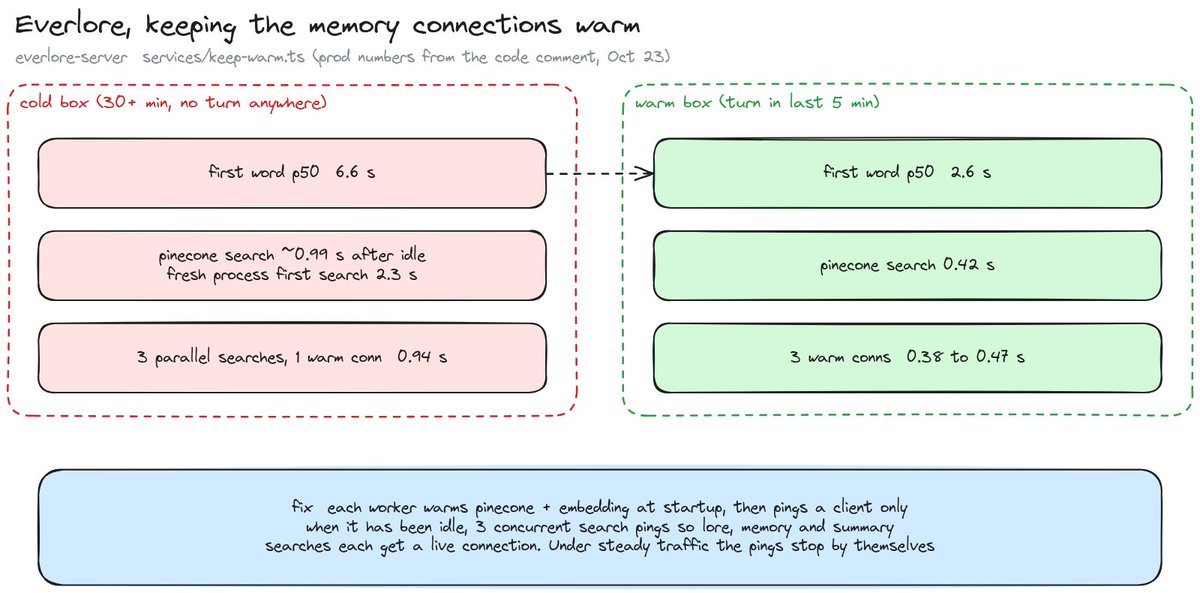
My AI rpg was taking 6.6s to say its first word after sitting idle.
Most of the fix had nothing to do with the vector search, and none of it meant making the narrator remember less. Here's how Everlore's memory actually works
The weirdest win wasn't even retrieval code, it was keeping connections warm. With no turn on the box for 30+ minutes the first word was p50 6.6s, with a turn in the last 5 minutes it was 2.6s. Pinecone also needs three live connections since three searches go out at once, one warm connection still gave 0.94s. So each worker sends three search pings at once and warms the embedding client when idle, and an idle first turn is now 3.3 to 3.6s