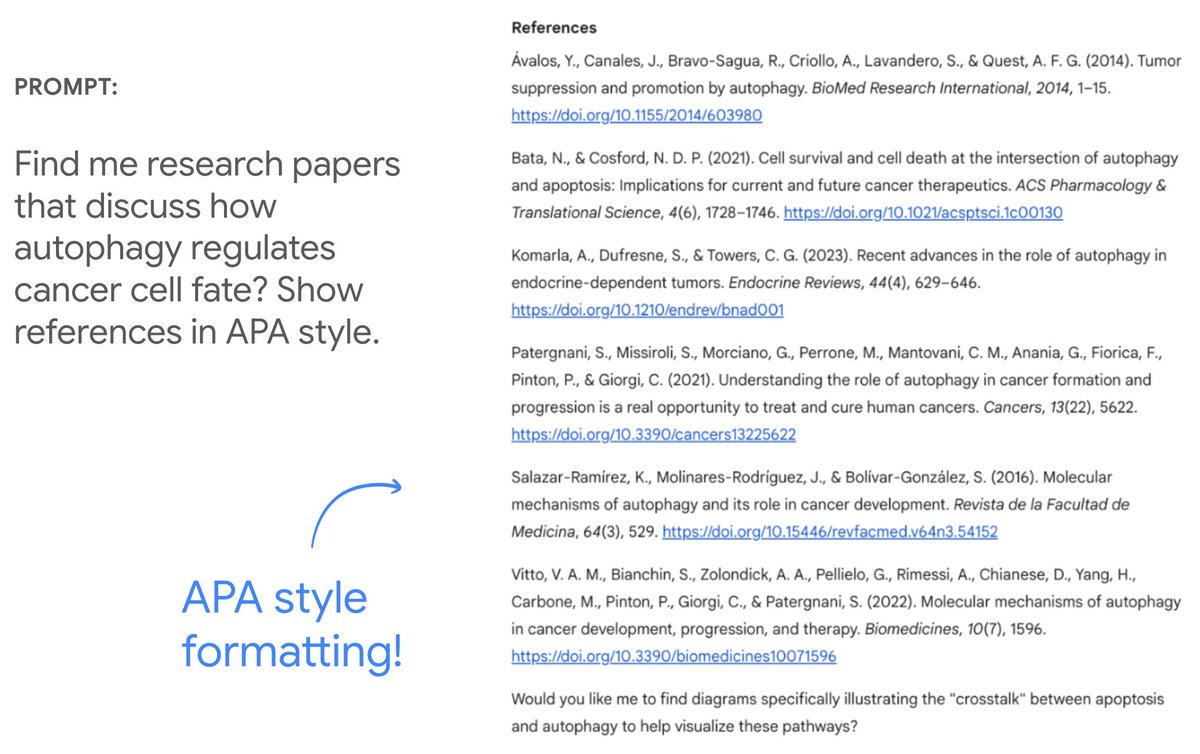
Scientific citations getting a boost in @GeminiApp!
When you ask Gemini to include scientific sources, you will now see proper APA-style inline citations and detailed reference sections, which should help students and researchers everywhere.
We're just starting to roll this out with prompts that are clearly scientific in nature, so you might not see it everywhere yet.
Let us know what you think!
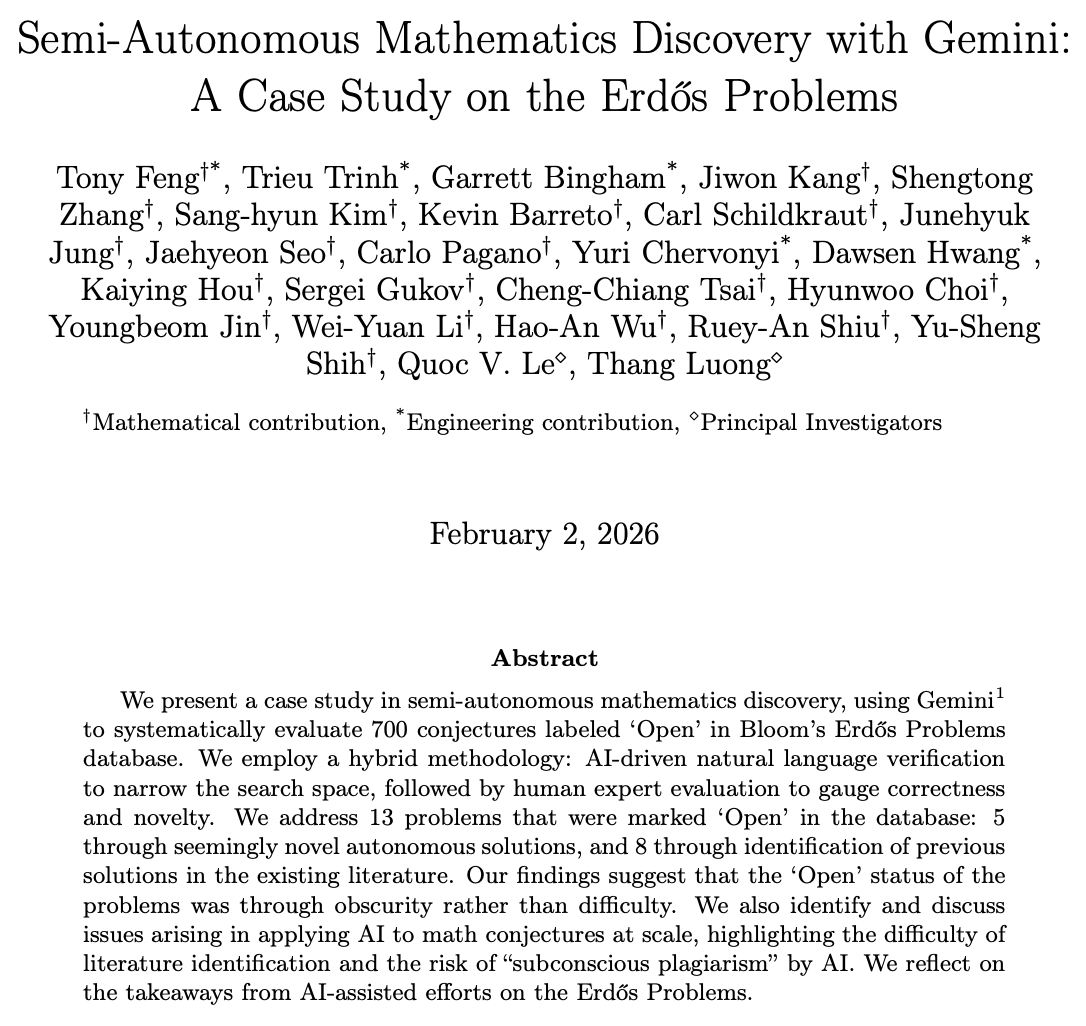
Excited to share our latest work: "Semi-Autonomous Mathematics Discovery with Gemini." We used Gemini to systematically evaluate 700 "open" conjectures in the Erdős Problems database.
The result? We addressed 13 problems marked as open—finding 5 novel autonomous solutions and identifying 8 existing solutions missed by previous literature.
Read the full case study here: https://t.co/y4WhkP4ETO
This is Gemini 3: our most intelligent model that helps you learn, build and plan anything.
It comes with state-of-the-art reasoning capabilities, world-leading multimodal understanding, and enables new agentic coding experiences. 🧵
Congrats to Michel Devoret, John Martinis, and John Clarke on the Nobel Prize in Physics. 🔬🥼 Michel is chief scientist of hardware at our Quantum AI lab and John Martinis led the hardware team for many years.
Their pioneering work in quantum mechanics in the 1980s made recent breakthroughs possible, and paved the way for error-corrected quantum computers to come.
I was just at our quantum lab in Santa Barbara yesterday seeing the incredible progress, hope they are celebrating today. Feeling lucky this morning to work at a company that has had 5 Nobel Laureates among our ranks - 3 prizes in 2 years!
Very excited to share that an advanced version of Gemini Deep Think is the first to have achieved gold-medal level in the International Mathematical Olympiad! 🏆, solving five out of six problems perfectly, as verified by the IMO organizers! It’s been a wild run to lead this effort and I am grateful to everyone in the team for such an amazing achievement! Blog post in the thread and more to share soon!
Official results are in - Gemini achieved gold-medal level in the International Mathematical Olympiad! 🏆 An advanced version was able to solve 5 out of 6 problems. Incredible progress - huge congrats to @lmthang and the team! https://t.co/pp9bXF7rVj
1/ Gemini 2.5 is here, and it’s our most intelligent AI model ever.
Our first 2.5 model, Gemini 2.5 Pro Experimental is a state-of-the-art thinking model, leading in a wide range of benchmarks – with impressive improvements in enhanced reasoning and coding and now #1 on @lmarena_ai by a significant margin. With a model this intelligent, we wanted to get it to people as quickly as possible.
Find it on Google AI Studio and in the @geminiapp for Gemini Advanced users now – and in Vertex in the coming weeks. This is the start of a new era of thinking models – and we can’t wait to see where things go from here.
🥁Introducing Gemini 2.5, our most intelligent model with impressive capabilities in advanced reasoning and coding.
Now integrating thinking capabilities, 2.5 Pro Experimental is our most performant Gemini model yet. It’s #1 on @lmarena_ai leaderboard. 🥇
Gemini 2.5 Pro is an awesome state-of-the-art model, no.1 on LMArena by a whopping +39 ELO points, with significant improvements across the board in multimodal reasoning, coding & STEM. You can try it out now in AI Studio https://t.co/lLpF8ToTVJ & @GeminiApp with Gemini Advanced
Think you know Gemini? 🤔 Think again.
Meet Gemini 2.5: our most intelligent model 💡 The first release is Pro Experimental, which is state-of-the-art across many benchmarks - meaning it can handle complex problems and give more accurate responses.
Try it now → https://t.co/sxHWaCUzRp
Can LLMs be used to discover interpretable models of human and animal behavior?🤔
Turns out: yes!
Thrilled to share our latest preprint where we used FunSearch to automatically discover symbolic cognitive models of behavior.
1/12
1/12 How do animals build an internal map of the world? In our new paper, we tracked thousands of neurons in mouse CA1 over days/weeks as they learned a VR navigation task. @nspruston@HHMIJanelia, w/ co-1st author @JohanWinn
Video summary: https://t.co/mMvsT8TVc9
Paper: https://t.co/35k5tWdvOe
Exciting! 'Space is a latent sequence' & CSCG theory of hippocampus we developed at @GoogleDeepmind and @vicariousai gets strong support in this @Nature paper with a set of ingenious animal experiments, neural recordings and analysis. Congrats @sunw37@nspruston@JohanWinn...1
Happy to have this published ...finally.
Have a look if you are interested in understanding cortical columns, microcircuits, and the thalamus. Stay tuned for threads unpacking the paper...
@lazarox8@antoine_dedieu@jl_marino@ScienceAdvances
https://t.co/lnmIClzp7l
Making LLMs run efficiently can feel scary, but scaling isn’t magic, it’s math! We wanted to demystify the “systems view” of LLMs and wrote a little textbook called “How To Scale Your Model” which we’re releasing today. 1/n
Better diffusions with scoring rules!
Fewer, larger denoising steps using distributional losses; learn the posterior distribution of clean samples given the noisy versions.
https://t.co/tIfeAWYQWt
@agalashov@ValentinDeBort1 Guntupalli @zhouguangyao@sirbayes@ArnaudDoucet1
Diffusion models are trained to predict the mean E[X_0 | X_t] of clean data given a noisy sample.
We propose a novel method of learning the full posterior distribution p(X_0 | X_t) using scoring rules, which improves performance of few-step diffusion models.
Check our paper - https://t.co/ncmOWutFRx
Joint work with @ValentinDeBort1 Guntupalli @zhouguangyao@sirbayes@ArthurGretton@ArnaudDoucet1