Today at Google I/O, we introduced Gemini 3.5 Flash! It has become an integral part of our daily research cycle and works with all the tools we have at Google.
We used a team of agents in Antigravity 2.0 to recreate the original AlphaZero research paper and build a playable version. They coded the reinforcement learning pipeline in JAX/Flax, trained a ResNet model from scratch via self-play on multi-TPU pods, and shipped a full-stack web app so you can play against it, from just 2 prompts. .
Here’s what else makes 3.5 Flash special 🧵
I am hiring a TPM lead for @GoogleAIStudio, the job is to accelerate our progress in every way possible across product, GTM, engineering, and more. If you are AI pilled, high agency, and want to push the frontier in Google DeepMind, consider working with us : )
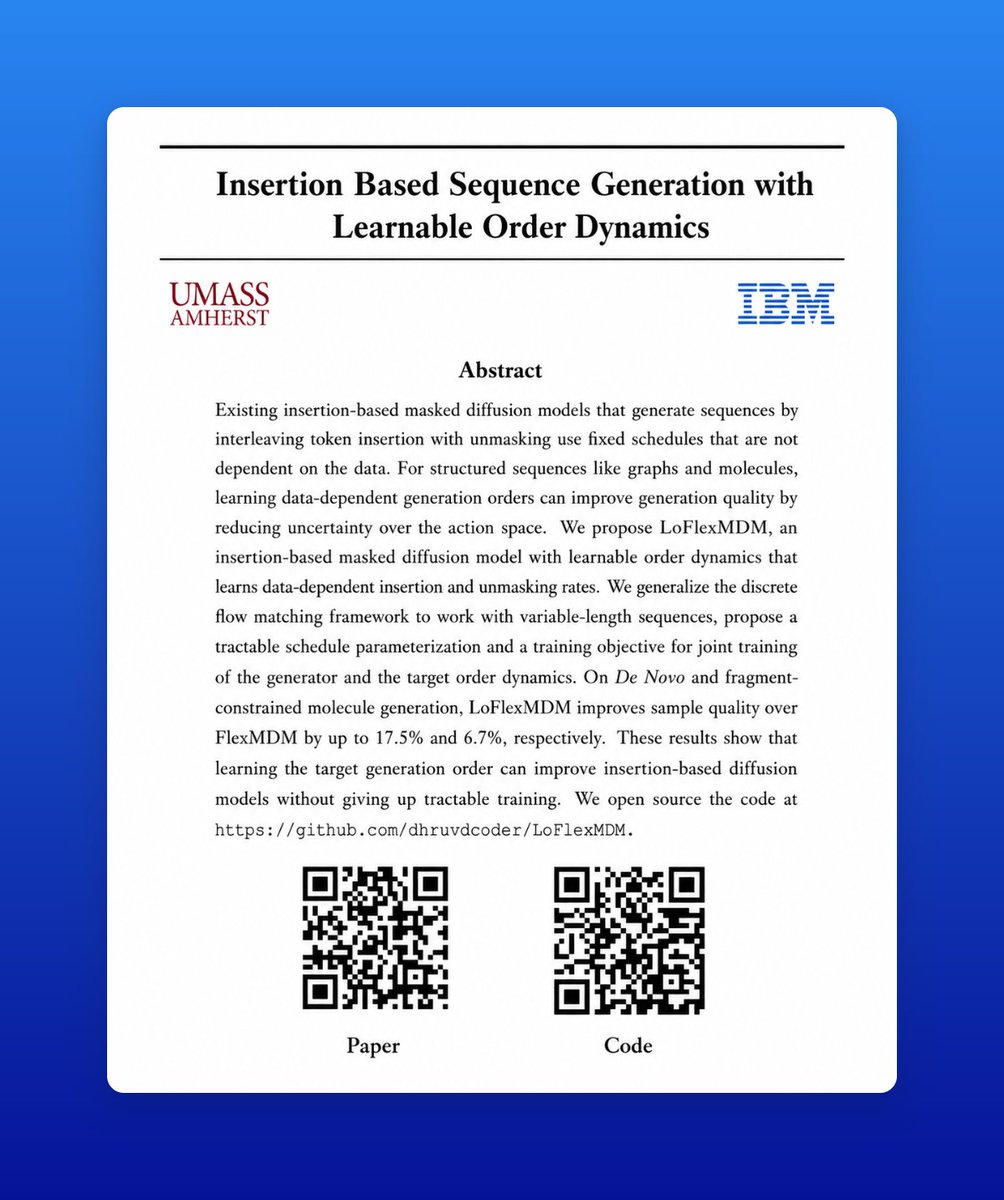
Variable-length masked diffusion models (FlexMDM and friends) generate by inserting mask tokens into any gap and unmasking them. But the insertion/unmasking schedule is fixed and data-independent.
So the model has to learn to produce every sequence in every possible order. For structured data that's a huge waste of capacity.
How do you learn data-dependent insertion and unmasking orders without breaking tractable training? We propose LoFlexMDM, which does exactly that. 🧵👇
How can we accurately evaluate whether an AI model has generated a genuinely novel concept?
Is there a widely accepted benchmark for measuring machine creativity or invention?
Talked all things AI with @Swarooprm7, Research Scientist at @GoogleDeepMind 🧠, diving into his work on Gemini and what the shift to AI-assisted coding actually means for software engineers.
We covered:
- Building Bard & Gemini
- Early days of instruction tuning (2021)
- The shift from writing code to reviewing it
- The future of token usage and measuring ROI
- Why first principles still matter most
Checkout the full video 👇
Our team at DeepMind is growing.
We've assembled a world class physics+material science team and are building an experimental lab.
If you want to solve real problems at the intersection of AI + material science to unlock a technological revolution - this is the place. Apply 👇
Introducing Ask YouTube, our new conversational search experience in @YouTube. 📽️
With Ask YouTube, you can ask more complex search queries, like needing help planning a road trip through the California coast or wanting tips on how to teach your kid to ride a bike. You can even ask follow-up questions to continue refining what you’re looking for.
Ask YouTube will compile the most relevant videos across all of YouTube’s catalogue — including long-form videos and Shorts — and provide an interactive, structured response instead of the usual list of video recommendations.
Ask YouTube is currently available for Premium members in the U.S., and it’ll be rolling out to all YouTube users soon.