This is insane.
1971:
-Gold was $43/oz
-Average hourly wage was $3.70
-Time needed to buy one oz of gold: 11.6 hours
2026:
-Gold: $5,000/oz
-Average hourly wage: $28
-Time needed to buy one oz of gold: 179 hours
What does this mean?
Your time is literally less valuable today than it was 50 years ago. Look at it this way:
In 1971: Work 12 hours ➡️ get 1 ounce of gold
In 2026: Work 12 hours ➡️ get 0.07 ounces of gold
Gold is still gold. One hour is still one hour. Wtf is happening?
We haven't used sound money since 1971, when U.S. President Richard Nixon took us off the gold standard. Money became infinitely printable, with nothing required to back it.
So they printed money, over and over. And over. And over. And over again.
Every time they printed new dollars, the dollar became worth less. Think about it like this:
If there's 10 copies of a rare painting, and then they make 1,000 new copies, all the copies become worth less. That's what happens when you increase the supply.
That's what's been happening to the dollar since 1971. And guess what?
The money you use represents your time.
You give time and energy to the market, the market gives you money in return. That money reflects the time you gave.
It's no wonder that time has become less valuable as the dollar has become less valuable.
We don't use gold to measure our time and energy. We use a money that can be printed out of thin air by a small, central group of elites that we have no real say over.
Anybody with the power to print money from nothing will eventually abuse that power. That's what's been happening since 1971.
As a result, it now takes more of your time to earn the same amount of gold, which is completely backwards from a species that is supposed to be progressing.
It should be going the other way. As we develop new technologies and bring more productivity to the market, it should take *less* time to earn the same amount of gold.
The only way -- THE ONLY WAY -- to stop your time from becoming less valuable is to use a different form of money. You must exit the dollar system. You cannot escape time-debasement if you are in a system with monetary-debasement.
You need a system that cannot be debased.
We have a monetary system that was explicitly created to prevent monetary debasement once and for all. We have evidence for those that have chosen that system.
If your money was Bitcoin, this is how much time it would take to buy one ounce of gold:
2012: 208 days
2016: 2 days, 22 hours
2020: 4 hours, 28 minutes
2024: 56 minutes
The dollar loses value over time, because it can be infinitely debased. The longer you use it as money, the more time you lose.
Bitcoin gains value over time, because it is the only money that cannot be debased. The longer you use it as money, the more time you gain.
The game is alignment.
Choose wisely.
Let’s gogogogo! Book finally arrived here to Koh Samui.
Your Framgångspodden episode back in 2019 really influenced me. We were the same age, and I remember thinking you made more sense than most people around me at the time.
Still do.
Looking forward to reading this!
The man who healed millions of minds:
Carl Jung.
Studying his philosophy will make you immune to mental health issues.
These are his 10 laws for having a powerful mind:
I'm 38.
At 30, I had $10K left in the bank after my eCommerce startup failed (I lost everything).
Then, I discovered James Clear's work on habit-building, and made my first million at 33.
13 of his insights that transformed my life (and will do the same for you):
I'm 38.
When I was 32 I worked in a bank, went woke (then broke) & suffered depression.
Then I discovered Naval Ravikant's "How to get rich" post & made several million dollars by 38
8 of his insights that transformed my life (and will do the same for you):
Strange times are these in which we live when old and young are taught falsehoods in school. And the person that dares to tell the truth is called at once a lunatic and fool
*Money Printing*
A seemingly simple, yet confusing topic.
I mean, why even sell bonds to the public, when the Fed can just print more dollars and pay for whatever the government wants to spend?
The answer is simple but requires a little critical thinking.
Time for a Fed 🧵👇
This is insane.
This is INSANE.
This is a blatantly obvious sign of the impending doom of the U.S. Dollar and all fiat currencies.
*This is as important as anything you will read this year*
The United States Treasury issues bonds and other investment securities.
They call these, “treasuries.”
The U.S. Treasury issues treasuries when the U.S. Federal Government spends past their budget, resulting in a “budgetary deficit.” The sale of treasuries makes up for the loss.
The treasuries are sold and tacked on as debt. This is the substance of the big $34 trillion debt number in the United States.
Key point: The U.S. Federal Government has been in a budgetary deficit in 49 of the last 53 years, with the last surplus year being in 2001.
But yet, even in that 2001 “budgetary surplus” year, the total debt amount increased.
Why?
Because a whole bunch of debt from years past came due.
The U.S. Treasury issues their treasuries with time periods of ownership ranging from 4 weeks to 30 years.
So, in 2001, the government had debt coming due that was issued to investors in 1971, as well as 1981, 1991, 1994, 1996, 1998, 1999, and the previous year.
The debt that was due in 2001 exceeded the budgetary surplus (debt issuance is not a part of the budget), thus, the government had to issue new debt to pay off the old debt, adding on further to the debt total.
Key point: The U.S. Treasury, which is part of the U.S. Federal Government, has to sell new debt to new investors to pay off the old debt from old investors. This is because of 1) the constant budgetary deficits and 2) the debt from years past coming due.
Key point: Being that the definition of a Ponzi scheme is, “An investment scheme where new investor money is used to pay off old investors.” …The U.S. Federal Government is running a Ponzi scheme. To the tune of $34.7 trillion, and counting.
Trillion is just a word. Let’s make sure we note the significance.
A *billion* seconds ago was 1993 (31 years ago).
A *trillion* seconds ago was 30,000 B.C.
And then multiply that trillion by 34.7.
That’s the scale of the United States debt bill.
But WAIT. It gets worse.
Key point: The U.S. Treasury always has to have buyers of its debt, because if they don’t, they won’t be able to pay off 1) their deficit spending and 2) the old debt coming due (and the interest on the debt). If they fail to pay those off, the Government would default and collapse.
Well, then, who buys all the U.S. Government debt?
Key point: The largest buyer and owner of the U.S. Federal Government debt is THE U.S. FEDERAL GOVERNMENT THEMSELVES.
Don’t trust, verify:
TAKE A SECOND TO CONTEMPLATE HOW INSANE THAT IS.
The U.S. Government spends in a budgetary deficit, then issues treasuries to pay for the spending, then, at a bigger rate than anybody else, buys the treasuries to cover the loss. An unbelievable Ponzi scheme.
The U.S. Government is the director of the Ponzi scheme, the old investor, and the new investor. A true masterclass.
But how do they do this? They have a money printer. It's that simple. The debt might as well not be real.
Key point: The United States is not the only country that runs this playbook. 182 of the 222 countries in the world are in budgetary deficits. The Ponzi scheme is everywhere.
The U.S. is the kingpin of the modern monetary world. They are the head honcho, the high priest, the big cheese.
The current global financial economy is built on the backs of the United States.
There would be a massive problem if the United States had debt buyer troubles.
In short, an increasing amount of investors are growing scared of the United Stages debt situation, turning them away from the purchasing of U.S. Treasuries.
Recent headlines:
“Treasury bond auction runs into weak demand amid fears that soaring US debt will overwhelm Wall Street” -October 12, 2023
“30-Year Treasury Auction Breaks Bad, Sinks Stock Market” -November 9, 2023
“World to Drown in U.S. Debt; Moody’s Downgrades Country’s Debt” -November 17, 2023
“5-Year Treasury Auction was a Dud” -January 24, 2024
“Treasury's $16 billion auction of 20-year bonds produces 'very ugly' results” -February 21, 2024
"Highest Treasury Yields of Year Fail to Tempt Buyers to Auction" -April 11, 2024.
With lower demand, and as quote tweeted below, the U.S. Treasury is starting a "treasury buy back operation," aimed to, as they say, "improve liquidity in the treasury market."
What's really happening is that the Treasury is using their money printer to directly buy the treasuries they are issuing, ensuring those low demand treasury auctions don't continue. This causes inflation in the money supply, which is a dangerous outcome.
Here's where the cookie crumbles:
The United States central bank, the Federal Reserve, has a 2% inflation target. Inflation has not been at 2% recently, and, in fact, has been accelerating higher for three months in a row.
The Federal Reserve has set high interest rates, currently at 5.25%, as a method of discouraging borrowing, spending, and taming inflation.
But it's not working. And there's a bigger problem.
Key point: The U.S. Federal Government pays interest to investors that own the treasuries, and this interest is part of the budget. Higher interest payments = more federal spending = bigger budgetary deficits = more debt issuance = higher supply of treasuries = lower demand = less buyers = Treasury printing = higher inflation = higher interest rates = higher interest payments.
A catastrophic feedback loop.
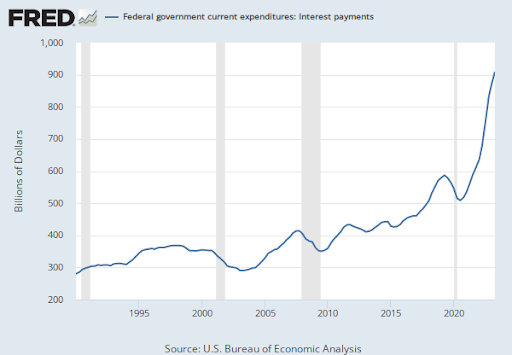
The interest paid out by the Federal Government has spiked in recent years:
The United States Dollar is screwed.
The Federal Reserve has set high interest rates to tame inflation, but that's not working. High interest rates are causing bigger interest payments, causing larger budgetary deficits.
This is causing the U.S. Treasury to issue more debt, which investors are getting scared of (because of runaway inflation and compounding debt levels), which is now causing the Treasury to print money and provide "liquidity" to stabilize the treasury market, adding fuel to the inflation fire once more.
The Federal Reserve can further raise interest rates to cool inflation, but that would increase interest payments and deficit spending, requiring even more debt issuance and "liquidity," which fuels inflation. An increase in interest rates could also cause a massive recession or depression, which would grind the economy to a halt, which would mean that the government is taking in less tax revenue, while still spending exorbitantly on entrenched government programs and stimulus, which would only increase budgetary deficits and debt issuance once more.
The Federal Reserve can lower interest rates, but that would immediately cause an uptick in inflation, as people are encouraged to borrow and spend with lower interest rates, which would then force the Fed to raise interest rates again.
The Federal Reserve can admit defeat and raise their inflation target to 3 or 4%, but that would signal that the system is failing, which would cause a further loss of confidence, which would result in less treasury buyers, resulting in more inflation, and would create demand for higher interest rates (because treasury investors want to keep up with inflation), which, again, causes bigger interest payments and so forth.
This is a debt spiral.
There is no way out.
You are witnessing it live. These are years that will go down in the all-time history books.
Every fiat currency has failed, and for the same reason. Turning on the money printer is too tempting.
Don't forget, the U.S. Government will never let the treasury market fail, because that would result in an automatic default on the debt and an unbelievably chaotic avalanche of collapse.
They will always turn to the money printer to bail things out. The Treasury will continue to print more money to keep the system afloat, as evidenced by their upcoming "buy back operation." But inflation is the fatal flaw.
The Ponzi scheme is in its final chapter. The endgame is here.
The inflation train has left the station, and it's never coming back.
Covid put the ruin into hyperdrive. Inflation ran away, now it cannot be tamed. It is feeding on itself, and will continue to do so, over and over, gradually, then suddenly.
And then, poof. It's gone.
Worthlessness.
If you haven't noticed, the U.S. Dollar has been heading toward the "worthless" direction for quite some time.
It is inevitable. The U.S. Dollar, and all fiat currencies, will die.
The Phoenix will then rise from the ashes.
An innovative, specifically designed, global, unprintable, unable to be manipulated, verifiable, instantaneous, digital monetary system will emerge, unchained from the grasp of bankers and governments, once and for all.
...and the world was fixed.
Fix the money, fix the world.
#Bitcoin
The Gov doesn’t want you to actually own anything,
Rather everything is debt (asset/liability)
- money in bank, owed to you
- stock on brokerage, owed to you
- gold in ETFs, owed to you
- bonds, owed to you
- land / RE, rented from Gov
No bearer assets, just debt.
Misunderstanding UTXOs will lead to problems with spending your #Bitcoin in the future.
Transaction fees are low - consolidate your UTXOs!
UTXO management for beginners:
(THREAD 👇)
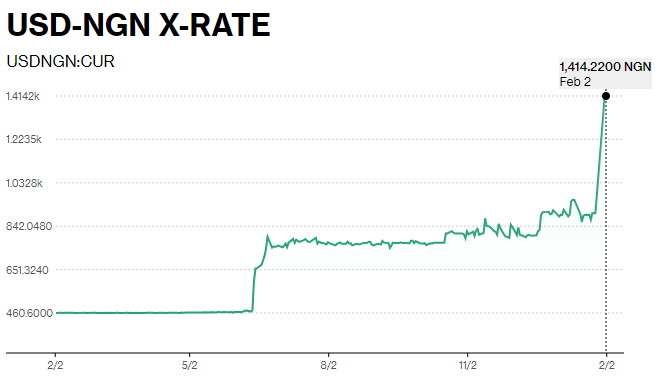
Nigeria's currency has lost 2/3rds of its value relative to USD over the past year.
Anyone holding domestic cash/deposits had their savings greatly devalued, and everyone who is paid in the local currency who can't negotiate a tripling of their income has less purchasing power.
There are 160+ currencies in the world, with each one being a centralized ledger. Many of them lose value rapidly, with this being the most recent example, affecting 200+ million people.
Since the currencies are all localized monopolies, people historically had little choice other than to denominate contracts and savings in them, and keep getting rug-pulled.
The wealthy often have more avenues to get foreign bank/brokerage accounts to hold value elsewhere, while the less wealthy often have fewer ways to get out of the repeated rug-pulling with whatever modest savings they have.
Technologies like bitcoin for the long term and stablecoins for the intermediate term give me people more options. They take what was once mostly accessible to the wealthy (more solid value outside of the control of the local centralized rug-pulling ledger), reduce the overhead of it, and make it more available to everyone.