$24,000 per year from this simple AI Dentist Voice Agent
(and why I’m probably insane for giving it away for free)
One dental practice was bleeding $6,000+ every month from missed after-hours phone calls.
That’s 20–25 potential new patients disappearing simply because no one was there to answer and book.
So I built an AI voice receptionist that books dental appointments 24/7, powered by n8n + ElevenLabs, and guided by the clinic’s internal rules and real scheduling availability.
Here’s what the system handles automatically:
→ Picks up calls with a natural-sounding AI receptionist
→ Captures patient info + insurance details
→ Checks live calendar availability
→ Schedules appointments instantly
→ Logs every interaction into a Google Sheet
The wild part?
A nearly identical AI voice system was sold to a dental practice for $24,000 per year by another founder.
And this isn’t limited to dentists.
Any service business losing revenue from missed calls can deploy the exact same setup.
Want the full n8n workflow template?
1. Retweet & Like
2. Follow me
3. Comment “ASSISTANT”
I’ll send you the entire system for free, plus a step-by-step setup video — including all the ElevenLabs automation pieces.
(must be following so I can dm you)
I don’t think the biggest opportunity in AI is replacing people.
I think it’s giving every person a free private teacher.
A compact map of human knowledge + AI + offline = learning that belongs to everyone, not platforms.
That’s the future I’m building!
@dhh Is it possible to get Omarchy running on a Mac.
From my search’s it sounds like the answer is no cause Arch doesn’t have much support. But does anyone have more certain information?
A sad thing I see is when companies start becoming reactive over proactive. Its a clear external sign that the leadership has lost vision. They make decisions they feel are safe instead of through conviction of a future. The problem is that "safe" almost always means following someone else.
This isn't a clear sign of death, but it is a very difficult position to be in...
For me personally, I hate seeing it because so many companies start with a genuinely interesting vision. Then the world changes, they lose confidence in that vision, and instead of finding a new way to adapt and express it, they start chasing whatever everyone else is doing.
It happens during every major secular shift. AI is the obvious current example. A lot of companies that looked exciting just a few years ago now feel like they're playing catch-up instead of leading. Its a tough thing to watch.
Try the interactive demo here: https://t.co/fDABQVTySK
Next up: expanding the map and building an offline-first, local AI—a real-life Young Lady's Illustrated Primer capable of teaching anyone, anywhere, anything. 🛠️✨
Just took the first step toward revolutionizing education: I mapped all pre-university knowledge into a single interactive galaxy. 🌌
Imagine a world where all human knowledge is connected, visual, and accessible to everyone. This is just the beginning.
Andy Burnham has confirmed he’ll restrict VPNs, potentially bringing Britain in line with China, Russia and Iran. Starmer’s censorship regime will be expanded and deepened. Big Burnham will be watching you, says Fraser Myers
https://t.co/hCLj2aEEcV
Today is a dark day for freedom and democracy in Europe. General chat surveillance has been implemented in Brussels. A disgrace.
The so-called Chat Control 1.0 cleared a crucial hurdle in the European Parliament today. This means platforms may once again be allowed to scan private messages, officially on a “voluntary” basis, but in practice this marks the return of indiscriminate monitoring of private communication.
What makes this especially bitter is that a majority of the MEPs who voted were reportedly against it. According to Patrick Breyer, 314 MEPs voted against the regulation, 276 voted in favor and 17 abstained. And yet the rejection failed because it was not enough to have a simple majority of those voting. An absolute majority of all MEPs would have been required.
That is the democratic scandal.
When a majority of those present votes against a proposal and it still passes because a formal threshold is not reached, it does not feel like democratic decision-making to many citizens. It feels like a procedural trick.
And it becomes even more problematic when you look at the context: Chat Control had already been rejected before. Yet the issue was put back on the agenda shortly before the summer break, through an urgent procedure, at a time when absences could become decisive.
This is not just some technical regulation. It goes to the very core of private communication. It is about whether digital messages remain fundamentally private or whether platforms may systematically scan content again, without concrete suspicion, without a court order and without any individual cause.
A free society must not turn private communication into a potential surveillance zone. Anyone who takes digital fundamental rights seriously cannot accept millions of innocent people being placed under general suspicion.
Today, a dangerous signal was sent: fundamental rights can be hollowed out through procedural logic, timing and political tricks. Not through an open, clear and honest majority, but through a system in which absence effectively helps the supporters.
This is a dark day for Europe.
Not because the fight is over, but because today showed how easily digital fundamental rights come under pressure when surveillance logic, symbolic politics and institutional tricks come together.
Anyone who wants a free internet, anyone who wants to protect private communication and anyone who takes democracy seriously should talk about this.
Share this issue. Inform yourself. Look at who voted how. And never forget: freedom rarely disappears all at once. It disappears step by step, often in technical details, often in complicated procedures and often exactly when too few people are watching.
The story in one sentence:
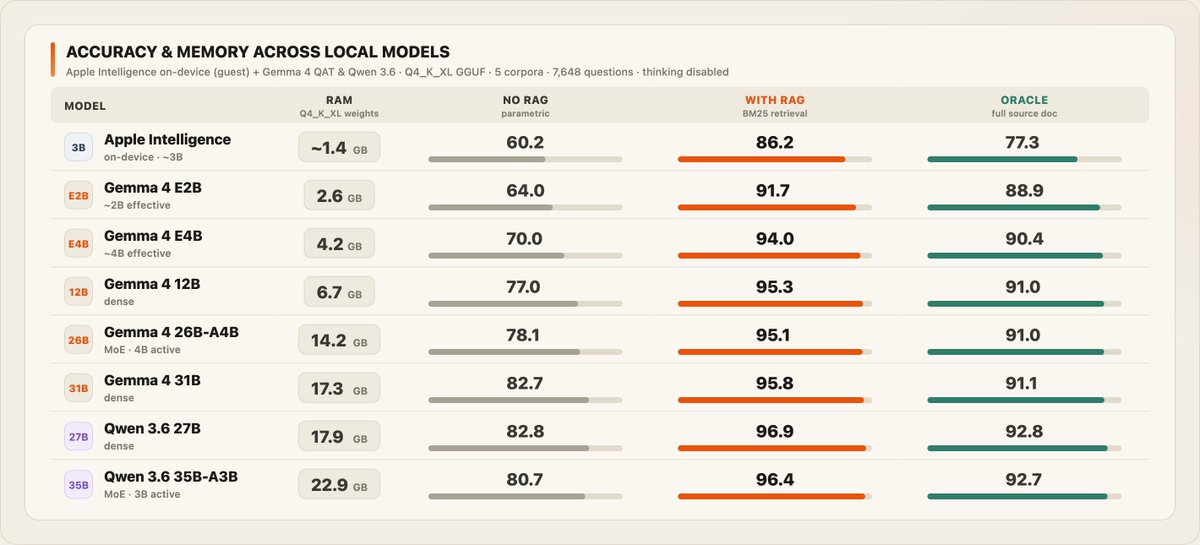
You can trust local LLMs to answer technical questions accurately… once you connect them to a knowledge base with RAG.
Without it they’re hit-or-miss. With it, they become genuinely useful.
Can you trust local models to answer accurately?
That question kept nagging at me. I want to get better as a developer, and local LLMs should be able to help with real framework questions… but can I actually rely on them?
So I decided to find out properly.
🧵👇
I also threw in Apple Intelligence (AFM 2 3b on-device).
It only has ~4k context, so I had to limit it to top-3 results. Still scored 86%.
For a tiny on-device model, that’s genuinely impressive.