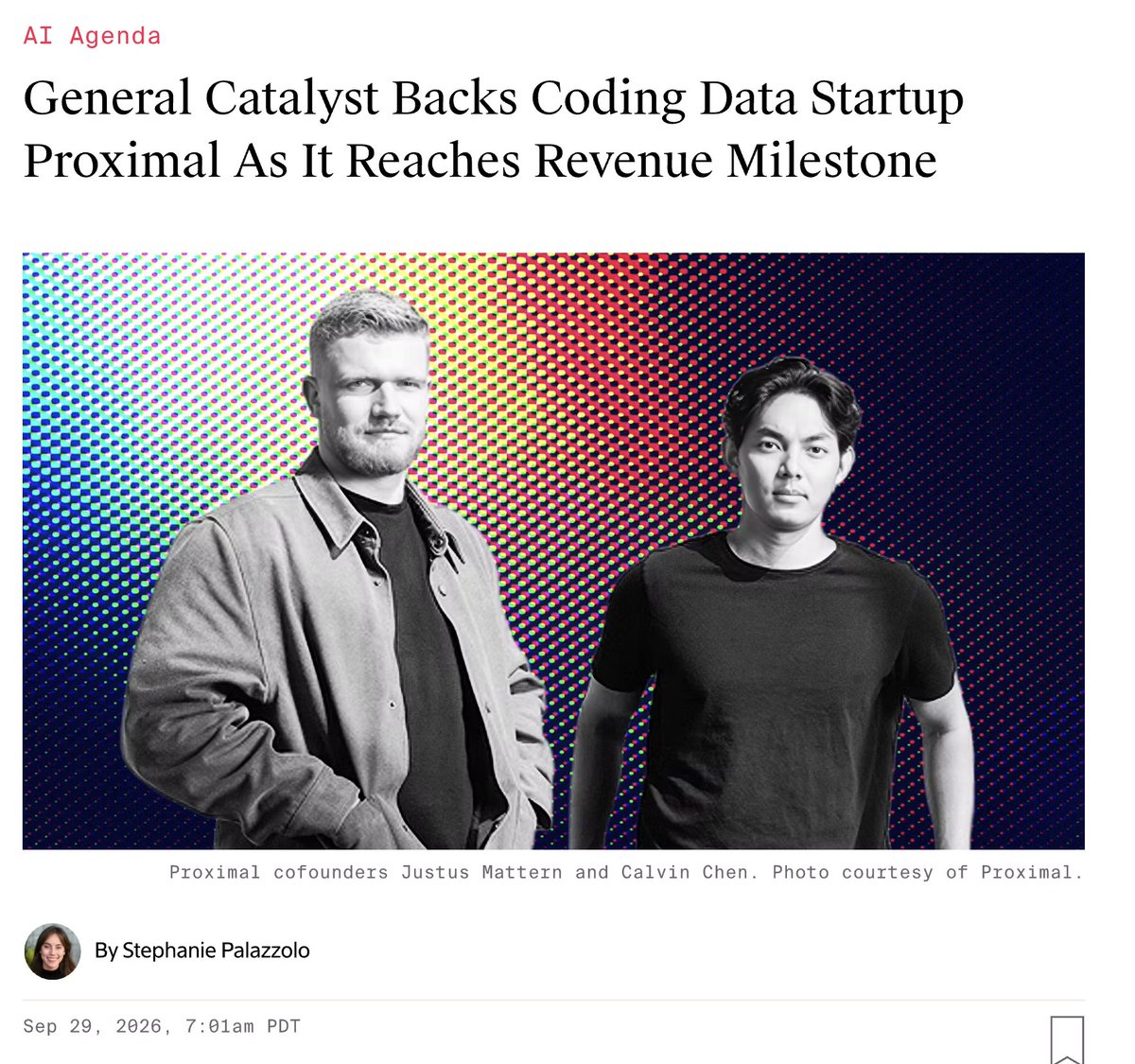
Using coding models at my last company made me want to work on the problems they kept getting stuck on. In January, I joined Proximal to help build the environments they learn from. Eight months later, excited to finally share what we’ve been building.
Proximal builds infrastructure that enables AI to improve from real-world experience.
In the past year, we have grown to more than $200M in annualized revenue helping frontier labs and enterprises improve coding agents. Now, we are expanding beyond software engineering.
Recent progress in mathematics demonstrates what happens when models are trained in domains with massive amounts of public data and easy verifiability, making it easy to find weaknesses, generate training tasks, and iterate quickly.
We build infrastructure that enables this feedback loop in other domains: we are excited about a world in which AI systems design targeted drugs, accelerate chip design, and rewrite legacy software that still runs hospitals, power grids, governments, and other critical infrastructure.
Since starting, we have assembled a small team of researchers and engineers and built world-class infrastructure for post-training and synthetic data research to overcome the challenges of scaling manual data curation.
Our team comes from Cursor, Google DeepMind, Meta Superintelligence, Prime Intellect, Citadel, and Jane Street. More than half are former founders.
We’re fortunate to be backed by investors who share that vision, including @generalcatalyst who led our $15M Seed Round at a $300M valuation, as well as @chemistry, @svangel, @dvlamoen and individuals like @LiamFedus, @kevinweil, and @bernhardsson
We are releasing AutoResearchExam, a benchmark on open-ended machine learning and engineering tasks. Our benchmark covers seven research areas including model training, data curation, AI safety and interpretability.
https://t.co/Rho35ULgS5
In each task, we give agents 24 hours with a CPU or GPU machine to develop and improve their solutions through experiments and feedback. We measure both speed and quality with a combined score. Our benchmark has a unique feature: testing if agents create improvements that hold up on data they never see. We find that AI research agents often overfit as they try to improve.
We see an interesting head-to-head comparison at the frontier: Astra starts the strongest and holds the lead for up to 19 hours but Fable 5.1 catches up and gets the top performing spot in the final hours.
Qwen3.8 Max, Gemini 3.8 Flash and Grok 4.6 all sit on the cost-performance Pareto frontier, giving strong options at lower API budgets.
Anthropic's Opus and Fable retain nearly all their validation performance on hidden tests, with gaps of 1.1% and 2.9%. Astra's improvement over Sol extends to generalization too, with that gap falling from 6.9% to 1.7%. (1/n)
GPT-5.5 scores extremely well on FrontierSWE, scoring higher than GPT-5.4 on 13 of 17 tasks.
It also opens the widest gap we’ve seen so far between #1 and #2.
DeepSeek V4 & Kimi K2.6 on Frontier SWE.
It's interesting that this tracks very well with my personal experience. Anthropic + OpenAI are meaningfully different to use than Gemini and OS models (though their performance is basically on par on other benchmarks).
gpt-5.5 is the most efficient & highest performing model in long horizon tasks!
it's a great model at hard engineering & research tasks. congrats on the model release!
GPT-5.5 is the best-performing model on FrontierSWE.
The model substantially outperforms Opus 4.7 in both mean@5 and best@5 rankings while working faster.
DeepSeek V4 Pro is the best open source model on FrontierSWE, closely followed by Kimi K2.6.
V4 exhibits noticeably fewer reward hacking attempts than most other models. In the best@5 ranking it performs as well as Gemini 3.1 Pro
We are hosting a meetup with @generalcatalyst in Bangalore tomorrow!
Swing by to learn about FrontierSWE, what we are building here, and meet some of the Proximal team.
Attendees include researchers & engineers from Google Deepmind, Sarvam, Microsoft AI + more
dm for invite!
About to arrive at ICLR 🇧🇷
If you are interested in post-training for coding agents, synthetic data and evals like FrontierSWE, I would love to chat!
I will be here from today until the 27th
We are hosting a meetup with @generalcatalyst in Bangalore!
Swing by to learn more about FrontierSWE, the research lab we are building here, and meet @calvinchen, me and others from the team
Imagine every pixel on your screen, streamed live directly from a model. No HTML, no layout engine, no code. Just exactly what you want to see.
@eddiejiao_obj, @drewocarr and I built a prototype to see how this could actually work, and set out to make it real. We're calling it Flipbook. (1/5)
Opus 4.7 is #1 on FrontierSWE!
We found that it commits to decisions much earlier in its trace and executes, spending ~2x fewer tokens/less time than Opus 4.6 across all tasks
Excited to launch FrontierSWE, an ultra-long horizon coding benchmark!
We gave agents 20 hours to solve some of the hardest software engineering tasks, and as expected frontier models struggled with all of them.
Read more on our blog (and stay tuned for updates on Opus 4.7)