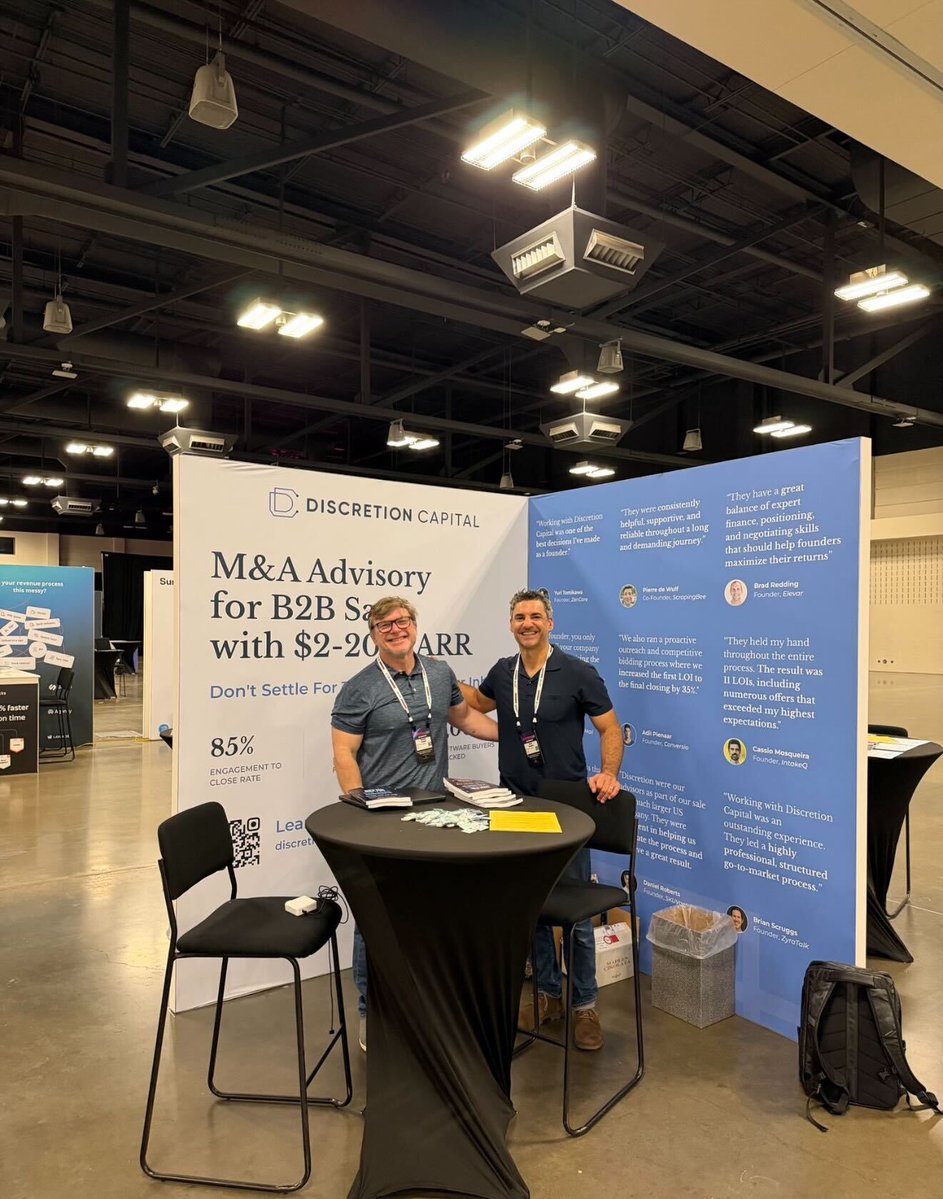
You really should hire a banker if you're handling inbound LOIs, but if you chose not to at least do yourself a favor and read this (exhaustive, and yes a bit exhausting) guide to SaaS M&A LOIs:
📚 CHAPTER 5: When to Sell
Most founders drift. Perpetually "maybe for sale."
This is the worst of both worlds.
Either be for sale, or don't be. But don't half-ass it.
Chapter 5 → https://t.co/d0ETuUb1Xa
🚨 The $9M Mistake
Two offers. Same company
🚨 Offer A: $45M
🚨 Offer B: $54M
Most founders pick B.
But after accounting for earnout probability, Offer A was worth $1.7M MORE.
Most founders never run this math.
Chapter 4 →https://t.co/d0ETuUb1Xa
📚 CHAPTER 2 IS LIVE: Who Buys B2B SaaS Companies ($2-20M ARR)?
70% of acquisitions are Private Equity. Not strategics.
The buyer you pick matters more than your metrics.
Read Chapter 2 → https://t.co/d0ETuUbzMI
📖 NEW: The Definitive Guide to M&A for B2B SaaS ($2-20M ARR) Everything we've learned helping founders exit. One chapter at a time. Free. First chapter drops Monday: Who Actually Buys B2B SaaS Companies?
Your VC, angel, and lawyer are giving you SaaS M&A advice based on a world that doesn't exist anymore. 15 years ago, PE firms didn't buy companies under $10M ARR. Today, they hunt $2M ARR companies. Founders routinely leave 100-300% on the table.
📖 New guide to fix this coming
My guest on today's podcast (Greg Crabtree) calls ~3MIL in revenue the 'death zone' for companies. Really it can be a wide span, but call it $500K - $3,000,000 ballpark.
Before 3MIL, the founder can often oversee most key areas of the business.
But at this point there's an "entrepreneurial mitosis moment." As a founder you find yourself having to do two full-time roles.
1) Operations
2) Sales/Marketing
Problem: It's complicated/expensive to hire somebody that's incredibly competent at one or the other (better than you).
Leads to two main strategies:
1) The most common is to over-hire for capacity and try and sell your way out of it. The common mistake here is that founders often never return to a healthy profitability of face what he calls 'profit truth.'
2) Another approach is to overload the operation until you can bring in the adults, or commonly for businesses 4M+. This has obvious challenges.
Greg has spent the last decade of his career coming up with strategies for companies to successfully make a run through the 'death zone' or to draw back and re-tool, while remaining capitalized and profitable.
Both of his books: Simple Numbers and Simple Numbers 2.0 are fantastic. Highly recommended.
We spent an hour on today's show diving into the implications of the above. Hope you enjoy!