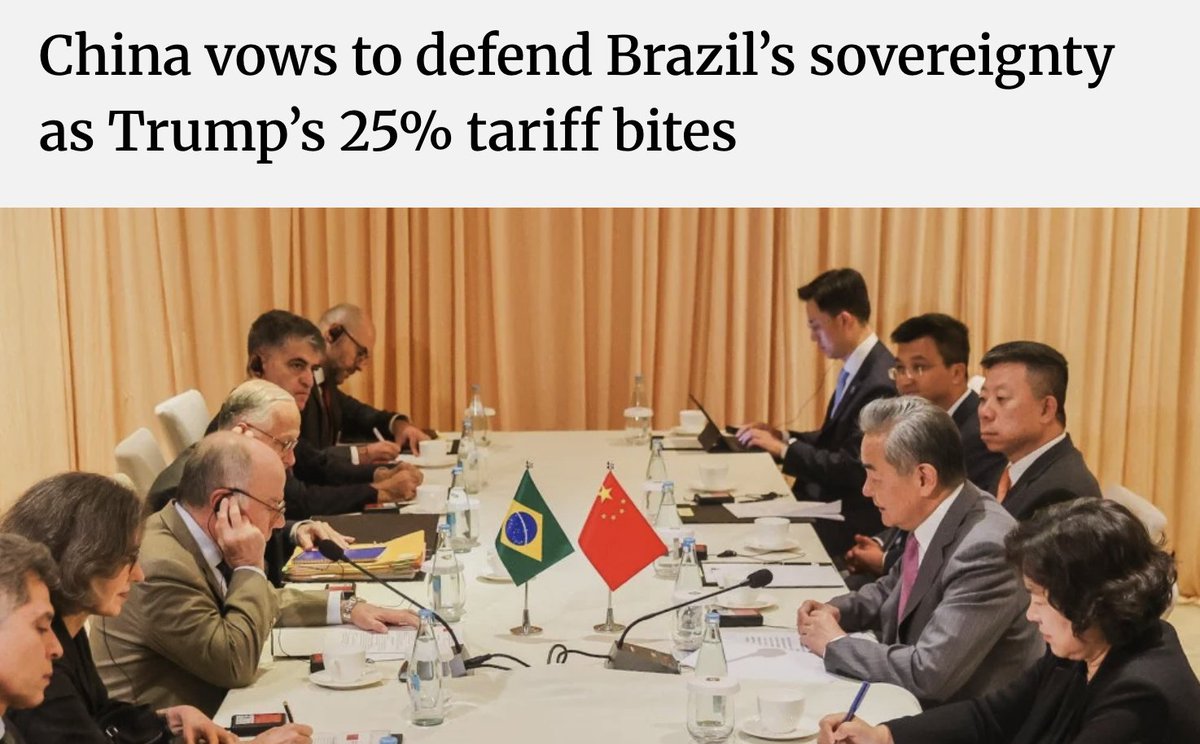
Hours after Trump’s 25 percent tariff on Brazilian goods took effect, China’s foreign minister Wang Yi met his Brazilian counterpart Mauro Vieira in Manila and pledged that Beijing would “support Brazil in safeguarding its sovereignty, security and development interests”.
The contrast between the US and China’s approaches to Brazil neatly encapsulates the difference between the logic of imperialism and the logic of multipolarity.
What products are being targeted by Washington’s tariffs? Specifically manufactured goods. Coffee, beef, orange juice, oil and gas are all excluded. Everything Washington wants out of Brazil flows on untaxed: the crops, the cattle, the hydrocarbons, the parts feeding US supply chains. What gets punished is Brazil’s capacity to make finished goods for itself. This is not a trade dispute; it is a tariff schedule designed to pin a country to the bottom of the value chain, keeping it a farm, a mine and a supplier of components, and taxing any attempt to be more than that.
Now look at what China put on the table in the same week. Wang Yi proposed expanding cooperation in aerospace, connectivity and artificial intelligence, and welcomed Brazil’s accession to the World Artificial Intelligence Cooperation Organisation – the new Shanghai-based body established this month by 29 countries. Vieira said Brazil hoped to use it to broaden scientific and technological cooperation.
China is engaging with Brazil on precisely the sectors that the US is walling off behind tariffs. And, lo and behold, these are the sectors that determine whether a country climbs the ladder or stays where the imperial division of labour assigned it.
The same fault line can be located in the approach to Brazil’s sovereignty. Trump’s tariffs are tied explicitly to the criminal prosecution of Jair Bolsonaro – economic coercion deployed to overturn the judicial process of a sovereign nation and rescue a coup-plotting ally. Washington has followed up by designating Brazilian criminal organisations as “foreign terrorist organisations”, the familiar rhetorical scaffolding for intervention in the region. This is the Monroe Doctrine in modern dress: Latin America as a backyard, its courts and its politics subject to “correction” from the north.
China on the other hand described Brazil as “an emerging economy with global influence and a representative voice of the Global South”, and pledged to support it in safeguarding its sovereignty, security and development interests.
The US is punishing Brazil for industrialising and for prosecuting fascist coup-plotters. China offers technology, investment and respect for sovereignty. Lula’s government can perfectly well understand the difference.
The hypocrisy of the 1999–2007 era remains indefensible. While ASUU strikes shut down public universities and denied an entire generation of Nigerian students including those of us who spent months or years chasing admissions that never came Vice President Atiku Abubakar chose that exact moment in 2003 to establish the American University of Nigeria.
A sitting VP, with direct responsibility for the education sector’s collapse, founded a private university for the elite while millions of young Nigerians were left stranded. That is not vision; it is a clear prioritisation of personal legacy and privilege over public duty.
Obasanjo’s Bells University followed in 2004 and compounds the same pattern of neglect, but Atiku’s decision stands out as particularly self-serving. He has never adequately explained why the solution for the powerful was a private institution while the public system he helped oversee was allowed to rot.
Leadership is judged by what it delivers for the ordinary citizen, not by private ventures launched amid national academic paralysis. This record alone raises serious questions about fitness for any further public office.
We need deep tech startups in many areas. See how critical this startup is for our society.
Solinas Integrity (Chennai, IIT Madras incubated) is using robotics and AI to end one of India’s most dangerous practices, manual scavenging.
Their flagship robot, HomoSEP, cleans septic tanks and manholes without any human entry. It breaks hard sludge, sucks out the waste, and keeps workers safely outside the toxic environment.
They also deploy Endobot robots that crawl inside water and sewer pipelines to detect leaks, blockages and damage, helping cities save water and prevent overflows.
These robots are already working on the ground in multiple cities including Chennai, Madurai, Coimbatore, Trichy and others, having cleaned thousands of tanks and manholes.
By replacing life threatening manual work with indigenous machines, Solinas is protecting sanitation workers, improving public health, and making urban sanitation safer and more dignified.
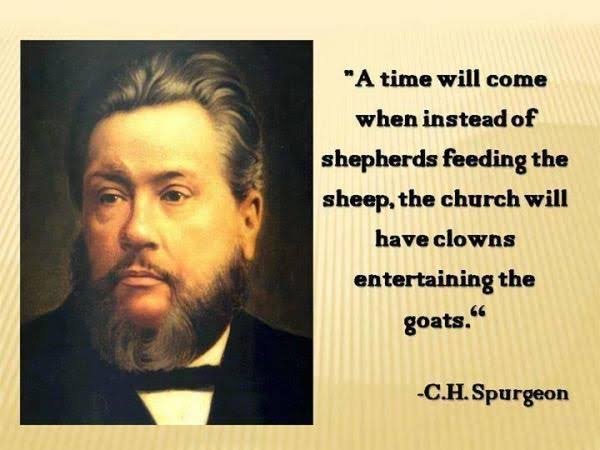
When foolish people take over the pulpit, this is the result.
How does anything he has said relate to the Bible?
And no, there's no other context to this.
Only foolishness.
An idiot with a micophone entertaining fellow idiots.
Thank you for amplifying this 776 founder; I can't wait for you all to see what Yinka and her team have built!
https://t.co/EA5iYpS7DB
https://t.co/tLaPgbHJdt
The media will tell you the Global South is poor because of corruption.
Because of poor governance.
Because of cultural factors.
Because of geography.
Because of a tragic cycle of instability that well-meaning international institutions are working tirelessly to address.
What the media will mention less:
The Democratic Republic of Congo contains an estimated $24 trillion in mineral wealth.
Its people have a life expectancy of 62 years.
It has been extracted from, colonized, had its democratically elected leader assassinated by a CIA-backed operation in 1961, subjected to proxy wars funded by foreign powers, had its resources removed by multinational corporations operating under agreements signed by governments that did not represent the people living above those resources.
For over a century.
And the explanation offered is corruption.
Local corruption.
Not the transnational corporate structures that move money through shell companies in jurisdictions that exist specifically to make money disappear before it can be taxed.
Not the arms sales that fund the militias that create the instability that justifies the peacekeeping missions that provide cover for the continued extraction.
Local. Corruption.
The simplicity of that explanation is not accidental.
The simplicity serves a purpose.
The purpose is to keep you from following the money.
The money goes somewhere.
It goes to the same place money from poor countries has always gone.
Atiku's political arrogance doesn't support his electoral records as a perennial contestant in Nigeria's political scenes since 1992.
In 1992, he lost his presidential bid for the SDP ticket to MKO Abiola and Babagana Kingibe. In the election proper, Bashir Tofa (of NRC) swept Adamawa to defeat Abiola.
In 1998, he became the guber candidate of Adamawa PDP and won the election proper in 1999. Subsequently, he was selected as VP runnin mate by PDP presidential candidate, Gen. Olusegun Obasanjo.
Prior to the presidential primary of the PDP in the 2002, by setting most of the PDP Governors against OBJ, Atiku Abubakar tinkered with the idea of hijacking, for himself, the ticket from his boss. Eventually, he capitulated and remained his running mate again.
In 2007, Atiku copped the presidential ticket of the defunct Action Congress and came a distant 3rd (with less than 2.5million votes) behind Yar'Adua and Buhari.
In 2010, when it was obvious that Yar'Adua wasn't going to survive the illness that had held him down for years, Atiku rushed back to the PDP so as to position himself for the presidential ticket of the party for the 2011 presidential election. A shadow primary was conducted by late Adamu Ciroma (and some other Northern leaders) amongst Atiku, IBB, and Aliyu Gusau. Atiku won it but was properly beaten by President Goodluck Jonathan in the presidential primary proper of the PDP. He sulked and squirmed in his loss.
After the formation of the APC by its legacy parties in 2013, Atiku left the PDP for the APC. He didn't leave without a fight and drama though - he tried to force GEJ into ceding the presidential ticket of the PDP to him. GEJ rebuffed him. Atiku alongside with some PDP Governors, Senators, Members of Reps, HoA members, etc, defected to the APC. He contested for the presidential ticket and came a distant 3rd behind Muhammadu Buhari and Rabiu Musa Kwankwaso.
In 2017, he again left the APC and returned to the PDP. He subsequently won the presidential primary against Governor Aminu Tambuwal. In the 2019 presidential election proper, Buhari defeated with over 4 million votes mergin.
In a bitter contest in 2022, Atiku won the presidential primary against Governor Nyesome Wike but in the election proper in 2023, he was properly beaten by a first time presidential contestant who is a former Governor of Lagos State and the National Leader of the APC, Senator Bola Ahmed Tinubu.
Today, he's the presidential candidate of the ADC, a party he and his cohorts procured in a questionable manner, a procurement that has landed them in leadership crisis and legal litigations.
In summary, in 7 instances, Atiku showed significant interest and made attempts to contest for the Presidency and he lost in all of them.
This concise history is necessary to lecture those who keep touting him as the one presidential candidate who has the capacity to defeat any presidential candidate in any election. His political record in the field doesn't support that claim.
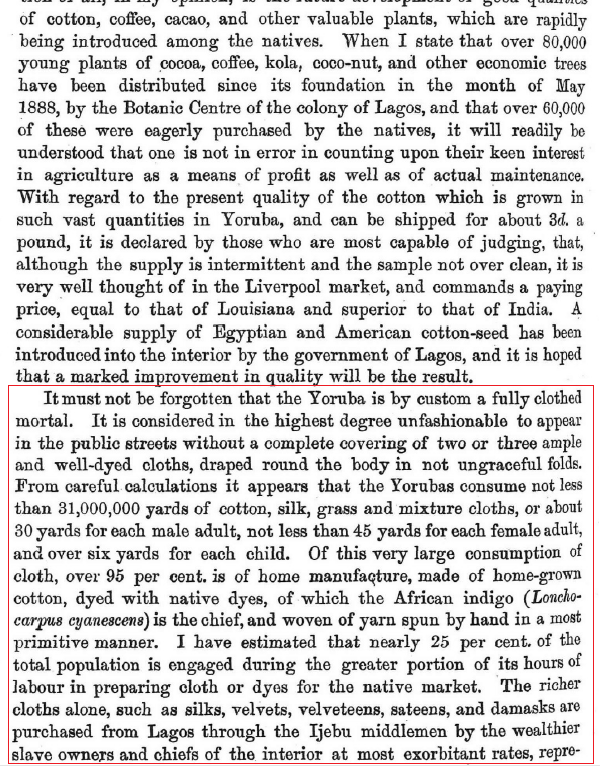
In case, anyone is trying to gaslight you that the Yoruba walked around naked like them in pre-colonial times, tell them to read this.
(Source: Millson, Alvan. "The Yoruba Country, West Africa." Proceedings of the Royal Geographical Society, no. X, Oct. 1891)
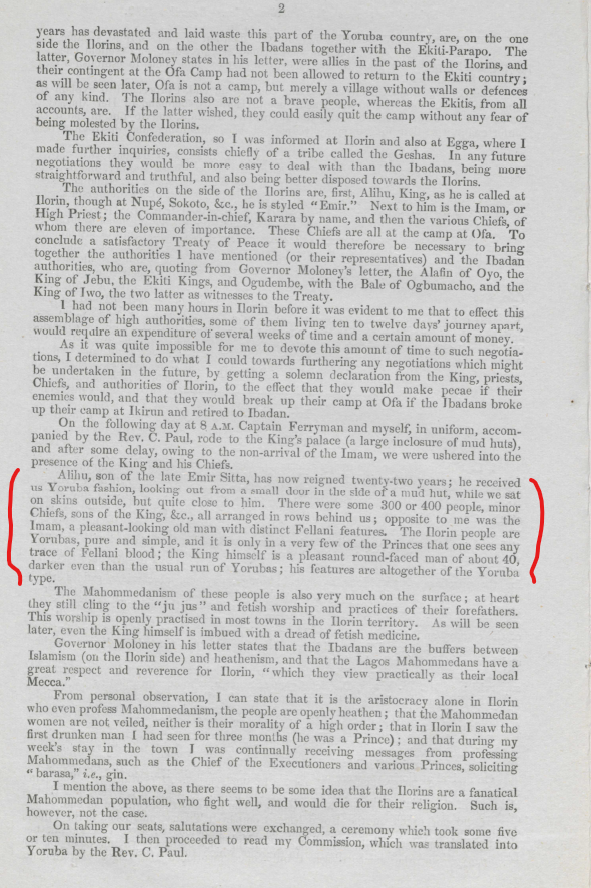
First Frame - An agreement between the Ilorin King and Chiefs, and the RNC. Note that the British identified Ilorin as part of the Yoruba country.
Second Frame - Excerpt from Major Macdonald's Report on the 1889 Expedition to Ilorin. Note that even an Oyinbo man like Macdonald dispelled the notion that Ilorin is anything other than Yoruba.