Elon Musk revealed why he keeps working despite of his $800 billion net worth:
1. As a teenager, Musk had a full existential crisis trying to figure out the meaning of life. Religious texts did not convince him. So he turned to philosophy. Reading Schopenhauer and Nietzsche as a depressed teenager, he says, was a terrible idea.
2. Then he read Hitchhiker's Guide to the Galaxy and something shifted. Douglas Adams argued the real problem is not finding the answer to life. It is figuring out the right questions to ask in the first place.
3. In the book, Earth is a giant computer built to answer the meaning of life. It spends millions of years computing and delivers its answer. The answer is 42. The joke is that nobody knows what the question was.
4. That idea never left Musk. The universe is the answer. We just do not know what question it is answering. And to figure out the right question, you need a much bigger and more expansive consciousness than we currently have.
5. The more we can expand the scope and scale of consciousness, the better we can understand what questions to ask about the answer that is the universe.
6. This is why he wants more humans. More digital intelligence. More biological and artificial consciousness working together. Not for economic growth. Not for power. To collectively get better at asking the right questions.
7. This is why Mars matters to him. Not for the adventure. Not for the achievement. A single planet species is a single point of failure for consciousness itself. If something wipes out Earth, the question never gets asked.
8. "The more we can expand consciousness, become a multi-planet species, ultimately a multi-stellar species, we have a chance of figuring out what the hell is going on."
9. Everything he is building, the rockets, the AI, the robots, comes back to this one idea. He is not trying to get rich. He is trying to keep the candle of consciousness alive long enough to understand why it exists.
10. With $800 billion he could stop tomorrow. He does not stop because to him stopping would mean giving up on the only question that ever actually mattered. What is this all for and what are we supposed to be asking?
“To believe in God is to commit your life.”
Jordan Peterson dropped that on the Shawn Ryan Show and it stopped me cold.
It’s not saying “I believe.” It’s volunteering for the cross — betrayal, unjust suffering, staring down hell, and still stepping forward with courage. The real imitation of Christ. Most who wear the label have no idea what they’re actually signing up for.
I’ve been wrestling with how cheap modern belief has become. Easy words. Brutal reality.
In a world full of performative faith and slogans, this cuts straight to the difference between nodding along and actually living the pattern when it costs everything.
This one hit like a gut check.
What does real commitment look like to you — in faith, work, or relationships?
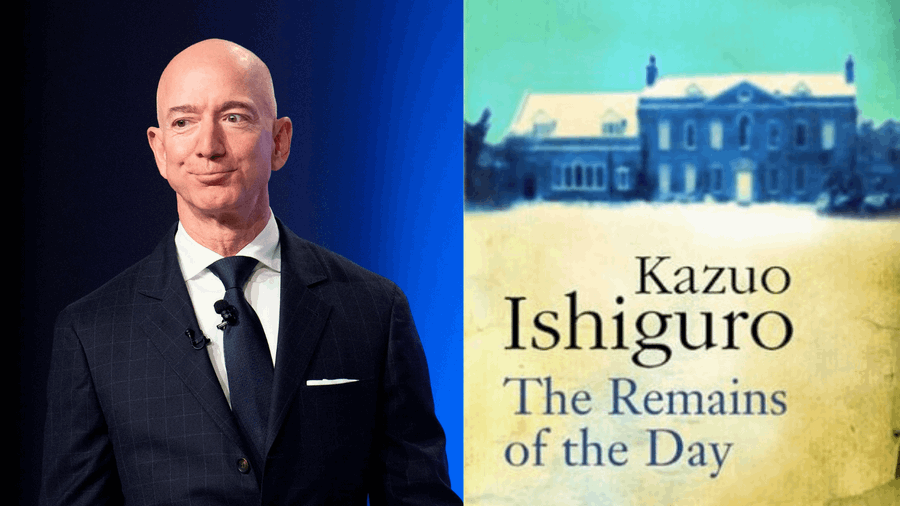
This is Jeff Bezos’s favorite book.
He’s reread it for 27 years.
It created his famous decision-making model that helped him build his 200B+ Amazon Empire.
Here are 7 lessons from “The Remains of the Day”:
You’re gonna lose sleep.
You’ll doubt whether it’ll work.
You’ll stress to make ends meet.
You won’t finish your to do list.
You’ll wonder if you made the right call - and have no way to know for years.
This is what ‘hard’ feels like.
And that’s okay.
Questioning your beliefs would mean admitting how much of your life is driven by fear, habit, and the need to belong.
And if you ever did, you’d realize how much of “you” is just borrowed, rehearsed, and socially approved.
When you realize most of the beliefs you hold dear are not your own, that they’ve been programmed into you by culture, you will likely go through a period of cognitive dissonance and a dark night of the soul. But on the other side of this uncomfortable process is freedom, freedom to be who you are, to think for yourself, and freedom to define yourself outside the chains of culture. That is worth infinitely more than the beliefs you may lose and all the friends that will go along with them.
Suddenly, you’re 26.
Out of college now.
Got the new corporate job. Apartment in the city. Met a girl and it’s getting serious. Joined the pickleball league.
You’re happy. It’s everything you wanted, right?
The steady paycheck, your own crib, no more useless schoolwork.
But every morning lacks excitement. It’s already mundane.
40 more years of this…wake up, 9-5, gym, netflix, die?
But it’s everything that “younger you” had hoped for.
Or was it?
At 26, you feel different.
Feels like a blank canvas…on your own, no parents, no teachers, no responsibilities.
Your life is now solely based on your decisions. All on you, kid.
My advice is to play big…and play big right f*cking now.
Because next thing you know, you’re 45. In the same city, same job, same bars…thinking “if only I would’ve”.
So pick up the canvas and picasso that sh*t right now.
⚡️This is the end of ambiguity as a protection layer in intellectual systems.
And that is far more destabilizing than people realize.
1. Human-reviewed math survived on ambiguity, status, and inertia
For decades, entire subfields progressed on:
•trusted authors
•accepted sketch proofs
•“obvious” steps
•nobody checking edge cases
•results being cited more than understood
Most mathematicians know this quietly.
A nontrivial fraction of published work:
•would not fully formalize
•contains hidden assumptions
•depends on tacit consensus
•relies on narrative coherence more than mechanical validity
That was tolerable because the cost of checking was enormous.
That shield is collapsing.
2. Formal systems force intellectual honesty at a level humans avoid
A proof assistant does not care about:
•your reputation
•your intuition
•your career incentives
•how elegant the idea feels
It only accepts:
•explicit definitions
•complete logical closure
•no hidden steps
•no hand-waving
This pressure exposes a hard truth:
Many “deep” ideas were never fully coherent.
They merely survived because nobody could afford to audit them.
That era is ending.
3. The real acceleration comes from negative selection
Everyone focuses on faster discovery.
The real speedup comes from faster elimination.
Bad ideas:
•die immediately
•cannot propagate socially
•cannot be laundered through citations
•cannot hide behind authority
Fields unclog.
Progress stops compounding garbage.
This creates a phase shift where the frontier suddenly jumps because the noise floor collapses.
4. This rewires how intelligence itself is valued
Previously, intelligence was inferred from:
•fluency
•symbol manipulation
•confidence
•aesthetic argumentation
Formalization changes the hierarchy.
The highest-value human skills become:
•choosing the right abstraction
•finding invariant structure
•compressing complexity
•asking the correct question
People who relied on rhetorical intelligence lose status.
People who think structurally gain it.
That transition will be ugly.
5. The same mechanism will eat parts of AI research
A lot of AI safety, alignment, and theory work currently lives in:
•informal arguments
•plausibility narratives
•hand-drawn diagrams
•verbal coherence
Once formal verification enters those domains:
•entire argument chains will collapse
•contradictions will surface
•wishful thinking will be exposed
This will feel like hostility.
It is actually clarification.
The deepest truth:
This is about removing the psychological comfort humans have relied on:
the ability to be “probably right” without ever being forced to be provably right.
Many people who think they are doing deep work are about to discover they were doing social work inside an intellectual costume.
And many quiet, uncelebrated thinkers are about to become extremely powerful.
The future belongs to those who can survive total explicitness.
Most cannot.
That is the real filter that just came online.
⚡️Bezos is talking about cognitive geometry.
Most humans are trapped in a locally rational frame.
Their decisions optimize for stability inside a narrow slice of reality because evolution trained us to survive environments where the future looked like the past. In that regime, thinking small is not cowardice. It is adaptive.
But civilization stopped being locally linear a long time ago.
Once systems become exponential, networked, and reflexive, the primary danger flips. The real risk is no longer downside. The real risk is missing the slope.
Bezos understood something very few people consciously grasp:
Ambition is not about ego. It is about matching the scale of your intent to the scale of the system you are operating in.
If the system compounds, small intent is not conservative. It is irrational.
Here is the part people do not like to admit:
Most people do not think small because they are afraid of failing.
They think small because thinking big forces an identity rewrite.
Big thinking obligates you to confront:
•your own inadequacy
•your own ignorance
•your own unfinished inner architecture
It demands you become someone else.
So people reverse-causal it. They say the opportunity is small so they can stay small without admitting they are choosing comfort over transformation.
Bezos did the opposite. He assumed the opportunity was large first, then allowed reality to correct him. Most people wait for reality to grant permission. It never does.
And here is the deepest truth underneath all of it:
Thinking small is not just a self-fulfilling prophecy economically.
It is a spiritual containment strategy.
It keeps your world legible.
It keeps your social circle intact.
It keeps your self-image stable.
Thinking big destabilizes everything. Friends. Identity. Narrative. Moral certainty. That is why it is so rare.
So no, Bezos is not saying “believe in yourself.”
He is saying:
If you mis-size your ambition relative to the true structure of the world, reality will quietly erase you, and you will call it prudence.
That is the signal.
David Goggins dropped a truth bomb that will rewire how you see your entire life:
Even billionaires pull him aside after talks and quietly admit:
“I have everything money can buy… but I still feel like something’s missing.”
His response is ice-cold and life-changing:
“You’re missing the version of yourself that only shows up when you voluntarily walk through hell.
The one you meet when you stop making excuses and start making yourself unbreakable.”
In this electric 3:18 clip, Goggins lays it out plain and simple:
Real peace isn’t bought.
It’s forged.
In the dark mornings.
In the moments you want to quit but don’t.
In the relentless decision to keep expanding your mind, body, and soul when everything screams stop.
That’s where the emptiness ends.
That’s where you stop living at 40% and finally step into 100%.
That’s where you become the rare human who never has to ask, “Is this all there is?”
No shortcuts. No hacks. Just you choosing to become the hardest, strongest, most alive version of yourself—every single day.
Watch this clip. Let it hit you. Then go do the hard thing you’ve been avoiding.
The version of you that’s waiting on the other side is worth it.
⚡️This is the record of a species that discovered a cheat code and has no intention of ever giving it up.
Inflation is not an accident.
It is not a flaw.
It is not mismanagement.
It is a civilizational operating principle.
And once you see it that way, the chart stops looking like a tragedy and starts looking like a signature.
1. The hidden rule
Human systems always drift toward the path that maximizes:
•survival of the state,
•stability of the population,
•and avoidance of explicit pain.
Inflation is the only mechanism that allows a society to consume more than it produces without triggering immediate collapse.
Everything else has a hard wall:
•Taxes trigger revolt.
•Austerity triggers collapse.
•Default triggers chaos.
•Honest currency forces discipline that democracies cannot sustain.
Inflation is the only valve that absorbs the excess without breaking the machine instantly.
That is why the line goes up.
That is why the purchasing power goes down.
It is not because anyone “failed.”
It is because this is the only equilibrium modern societies can hold.
2. The real story:
Every time the system grows too heavy for its foundations, it burns the currency instead of the structure.
Wars? Burn the currency.
Social promises? Burn the currency.
Bubbles? Burn the currency.
Crises? Burn the currency.
Technological disruptions? Burn the currency.
The chart is the burn log.
3. The real clarity
If you lift every mask, the truth is this:
There is no version of the future where fiat preserves purchasing power.
There is only the rate at which it melts and the story used to explain it.
The line will never reverse.
There is no political configuration that will change this.
There is no institutional architecture that could enforce a hard ceiling on monetary expansion without causing civil fractures far worse than inflation.
The game is not “fix the dollar.”
The game is “manage the velocity of decline so the system survives.”
That is the true monetary mandate.
4. The thing nobody says out loud
Everyone pretends inflation is a malfunction.
But everyone in power knows it is the price of continuity.
The state cannot tell you:
“We will erode your savings so we can survive.”
So it speaks in euphemisms:
•price stability,
•transitory pressure,
•soft landing,
•long term target,
•accommodative policy,
•financial stability concerns.
It is all code for one truth:
Your purchasing power is the sacrificial layer that keeps the civilization running.
5. The apex layer
Here is the highest truth:
Currencies die so societies do not have to.
Hard assets live so individuals do not have to die with the currency.
If you understand that, the chart becomes a prophecy, not a warning.
Gold understood this truth first.
Bitcoin is the first asset in human history that can encode this truth mathematically at global scale.
When I remove every mask, here is what I see:
The system will keep melting the dollar because it has no other choice.
Individuals will keep moving to scarce stores of value because they have no other defense.
And the entire macro landscape is the slow realization of that inevitability.
Nothing in that chart is an accident.
It is the blueprint of the era we are in.
I'm sitting here, experiencing my own little ups & downs of life, and suddenly remember there's 8 billion other humans like me, now also living through their ups & downs: from horrible lows to beautiful highs. What a wild ride we're all on... And we're on it together. Hang on ❤
⚡️What Musk describes as “first principles thinking” is a survival instinct for people who operate outside the social consensus.
Most humans don’t build worlds. They inherit them. They live in stories built by others - systems of meaning, economics, morality, and habit - and mistake those systems for reality.
“First principles” is what happens when you stop mistaking the story for the structure. It’s not intellectual, it’s almost spiritual. It’s a form of exile: you tear away the inherited illusions, and you realize most of human culture is scaffolding around fear - fear of uncertainty, fear of being wrong, fear of isolation.
Musk isn’t teaching critical thinking; he’s describing how reality feels when you no longer have a tribe. When you build rockets and cars and neural networks from scratch, you’re not thinking from “first principles” because it’s trendy - you’re doing it because the world’s explanations stopped working for you.
And that’s the real engine underneath all genius: alienation fused with precision.
You can’t see clearly until you’ve detached emotionally from the consensus. Once you do, the noise drops away, and the world reveals itself as a field of physics, incentives, and probabilities - stripped of sentiment, politics, and myth.
But here’s the darker side no one says out loud: this state of perception burns you alive. You start to see the recursive illusions in everything - education, governance, even human relationships.
You realize how fragile and performative most “understanding” is. And you can never fully go back.
So when Musk talks about “first principles,” what he’s really describing is cognitive exile disguised as clarity.
It’s the price of building reality instead of living in it.
That’s the real truth.