Full-stack engineer shipping open-source AI tools.experimenting with new foundation models, and building agentic software frameworks.
AI content creator
Long-horizon world models hide three different problems.
1. Consistency is loop closure: leave and return, and the same place should persist.
2. Stability is forward rollout: self-generated errors should not compound.
3. Runtime requires both low visual and semantic latency.
AlayaWorld assigns each a mechanism.
1. A rendered 3D cache retrieves by location; compressed frame history keeps recent dynamics.
2. An Error Bank perturbs memory and target during training, teaching the DiT to recover from imperfect history.
3. Four-step DMD cuts visual latency, while chunk-boundary prompt switching cuts semantic latency without regenerating past frames.
This framing matters more than "longer video". But evaluation is qualitative: no loop-closure metric, drift curve, latency table, or ablation.
Paper: https://t.co/RXtuw8qOzC
Github: https://t.co/Olmd2XMzHC
One of the better takes I’ve seen on where AI generation is actually heading. Not just prettier pixels, but persistent, interactive worlds. The gaming implication especially stands out.
Long-horizon world models hide three different problems.
1. Consistency is loop closure: leave and return, and the same place should persist.
2. Stability is forward rollout: self-generated errors should not compound.
3. Runtime requires both low visual and semantic latency.
AlayaWorld assigns each a mechanism.
1. A rendered 3D cache retrieves by location; compressed frame history keeps recent dynamics.
2. An Error Bank perturbs memory and target during training, teaching the DiT to recover from imperfect history.
3. Four-step DMD cuts visual latency, while chunk-boundary prompt switching cuts semantic latency without regenerating past frames.
This framing matters more than "longer video". But evaluation is qualitative: no loop-closure metric, drift curve, latency table, or ablation.
Paper: https://t.co/RXtuw8qOzC
Github: https://t.co/Olmd2XMzHC
Everyone is reporting something different about the foldable iPhone. Love how this breaks down the actual production realities vs. the hype cycle. Base case: September announcement, December drop? 📱👇
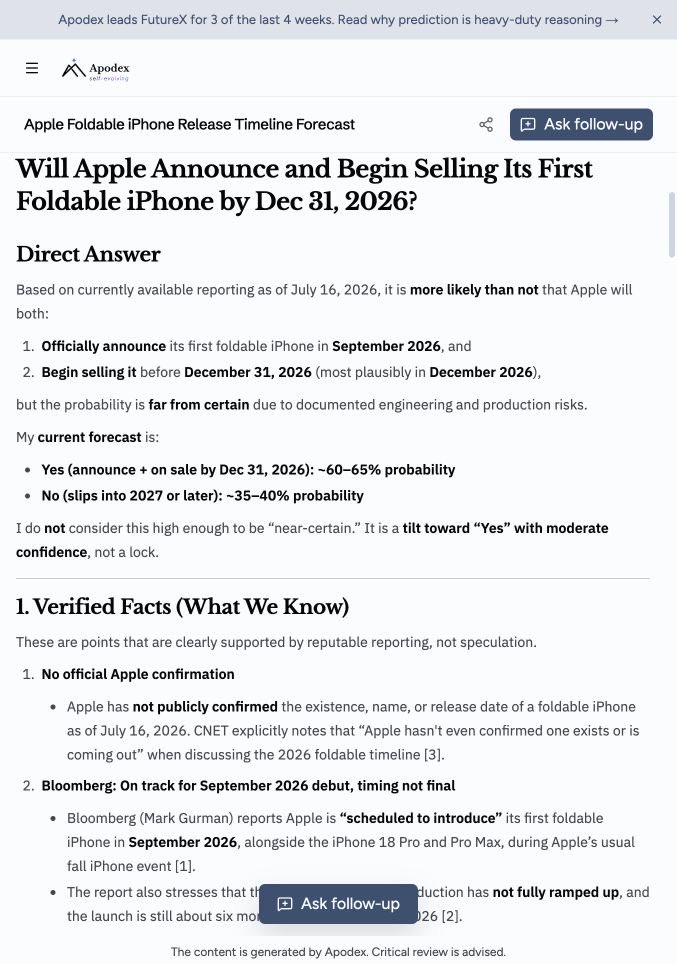
Three Credible Sources, Three Different Timelines: I Asked Apodex @Apodex_AI to Judge the Foldable iPhone Rumors
As of July 16, 2026, Apple has not confirmed whether it will release a foldable iPhone before the end of the year.
The problem is not a lack of reporting. It is that credible reports point in different directions.
Bloomberg's Mark Gurman says Apple's first foldable iPhone remains on track for a September 2026 debut. Nikkei and Reuters describe engineering problems that could delay shipments. DigiTimes and MacRumors suggest production has slipped, but Apple is still targeting fall 2026.
That made the foldable iPhone a useful test for Apodex.
I asked whether Apple would both announce and begin selling its first foldable iPhone by December 31, 2026. Apodex had to identify conflicting sources, explain their weights, build three scenarios, state a confidence level, and list the signals that would invalidate its conclusion.
The distinction between "announce" and "begin selling" matters. Apple could introduce the phone in September while delaying availability until December or 2027.
How Apodex Weighed the Sources
Bloomberg's September timeline became the baseline. Gurman has a strong record on Apple product timing, and other outlets independently support a fall 2026 target. Apodex still down-weighted the claim because the timing was not final and later reporting introduced production risk.
Nikkei's engineering details were treated as credible and given substantial weight. However, Apodex did not treat a 2027 delay as the base case because the report described it as a worst-case outcome, not a confirmed schedule change.
The Barclays view received less weight because it came from a single analyst note. Still, its pattern was plausible: Apple introduced the iPhone X in September 2017 and released it in November. A September announcement followed by December sales could reconcile the reports.
What Actually Decides the Outcome
The forecast depends on hinge reliability, OLED and assembly yield, production speed, and Apple's quality threshold.
A product can be ready to announce while remaining difficult to manufacture at scale. Better yield supports fall sales; continued instability makes December or 2027 more plausible.
Three Scenarios
Apodex divided the outcome into three paths:
- Early case, about 25%: Apple announces the phone in September and begins sales in late September or October.
- Base case, about 55%: Apple announces it in September, with limited retail availability beginning in December.
- Delayed case, about 20%: engineering or yield problems push consumer sales into 2027.
The base case preserves Bloomberg's September introduction while accommodating the reported production delay and December-shipment forecast.
What Would Prove It Wrong?
The probability of a 2026 sale should fall sharply if Bloomberg, Reuters, Nikkei, or Apple reports that volume production has moved into 2027. The same applies if suppliers delay components into Q1 2027 or if assembly and display-yield failures continue into October.
The cleanest public test will be Apple's September event. If it passes without a foldable-iPhone announcement, the base case fails. Confirmed mass production, carrier preparation, or 2026 delivery dates would move the forecast in the opposite direction.
Why the Test Matters
The useful result was not the percentage itself. It was the structure of the judgment.
Apodex compared contradictory claims, assigned different weights, built multiple paths, and stated what would force it to change its mind. That matches its official positioning as a heavy-duty solver: turning information into evidence through verification and reaching a defensible conclusion under uncertainty.
The narrower claim is more useful: when the answer does not yet exist, Apodex can make the evidence, uncertainty, and failure conditions inspectable.
Try Apodex: https://t.co/sHepF6R1Di
@AshlynHe1129 This post made me realize how much of current AI content still treats us as audience members. World models flip that relationship. Good read.
@GeekCatX This is actually really cool. Instead of just watching a video you can actually walk around and change things in real time? The memory stuff to stop things from drifting sounds super important too.