@india_plus_ We underestimate our doctors' capabilities and affordability; of late, it's getting super commercial though.
Neighbour, 46+ Dutch, was suffering from a hip issue for the last 5 years; still in lurch.
I told him to hop on a flight for a 2-month vacation and come back healthy.
@Ravindra_reddyP@naralokesh@HemanthNBK2 He is also a parent, raising a high-IQ kid, politics is not just kissing the asses of the masses for votes but also behaving just like a human, a normal mortal human being.
Nuclear is the loudest theme in Indian markets right now. The harder question is which of the listed names actually has the orders, and which are riding the headline.
The order books say something interesting.
🔹 KSB Ltd
Total order book: ₹2,585 cr (Dec 2025). Nuclear: ₹1,282 cr - 49.5%.
First Indian company in the pump industry to be accredited with ISO 19443:2018. Effective monopoly on primary coolant pumps for India's PHWR fleet. Confirmed on most reactors under construction.
Nuclear revenue in CY25 was under ₹50 cr because of testbed delays at Tarapur; management guides ₹300-400 cr in CY26.
🔹 MTAR Technologies
Total order book: ₹2,394.9 cr (Dec 2025). 3.5x annual revenue, the highest in company history.
₹504 cr of nuclear orders bagged for Kaiga 5 and 6 in December 2025 alone. Nuclear contributed only ₹16.6 cr to 9MFY26 revenue (3%). Means the order book has barely started flowing through.
Management guiding 50% revenue growth in FY27.
🔹 BHEL
Total order book: ₹2.4 lakh crore (Mar 2026). FY26 inflows: ₹75,000 cr. Lone domestic supplier of nuclear steam turbines in India. ~75% of PHWR units operate with BHEL turbine and generator sets. Won the ₹10,800 cr turbine island package for six 700 MWe PHWRs and ₹1,400 cr steam generator order under fleet mode procurement. Signed MoU with EDF in Nov 2023 for Jaitapur localisation (six EPRs of 1,650 MW each).
🔹 L&T Heavy Engineering
Has manufactured and dispatched 42+ steam generators across India's nuclear programme. Joint venture with NPCIL at Hazira is the only Indian facility capable of forgings up to 120 MT. Just dispatched the 7th 700 MWe steam generator to NPCIL. Management has guided for 3 to 3.5x nuclear revenue growth over the next 5 years.
🔹 Hindustan Construction Company (HCC)
Total order book: ₹13,148 cr (Dec 2025). Bid pipeline: ~₹53,820 cr.
HCC's own concall: built 65%+ of India's nuclear power plant capacity. Nuclear is only 3% of the current order book - the rest is transportation (63%), hydropower (22%), water (12%). Currently executing BARC reactor labs in Maharashtra and IGCAR Kalpakkam FRFCF. Just disclosed plans to enter LWR civil works.
🔹 Kirloskar Brothers (KBL)
Power segment order book: ₹495 cr (22% of standalone). Made the primary and secondary heat transport pumps for the Kalpakkam Fast Breeder Reactor. Each pump weighs 135 tonnes, handles liquid sodium at 500°C+. Per KBL, only 4 companies globally can manufacture these. Q3FY26 concall disclosure: 4 PHWR primary circuit pump types now developed in-house and qualified by NPCIL. Direct challenger to KSB on the next PHWR fleet order.
🔹 Walchandnagar Industries
Total order book: ₹670 cr, primarily nuclear. Quietly turned the corner in Q3 FY26: net profit of ₹4.66 cr (vs loss of ₹17.13 cr YoY), revenue ₹80.95 cr (+37% YoY), EBITDA margin 22%. Two consecutive quarters of positive EBITDA. Management called it "a turning point, not a peak". The full-year FY25 was still a ₹86 cr loss. Promoters have pledged 49.2% of holding — that's the live overhang.
The pattern that nobody is calling out:
The order books are split into 3 distinct groups, and they don't deserve the same multiple.
Group 1: Order book and revenue both compounding: MTAR, KSB, L&T, BHEL.
Group 2: Order book is strong, nuclear is a small slice of it: HCC.
Group 3: Order book exists, turn happening, balance sheet still recovering: Walchandnagar.
Group 4: Order book modest, but the technical moat is real: KBL.
The market is currently pricing all of them as one story.
They're not.
⚡️Disclaimer: The above data should not be considered as a buy or sell recommendation. The analysis has been done for educational and learning purposes only.
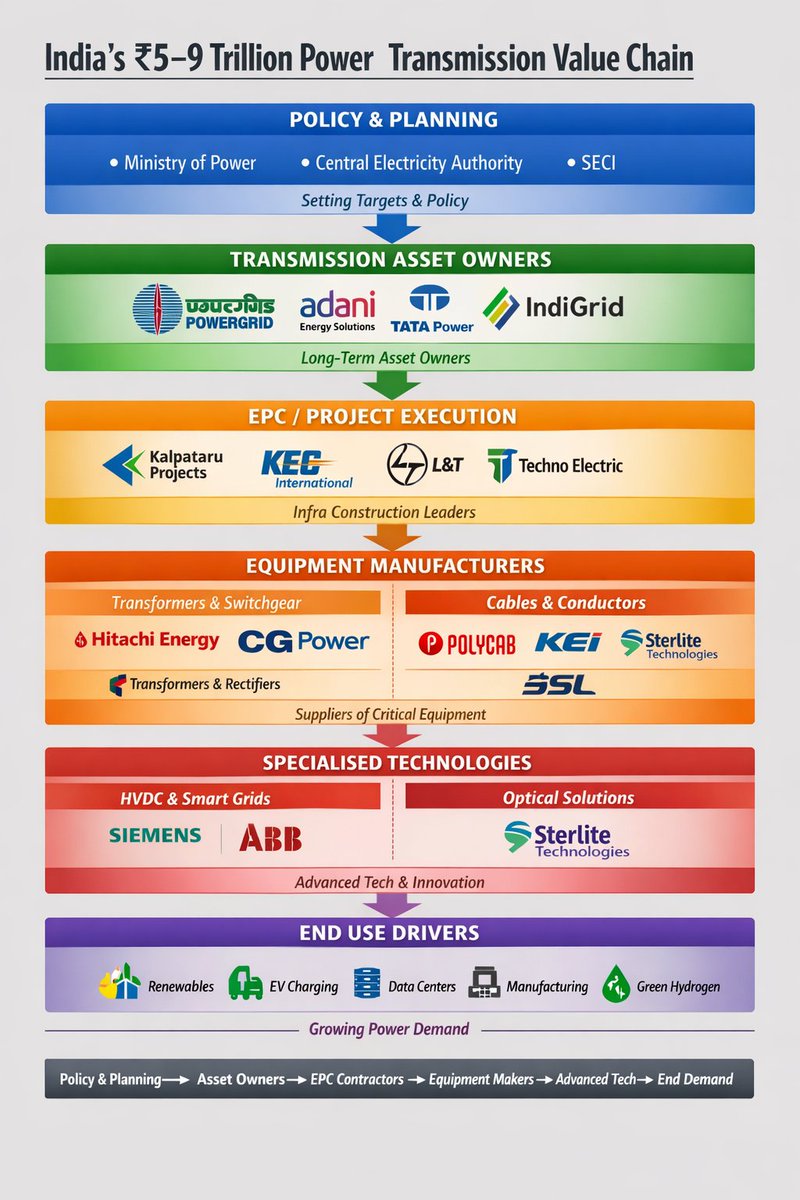
⚡ India’s ₹5-9 TRILLION Power Transmission Opportunity. What is driving this:
☀️ 500GW Renewables
🚗 EVs
🖥 Data Centers
🏭 Manufacturing
👉 Transmission = Backbone of India’s growth
Most investors are still underestimating this cycle.
#PowerSector#Capex#IndiaGrowth#Infra #Investing
I wanted to check: did any ace investor spot India's nuclear theme BEFORE the Fast Breeder Reactor went critical?
So I went through the Dec 2025 shareholding data of every major portfolio. Here's what came up.
Mukul Agrawal quietly built a 4-stock nuclear basket without anyone noticing.
✍️ HCC (Hindustan Construction Company) This is the company that built 60% of India's nuclear power capacity. Tarapur, Kakrapar, Kudankulam. Every major reactor, HCC did the civil construction.
✍️ PTC Industries Specialised alloy castings for reactor internals. Precision components that go inside the core. Niche. Hard to replicate. Years of qualification needed.
✍️ WPIL Ltd Pumps for reactor cooling systems. NPCIL is a direct client.
✍️ KRN Heat Exchanger Heat exchangers are critical for reactor thermal management. Every new reactor needs them.
4 companies. All in the nuclear supply chain. All in one portfolio. All bought BEFORE the PFBR achieved criticality on April 6, 2026.
A ₹7,000 crore portfolio doesn't take 4 bets on one theme by accident.He saw the nuclear capex cycle coming before the headlines did.
Now here's the bigger picture of what's ahead:
🔸 8.18 GW installed today → 100 GW target by 2047
🔸 ₹20,000 Cr Nuclear Energy Mission
🔸 Atomic Energy Act amendments opening the sector to private players for the first time
🔸 3.8 GW of fast breeder capacity planned by BHAVINI
🔸 ₹18,000-20,000 Cr PLI scheme coming for nuclear component makers
Defence went 5-10x after the capex cycle began in 2020. The smart money is now front-running the same playbook in nuclear.
Hi 👋 I'm Sam, I create interactive visualisations about programming.
My posts from 2024:
- https://t.co/yfIDlOg18H
- https://t.co/YBTnk9W4dR
- https://t.co/dudFFQVIgw
I also appeared on 2 podcasts :
- https://t.co/hKKSrulOwi
- https://t.co/hzGftRSWmN
Cloud Disaster Recovery Strategies 👇
Any DR strategy starts with finalizing:
𝟭. 𝗥𝗧𝗢 (𝗥𝗲𝗰𝗼𝘃𝗲𝗿𝘆 𝗧𝗶𝗺𝗲 𝗢𝗯𝗷𝗲𝗰𝘁𝗶𝘃𝗲):
How much downtime one can accept ?
𝟮. 𝗥𝗣𝗢 (𝗥𝗲𝗰𝗼𝘃𝗲𝗿𝘆 𝗣𝗼𝗶𝗻𝘁 𝗢𝗯𝗷𝗲𝗰𝘁𝗶𝘃𝗲):
How much data loss one can accept ?
Disaster Recovery Strategies:
𝟭. 𝗕𝗮𝗰𝗸𝘂𝗽 𝗮𝗻𝗱 𝗥𝗲𝘀𝘁𝗼𝗿𝗲:
Creating copies of data and systems periodically to be used for recovery in case of a disaster
Typical,
𝘙𝘛𝘖: Several hours to days
𝘙𝘗𝘖: Can vary from several hours to the last successful backup
𝟮. 𝗣𝗶𝗹𝗼𝘁 𝗟𝗶𝗴𝗵𝘁:
Maintaining essential components in a standby state to quickly scale up the infrastructure during a disaster
Typical,
𝘙𝘛𝘖: Mins to a few hours
𝘙𝘗𝘖: How frequently data is synchronized
𝟯. 𝗪𝗮𝗿𝗺 𝗦𝘁𝗮𝗻𝗱𝗯𝘆:
Preparing a partially operational environment with up-to-date data to minimize downtime during recovery
Typical,
𝘙𝘛𝘖: Mins to a few hours
𝘙𝘗𝘖: Within the last few minutes or hours
𝟰. 𝗛𝗼𝘁 𝗦𝗶𝘁𝗲 / 𝗠𝘂𝗹𝘁𝗶 𝗦𝗶𝘁𝗲:
Running a fully redundant, active production environment in parallel with the primary system, ensuring continuous business operations
Typical,
𝘙𝘛𝘖: Near-zero or a few minutes
𝘙𝘗𝘖: Very minimal, often within the last few seconds
55K+ read my DevOps and Cloud newsletter: https://t.co/WBucLdwLhJ
Sign up to get 'The Practical Linux Guide for DevOps Engineers'
What do we cover:
DevOps, Cloud, Kubernetes, IaC, GitOps, MLOps
🔁 Consider a Repost if this is helpful
APCRDA రీజియన్ అనేద��� మీ సైతాన్ వాటికన్ లా ఫీల్ అవుతున్న మావిగన్ కి అమ్మా మొగుడు. క్యాపిటల్ రీజియన్ అని సైతాన్లు చెప్పే దానికి మూడింతలు ఉంది ప్రస్తుత అమరావతి క్యాపిటల్ రీజియన్. అందుకే జోకర్స్ ఎంత డబ్బా కొడదాం అనుకున్నా వాళ్ల వాదన నిలబడదు. #MaViGun #CRDA
India went on to build its 6000T Arihant class SSBNs ,then Aright class 7000T SSBN....now proceeding to build its 10000T Project-77 SSN and 15000T S5 SSBN. A monumental feet overlooked by the world and enemies. S-Korea, Brazil, Australia,Turkey r yet to start their SSN projects
What does fighting corruption really get you?
Last evening in Mumbai, I attended an event where one of the guests was a politician. I have known him long enough to understand what he truly represents. Yet there he was, surrounded by admiration. People queued up for selfies, eager to shake his hand.
What stayed with me was not just the crowd, but the effort to manufacture respect. The anchor spent nearly fifteen minutes building a glowing image, carefully stitching together a personality that did not exist. And the audience accepted it without hesitation.
It made me think of someone most people have already forgotten. Manjunath Shanmugam.
A young officer from Indian Oil Corporation. Educated at IIM Lucknow. Posted in a region where fuel adulteration was routine and protected by local power structures.
He chose to do his job honestly.
He sealed petrol pumps that were cheating consumers. He refused bribes. He ignored threats. And when a sealed pump reopened illegally, he went back to inspect it again.
He was shot dead for that decision. He was 27.
There were protests. There was outrage. There were court cases. For a brief moment, the country spoke about integrity, courage, and the cost of doing the right thing.
And then we moved on.
Today, the corrupt are visible, celebrated, even admired. They occupy our conversations, our stages, our attention. We amplify them, knowingly or unknowingly.
But the honest? The ones who refuse to bend, who quietly stand their ground, who pay the ultimate price? They fade into footnotes.
This is not just about one man. It is about what we choose to value as a society. What message are we really sending?
The transformation of Early Coimbatore in to the "Manchester of South India" was largely driven by visionary Telugu-speaking industrialists. These stalwarts laid the foundation for the region's massive textile and engineering ecosystem.
01. S. P. Narasimhalu Naidu (1854–1922) :
Known as a key architect of modern Coimbatore, he co-founded the city’s first textile mill, Coimbatore Spinning and Weaving Mills (CS&W), in 1888 alongside Robert Stanes, and also planner of Siruvani Dam.
02. G. Kuppuswamy Naidu (1884–1942) :
A titan of the industry, he founded Lakshmi Mills in 1910, which became one of India’s premier textile manufacturers . His legacy expanded into the Lakshmi Machine Works (LMW).
03. G. D. Naidu (1893–1974) :
Often called the "Edison of India," he was a self-taught genius and a prolific inventor. While he revolutionized public transport with United Motor Service (UMS), his contributions to the textile sector included inventing mechanical improvements for ginning and spinning. He is credited with manufacturing India’s first electric motor in 1937.
04. Narayanaswamy Naidu :
He established the Dhandayuthapani Foundry (DPF), which became a cornerstone of Coimbatore’s engineering growth. By 1928, his foundry produced Coimbatore’s first belt-driven pump, marking the beginning of the city's dominance in the pump and motor industry.
05. K. Govindaswamy Naidu (1907–1995) :
Popularly known as "KG" he was a major industrialist and philanthropist who further expanded the "KG Group" into various textile and healthcare ventures.
06. D. Balasundaram Naidu (1913–2009) :
was a pioneering industrialist and engineer who played a central role in establishing Coimbatore as an indigenous manufacturing hub. He is best known as the founder of Textool Company Limited, which was the first in India to manufacture a complete range of indigenous textile machinery.
@PemmasaniOnX@PemmasaniOnX All the colours fade when chilli reaches mandi, and all that is left is a debts & fears but not profits for avg indian farmer.
How TDP government gearing up for EU market opportunities with end products!
Especially red chilli crops go through high pest ctrl
@PrasunNagar There were many wars/conflicts among indian kings, yet the population is devoid of hatred against each other, unlike the rest of the world, where enmity is passed down like DNA.
Not all civilisations are the same.