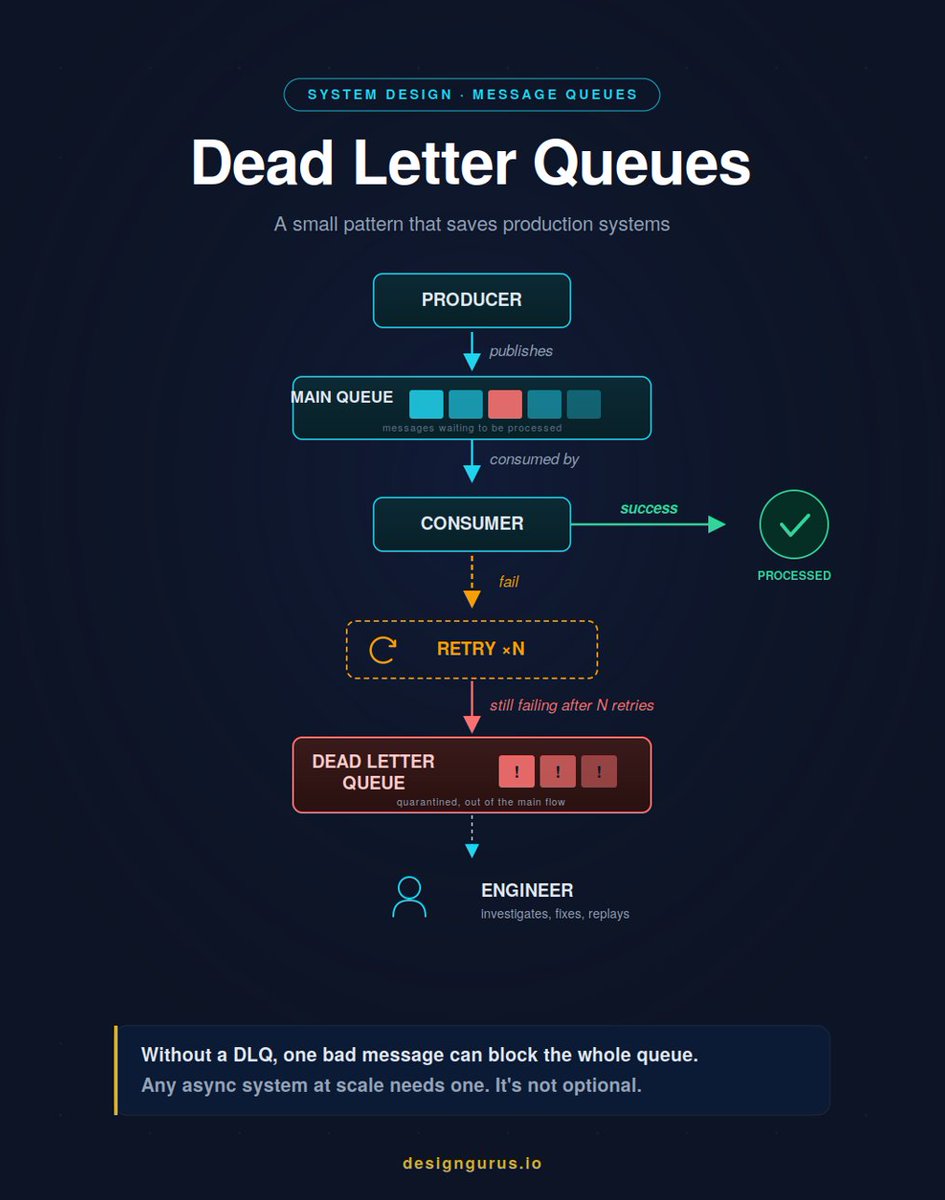
When a message fails to be processed, what do you do?
Drop it? Retry forever?
Neither. You send it to a dead letter queue.
They sit there, out of the main flow, waiting for a human to look at them.
Reference: Grokking System Design Interview - https://t.co/cbyUjy2Ezv
After reviewing 64 system design interview questions across 4 popular courses, I narrowed it down to the 𝟮𝟱 𝗜'𝗱 𝗮𝗰𝘁𝘂𝗮𝗹𝗹𝘆 𝘀𝘁𝘂𝗱𝘆.
https://t.co/Qsr4dYx7wV
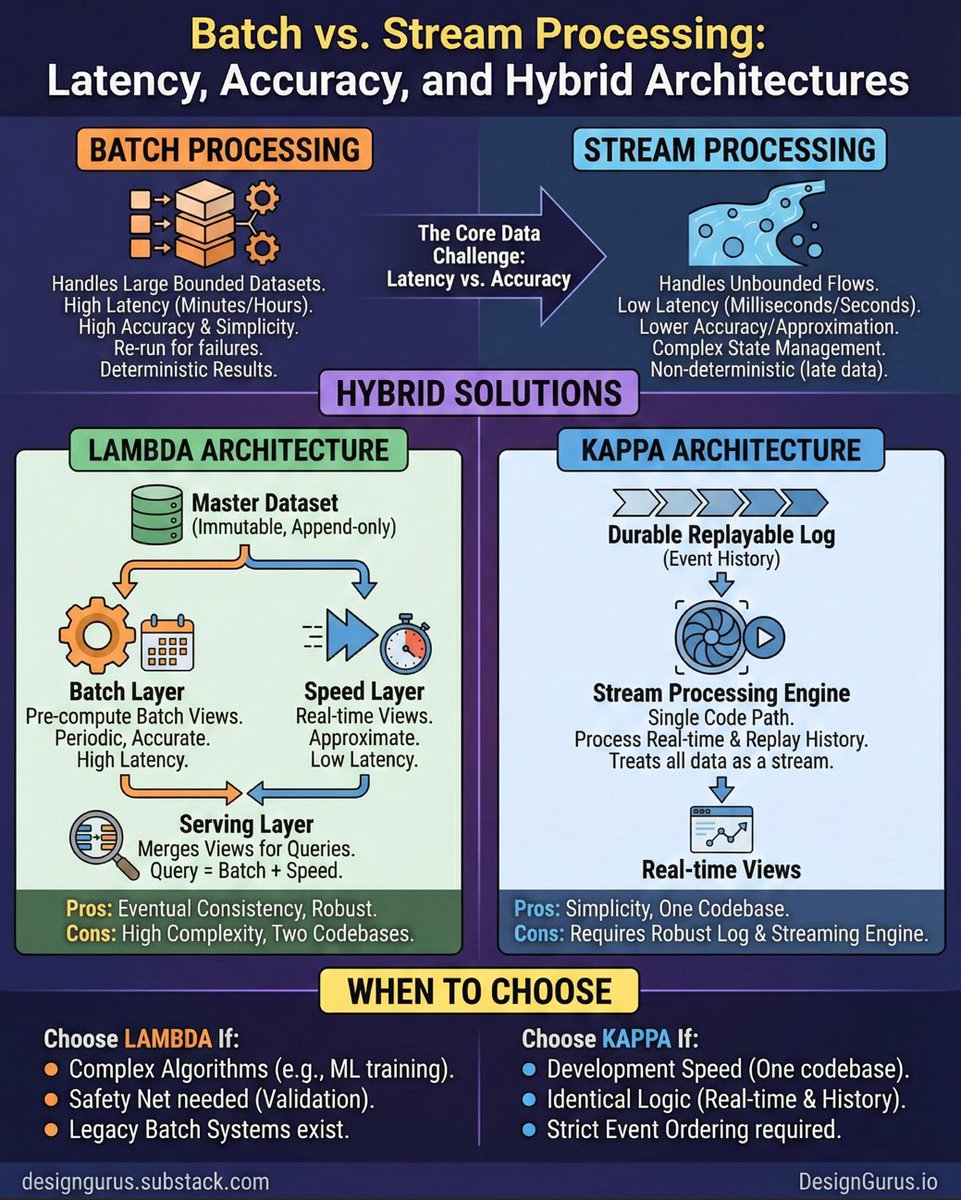
𝗕𝗮𝘁𝗰𝗵 𝘃𝘀. 𝗦𝘁𝗿𝗲𝗮𝗺 𝘃𝘀. 𝗟𝗮𝗺𝗯𝗱𝗮: 𝗧𝗵𝗲 𝗗𝗮𝘁𝗮 𝗔𝗿𝗰𝗵𝗶𝘁𝗲𝗰𝘁𝘂𝗿𝗲 𝗖𝗵𝗲𝗮𝘁 𝗦𝗵𝗲𝗲𝘁
In system design, we are always fighting a war between Latency (Speed) and Accuracy (Completeness).
You want data instantly, but you also want it to be perfect. Usually, you can't have both.
Here is how the top 3 patterns solve this trade-off:
𝟭. 𝗕𝗮𝘁𝗰𝗵 𝗣𝗿𝗼𝗰𝗲𝘀𝘀𝗶𝗻𝗴 The "Slow & Steady" approach.
How it works: Collects data over time and processes it in big chunks (e.g., every 2 hours).
Pros: High accuracy, simple logic, easy to fix errors (just re-run the batch).
Cons: High Latency. You are always looking at old data.
𝟮. 𝗦𝘁𝗿𝗲𝗮𝗺 𝗣𝗿𝗼𝗰𝗲𝘀𝘀𝗶𝗻𝗴 The "Need for Speed" approach.
How it works: Processes every event the instant it arrives.
Pros: Low Latency. Real-time dashboards.
Cons: Complexity. Handling late-arriving data and ensuring "exactly-once" processing is hard.
𝟯. 𝗧𝗵𝗲 𝗟𝗮𝗺𝗯𝗱𝗮 𝗔𝗿𝗰𝗵𝗶𝘁𝗲𝗰𝘁𝘂𝗿𝗲 The "Best of Both Worlds" approach.
How it works: Runs BOTH Batch and Stream in parallel.
Batch Layer: Processes all history perfectly.
Speed Layer: Processes recent data quickly (approximate).
Serving Layer: Merges the two (Total = Batch + Speed).
The Trade-off: You have to write your code twice (Two codebases).
If you want to simplify Lambda, look into the 𝗞𝗮𝗽𝗽𝗮 𝗔𝗿𝗰𝗵𝗶𝘁𝗲𝗰𝘁𝘂𝗿𝗲, which treats everything (even history) as a stream.
Read full post: https://t.co/yUfLh6qwFs
#SystemDesign #DataEngineering #BigData #Architecture #TechTips
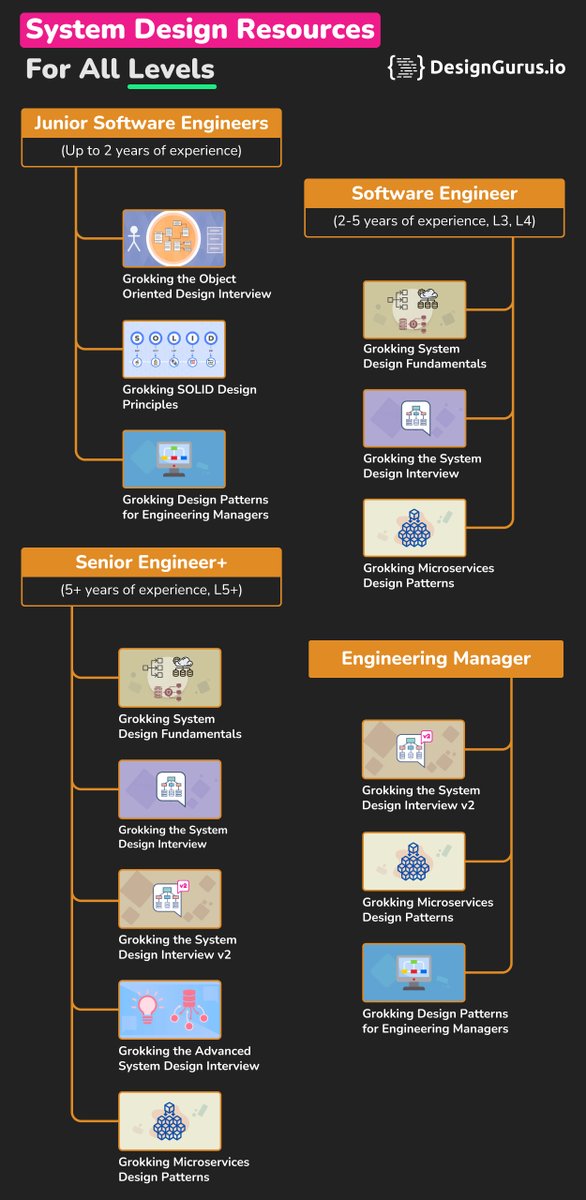
𝗧𝗵𝗲 𝗱𝗶𝗳𝗳𝗲𝗿𝗲𝗻𝗰𝗲 𝗯𝗲𝘁𝘄𝗲𝗲𝗻 𝗟𝟯 𝗮𝗻𝗱 𝗟𝟱 𝗶𝘀 𝗦𝘆𝘀𝘁𝗲𝗺 𝗗𝗲𝘀𝗶𝗴𝗻.
When you are a Junior (𝟎-𝟐 𝐘𝐎𝐄), your job is to write clean, working classes. You focus on 𝐒𝐎𝐋𝐈𝐃 𝐏𝐫𝐢𝐧𝐜𝐢𝐩𝐥𝐞𝐬 and 𝐎𝐛𝐣𝐞𝐜𝐭-𝐎𝐫𝐢𝐞𝐧𝐭𝐞𝐝 𝐃𝐞𝐬𝐢𝐠𝐧.
When you become a 𝐒𝐞𝐧𝐢𝐨𝐫 (𝟓+ 𝐘𝐎𝐄), your job changes. You stop designing Classes and start designing 𝐀𝐫𝐜𝐡𝐢𝐭𝐞𝐜𝐭𝐮𝐫𝐞𝐬.
You stop worrying about "How to write this function" and start worrying about:
🔹 Scalability (Can we handle 10M users?)
🔹 Availability (What happens if AWS goes down?)
🔹 Microservices (How do we split this Monolith?)
Many engineers get stuck at L4 because they keep practicing Junior skills. They get better at coding, but they don't get better at designing.
I’ve attached a cheat sheet from 𝐃𝐞𝐬𝐢𝐠𝐧𝐆𝐮𝐫𝐮𝐬.𝐢𝐨 that shows exactly which resources you need to bridge that gap.
Save this image. It’s your curriculum for the next 5 years.
Ref:
1) Grokking the System Design Interview: https://t.co/ddgSvk7kqC
2) Grokking the System Design Interview II: https://t.co/vYMt9eQgX9
#Engineering #TechCareers #SystemDesign #Developers #Management
𝗧𝘄𝗼 𝗶𝘀 𝗼𝗻𝗲. 𝗢𝗻𝗲 𝗶𝘀 𝗻𝗼𝗻𝗲.
This is the golden rule of 𝗛𝗶𝗴𝗵 𝗔𝘃𝗮𝗶𝗹𝗮𝗯𝗶𝗹𝗶𝘁𝘆.
If you rely on a single database, you don't have a database. You have a ticking time bomb.
To build systems that never sleep, you need to master these 5 layers of defense:
✅ 1. Redundancy: Duplicating every critical component.
✅ 2. Replication: Copying data in real-time so nothing is lost.
✅ 3. Load Balancing: Detecting failures and re-routing traffic instantly.
✅ 4. Rate Limiting: Protecting your servers from traffic spikes.
✅ 5. Geo-Distribution: Surviving entire regional outages (like a hurricane).
I broke down exactly how these pieces fit together in my latest article.
Read it here: https://t.co/xqNz0rKVh6
#SystemDesign #Architecture #TechTips #Programming #SoftwareEngineering
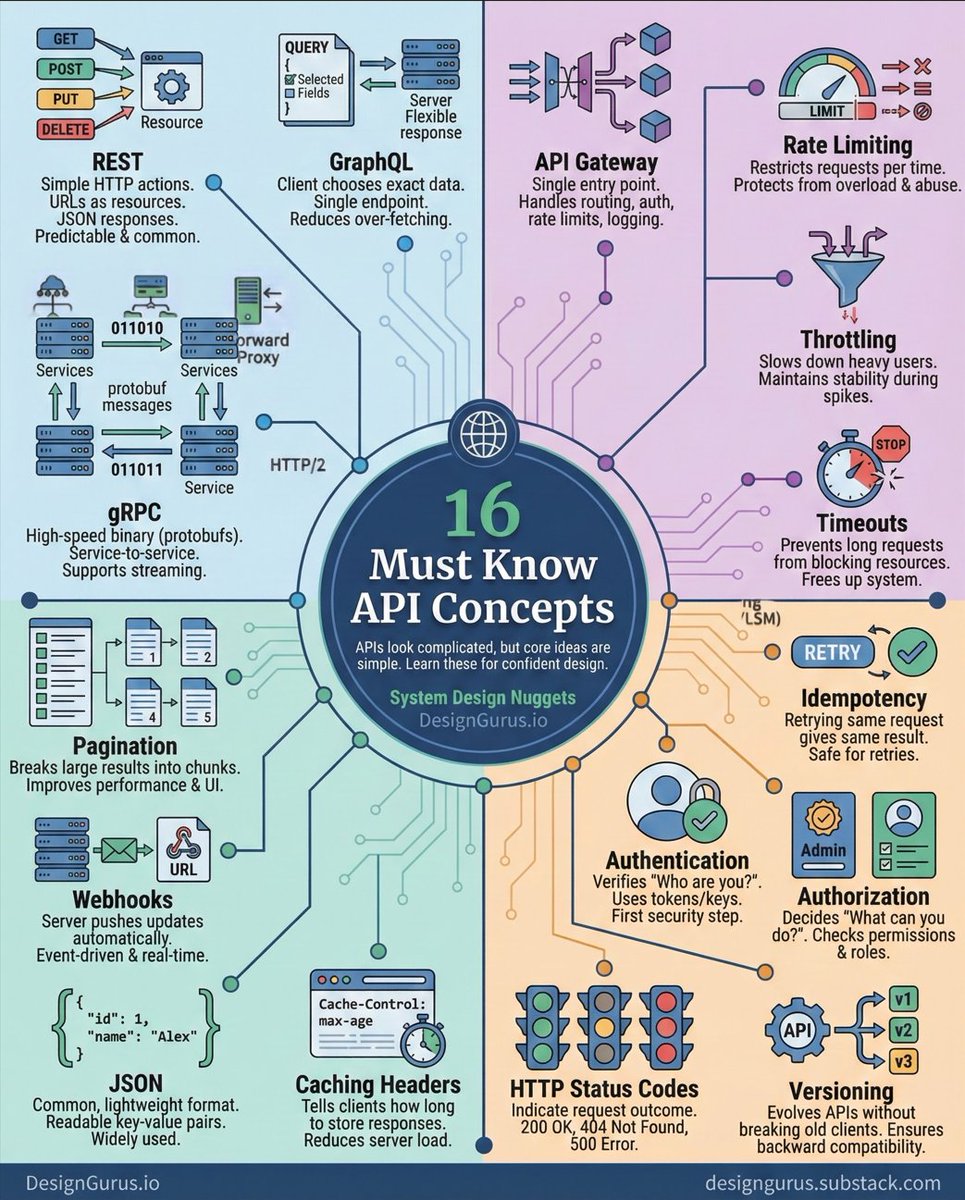
𝟭𝟲 𝗔𝗣𝗜 𝗖𝗼𝗻𝗰𝗲𝗽𝘁𝘀 𝘁𝗵𝗮𝘁 𝘀𝗲𝗽𝗮𝗿𝗮𝘁𝗲 𝗝𝘂𝗻𝗶𝗼𝗿𝘀 𝗳𝗿𝗼𝗺 𝗦𝗲𝗻𝗶𝗼𝗿𝘀.
Most engineers just know "GET" and "POST." Senior engineers know Idempotency and Throttling.
Here is the 2026 Cheat Sheet for modern APIs. I’ve broken the 16 concepts into 4 mental buckets:
𝟭. 𝗧𝗵𝗲 𝗖𝗼𝗺𝗺𝘂𝗻𝗶𝗰𝗮𝘁𝗶𝗼𝗻 𝗦𝘁𝘆𝗹𝗲𝘀 (𝗧𝗵𝗲 "𝗛𝗼𝘄")
• REST: The classic. Simple HTTP actions (GET, POST, DELETE).
• GraphQL: The flexible one. The client asks for exactly what it wants. Great for mobile.
• gRPC: The speed demon. Uses binary protobufs for ultra-fast microservice talk.
• Webhooks: Don't call us, we'll call you. The server pushes updates automatically.
𝟮. 𝗧𝗵𝗲 𝗧𝗿𝗮𝗳𝗳𝗶𝗰 𝗖𝗼𝗽𝘀 (𝗧𝗵𝗲 "𝗖𝗼𝗻𝘁𝗿𝗼𝗹")
• API Gateway: The single front door for all requests. Handles auth, routing, and logging.
• Rate Limiting: Stops abuse by blocking users who send too many requests.
• Throttling: Slows down heavy users instead of blocking them. A gentler approach.
𝟯. 𝗧𝗵𝗲 "𝗠𝗮𝗸𝗲 𝗶𝘁 𝗦𝗮𝗳𝗲 & 𝗙𝗮𝘀𝘁" 𝗕𝘂𝗰𝗸𝗲𝘁
• Idempotency: Safely retrying a request (like payment) without causing duplicate actions.
• Caching Headers: Telling the browser to store data locally so it loads instantly next time.
• Timeouts: Preventing a slow database from hanging your entire system forever.
• Pagination: Breaking 50,000 results into manageable pages of 20.
𝟰. 𝗧𝗵𝗲 𝗙𝗼𝘂𝗻𝗱𝗮𝘁𝗶𝗼𝗻𝗮𝗹 𝗕𝗮𝘀𝗶𝗰𝘀
• AuthN vs. AuthZ: Authentication is "Who are you?". Authorization is "What are you allowed to do?".
• Versioning: Evolving your API (v1 -> v2) without breaking old apps.
• JSON: The standard, easy-to-read format for API responses.
• HTTP Status Codes: The universal language for success (200) or failure (404, 500).
System design is about knowing which tool to use for which problem.
I cover all 16 concepts in the full guide.
𝗥𝗲𝗮𝗱 𝗶𝘁 𝗵𝗲𝗿𝗲: https://t.co/gkLUik4q9N
♻️ 𝗥𝗲𝗽𝗼𝘀𝘁 to save a developer from failing an interview.
#SystemDesign #SoftwareEngineering #APIDesign #Backend #TechCareers
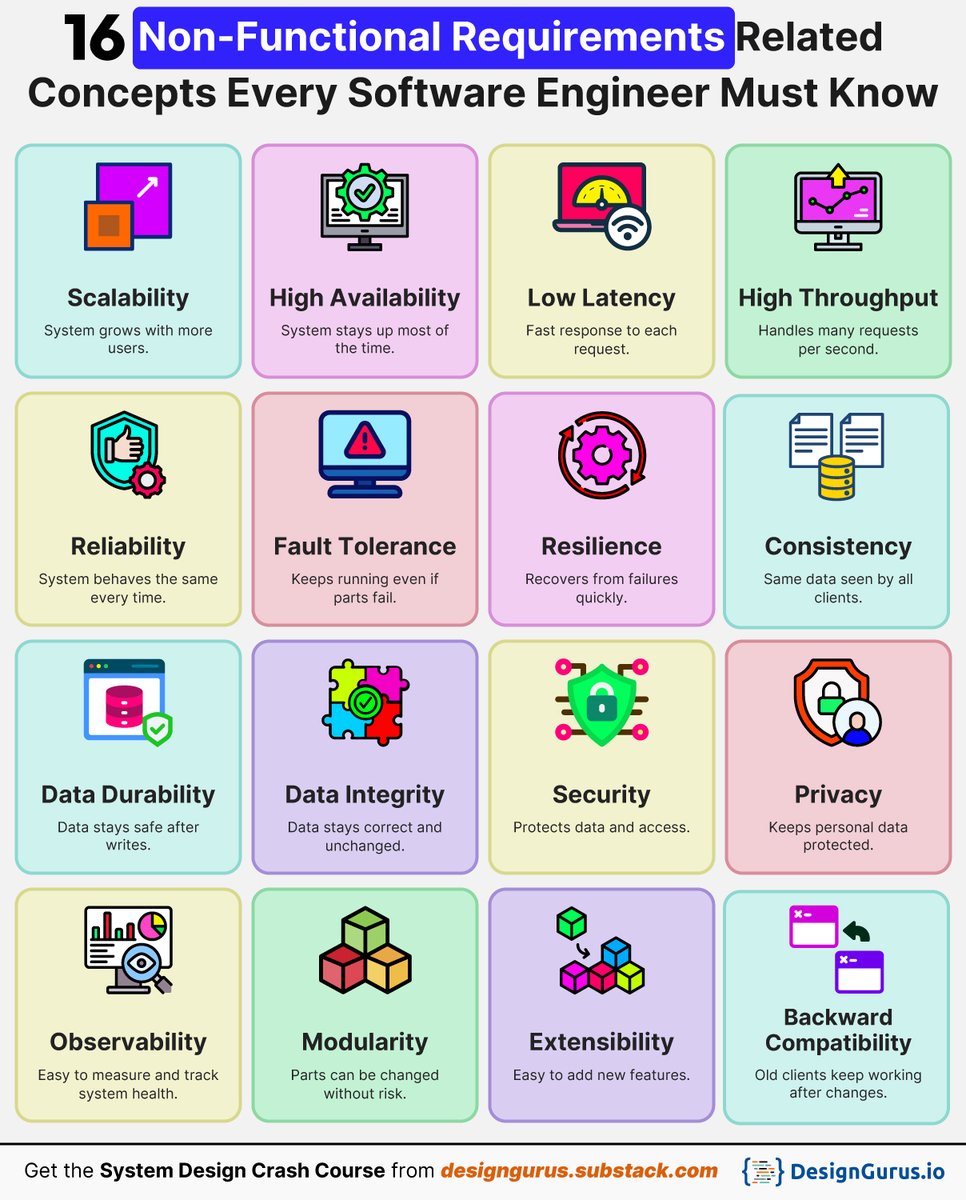
𝟏𝟔 𝐍𝐨𝐧-𝐅𝐮𝐧𝐜𝐭𝐢𝐨𝐧𝐚𝐥 𝐑𝐞𝐪𝐮𝐢𝐫𝐞𝐦𝐞𝐧𝐭𝐬 𝐑𝐞𝐥𝐚𝐭𝐞𝐝 𝐂𝐨𝐧𝐜𝐞𝐩𝐭𝐬 𝐄𝐯𝐞𝐫𝐲 𝐒𝐨𝐟𝐭𝐰𝐚𝐫𝐞 𝐄𝐧𝐠𝐢𝐧𝐞𝐞𝐫 𝐌𝐮𝐬𝐭 𝐊𝐧𝐨𝐰
Join by Substack to read more: https://t.co/myTagYrrR9
1. Scalability: System grows with more users.
2. High Availability: System stays up most of the time.
3. Low Latency: Fast response to each request.
4. High Throughput: Handles many requests per second.
5. Reliability: System behaves the same every time.
6. Fault Tolerance: Keeps running even if parts fail.
7. Resilience: Recovers from failures quickly.
8. Consistency: Same data seen by all clients.
9. Data Durability: Data stays safe after writes.
10. Data Integrity: Data stays correct and unchanged.
11. Security: Protects data and access.
12. Privacy: Keeps personal data protected.
13. Observability: Easy to measure and track system health.
14. Modularity: Parts can be changed without risk.
15. Extensibility: Easy to add new features.
16. Backward Compatibility: Old clients keep working after changes.
Join by Substack to read more: https://t.co/myTagYrrR9
𝟏𝟔 𝐌𝐮𝐬𝐭 𝐊𝐧𝐨𝐰 𝐀𝐏𝐈 𝐂𝐨𝐧𝐜𝐞𝐩𝐭𝐬 𝐟𝐨𝐫 𝐒𝐨𝐟𝐭𝐰𝐚𝐫𝐞 𝐄𝐧𝐠𝐢𝐧𝐞𝐞𝐫𝐬
Understand 16 essential API fundamentals with clear explanations and quick examples to help you build better backend systems and ace interviews.
Read the full post at https://t.co/gkLUik4XZl
#API #systemdesign #REST #grpagql
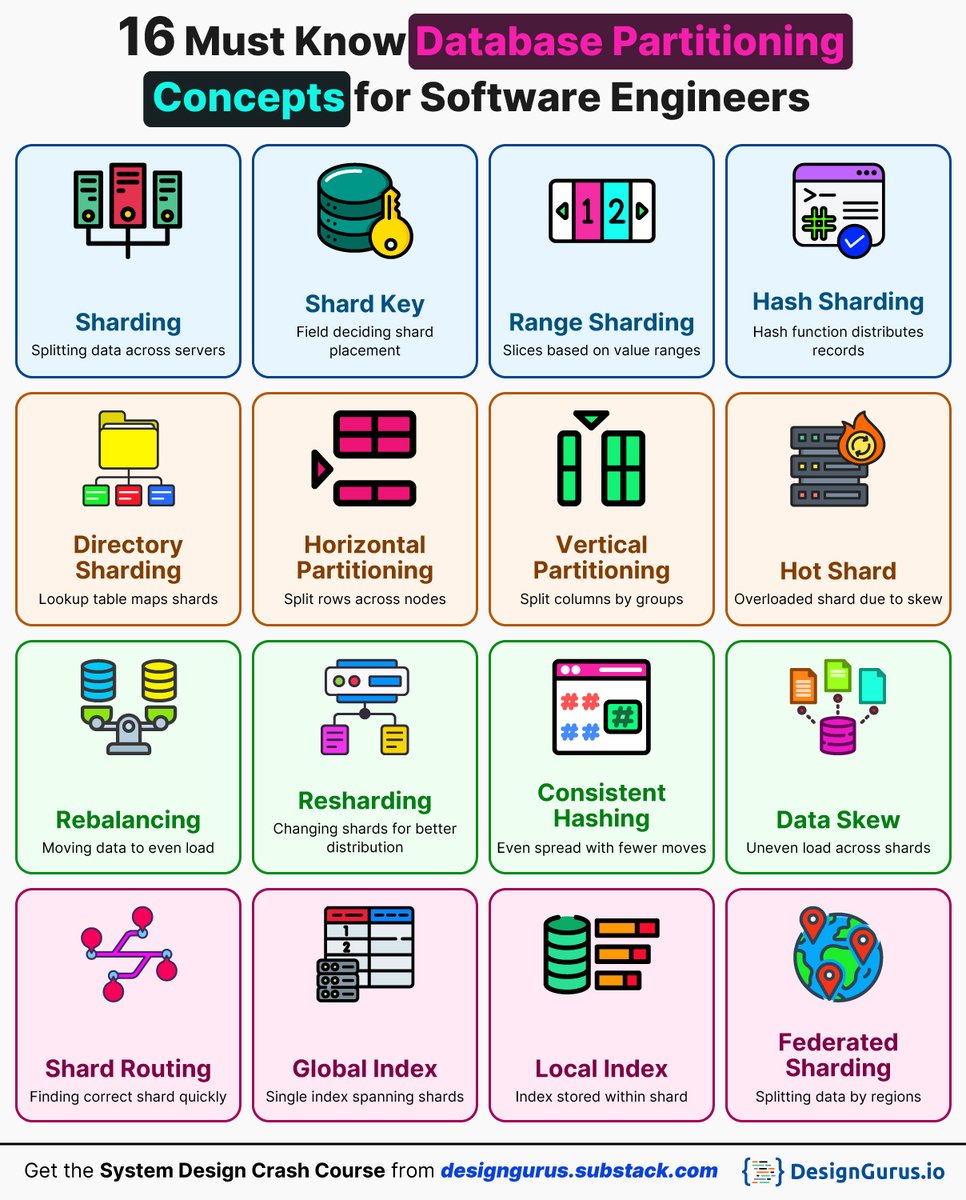
𝟏𝟔 𝐃𝐚𝐭𝐚𝐛𝐚𝐬𝐞 𝐏𝐚𝐫𝐭𝐢𝐭𝐢𝐨𝐧𝐢𝐧𝐠 𝐂𝐨𝐧𝐜𝐞𝐩𝐭𝐬 𝐄𝐯𝐞𝐫𝐲 𝐒𝐨𝐟𝐭𝐰𝐚𝐫𝐞 𝐄𝐧𝐠𝐢𝐧𝐞𝐞𝐫 𝐌𝐮𝐬𝐭 𝐊𝐧𝐨𝐰
Learn these database partitioning concepts before your next system design interview: https://t.co/auQW65KWOW
Sharding. Splitting data across servers
Shard Key. Field deciding shard placement
Range Sharding. Slices based on value ranges
Hash Sharding. Hash function distributes records
Directory Sharding. Lookup table maps shards
Horizontal Partitioning. Split rows across nodes
Vertical Partitioning. Split columns by groups
Hot Shard. Overloaded shard due to skew
Rebalancing. Moving data to even load
Resharding. Changing shards for better distribution
Consistent Hashing. Even spread with fewer moves
Data Skew. Uneven load across shards
Shard Routing. Finding correct shard quickly
Global Index. Single index spanning shards
Local Index. Index stored within shard
Federated Sharding: Splitting data by regions
Read full article: https://t.co/auQW65KWOW
#database #systemdesign #interview
𝐇𝐨𝐰 𝐝𝐨 𝐭𝐞𝐜𝐡 𝐠𝐢𝐚𝐧𝐭𝐬 𝐤𝐞𝐞𝐩 𝐭𝐡𝐞𝐢𝐫 𝐚𝐩𝐩𝐬 𝐫𝐮𝐧𝐧𝐢𝐧𝐠 𝟐𝟒/𝟕 — 𝐞𝐯𝐞𝐧 𝐰𝐡𝐞𝐧 𝐭𝐡𝐢𝐧𝐠𝐬 𝐛𝐫𝐞𝐚𝐤?
From Netflix to Amazon, reliability isn’t an accident — it’s engineered.
In our latest blog, we break down 8 techniques for building reliable distributed systems that never go down (well, almost never):
-> Redundancy & Replication
-> Load Balancing
->Fault Isolation
-> Self-Healing & Monitoring
-> Timeouts & Retries
-> Circuit Breakers
-> Chaos Engineering
-> Backup & Disaster Recovery
If you design systems that millions depend on — or you’re preparing for a system design interview — this is a must-read.
👉 Read the full article: https://t.co/yhJ0855R1n
🔹Grokking System Design Interview - https://t.co/ddgSvk7kqC
𝐄𝐯𝐞𝐧𝐭-𝐃𝐫𝐢𝐯𝐞𝐧 𝐯𝐬 𝐑𝐞𝐪𝐮𝐞𝐬𝐭-𝐃𝐫𝐢𝐯𝐞𝐧 𝐀𝐫𝐜𝐡𝐢𝐭𝐞𝐜𝐭𝐮𝐫𝐞
When you hit “Buy Now,” should your app wait for each service to respond, or just publish an event and move on?
That’s the key difference between 𝐑𝐞𝐪𝐮𝐞𝐬𝐭-𝐃𝐫𝐢𝐯𝐞𝐧 (𝐬𝐲𝐧𝐜𝐡𝐫𝐨𝐧𝐨𝐮𝐬) and 𝐄𝐯𝐞𝐧𝐭-𝐃𝐫𝐢𝐯𝐞𝐧 (𝐚𝐬𝐲𝐧𝐜𝐡𝐫𝐨𝐧𝐨𝐮𝐬) systems.
In this blog, we break down:
✅ How each architecture works
✅ Real-world pros and cons
✅ When to mix both for scalability
💡 Perfect for engineers mastering system design interviews.
👉 Read now on https://t.co/FfXtzrMwfi
#SystemDesign #Scalability #Architecture #FAANGPrep
𝐒𝐲𝐬𝐭𝐞𝐦 𝐃𝐞𝐬𝐢𝐠𝐧 𝐂𝐫𝐚𝐬𝐡 𝐂𝐨𝐮𝐫𝐬𝐞
I’ve interviewed hundreds of engineers, and I can tell you this: 𝐬𝐲𝐬𝐭𝐞𝐦 𝐝𝐞𝐬𝐢𝐠𝐧 𝐝𝐨𝐞𝐬𝐧’𝐭 𝐭𝐞𝐬𝐭 𝐦𝐞𝐦𝐨𝐫𝐲; 𝐢𝐭 𝐭𝐞𝐬𝐭𝐬 𝐜𝐥𝐚𝐫𝐢𝐭𝐲 𝐨𝐟 𝐭𝐡𝐨𝐮𝐠𝐡𝐭.
Most candidates guess. The great ones understand why systems scale, cache, replicate, and fail gracefully.
I have also realized that most developers make system design way harder than it needs to be.
𝐘𝐨𝐮 𝐝𝐨𝐧’𝐭 𝐧𝐞𝐞𝐝 𝟏𝟎𝟎 𝐡𝐨𝐮𝐫𝐬 𝐨𝐟 𝐘𝐨𝐮𝐓𝐮𝐛𝐞 𝐭𝐮𝐭𝐨𝐫𝐢𝐚𝐥𝐬.
You just need to understand fundamental concepts, load balancing, caching, sharding, CAP theorem, scalability, and more, explained clearly.
That’s exactly what I've covered in our System Design Crash Course, containing 20 core concepts that you can learn within an hour.
Whether you’re interviewing at FAANG or designing your next product, these principles will change how you think about systems.
🚀 Learn the fundamentals that top engineers use every day: 𝐒𝐲𝐬𝐭𝐞𝐦 𝐃𝐞𝐬𝐢𝐠𝐧 𝐂𝐫𝐚𝐬𝐡 𝐂𝐨𝐮𝐫𝐬𝐞: https://t.co/kndDDemLRk
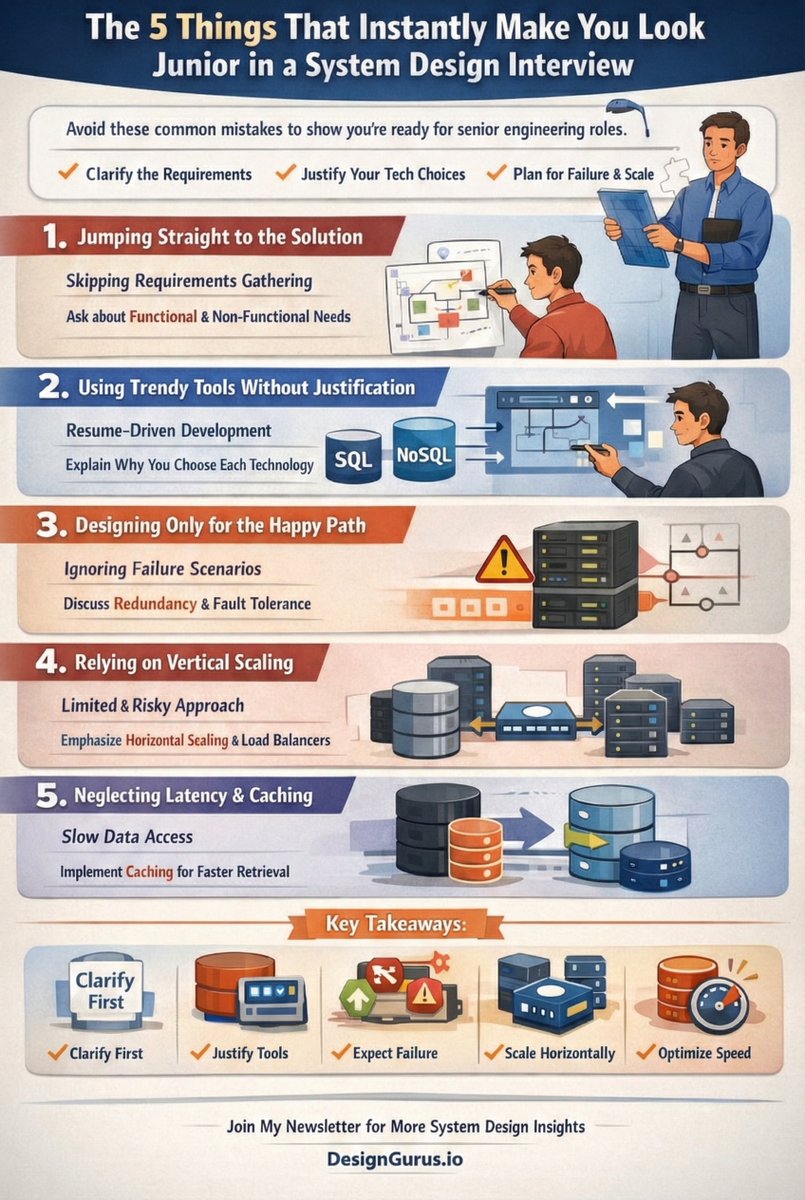
𝐓𝐡𝐞 𝟕 𝐃𝐞𝐚𝐝𝐥𝐲 𝐒𝐢𝐧𝐬 𝐨𝐟 𝐒𝐲𝐬𝐭𝐞𝐦 𝐃𝐞𝐬𝐢𝐠𝐧 𝐈𝐧𝐭𝐞𝐫𝐯𝐢𝐞𝐰𝐬 (𝐚𝐧𝐝 𝐇𝐨𝐰 𝐭𝐨 𝐀𝐯𝐨𝐢𝐝 𝐓𝐡𝐞𝐦 𝐋𝐢𝐤𝐞 𝐚 𝐏𝐫𝐨)
Ever freeze when you hear: “Design Twitter”?
You’re not alone. Most engineers walk into system design interviews with strong coding skills — but weak design instincts.
In our new blog, we break down the 7 common mistakes that make interviewers silently write “lacks structured thinking” — and how to avoid them:
❌ Starting with databases, not users
❌ Overengineering everything
❌ Ignoring bottlenecks and metrics
❌ Forgetting the “why” behind choices
❌ Talking in fragments, not flows
❌ Skipping trade-offs
❌ Not practicing out loud
Turn each sin into a strength and think like a real system architect.
Learn how to reason about trade-offs, scalability, and real-world constraints.
👉 Read the full breakdown: https://t.co/VtfQQFMA2b
#SystemDesign #Interviews #FAANG #CareerGrowth #DesignGurus.IO
𝐒𝐜𝐚𝐥𝐢𝐧𝐠 𝐖𝐫𝐢𝐭𝐞𝐬: 𝐓𝐡𝐞 𝐇𝐚𝐫𝐝𝐞𝐬𝐭 𝐏𝐫𝐨𝐛𝐥𝐞𝐦 𝐢𝐧 𝐒𝐲𝐬𝐭𝐞𝐦 𝐃𝐞𝐬𝐢𝐠𝐧 𝐈𝐧𝐭𝐞𝐫𝐯𝐢𝐞𝐰𝐬
Everyone adds read replicas to scale reads — but what about writes?
In our latest blog, we break down four proven patterns to handle write-heavy workloads that can crush your database under load:
1️⃣ 𝐕𝐞𝐫𝐭𝐢𝐜𝐚𝐥 𝐒𝐜𝐚𝐥𝐢𝐧𝐠 & 𝐎𝐩𝐭𝐢𝐦𝐢𝐳𝐚𝐭𝐢𝐨𝐧 — Bigger machines, smarter configs.
2️⃣ 𝐒𝐡𝐚𝐫𝐝𝐢𝐧𝐠 & 𝐏𝐚𝐫𝐭𝐢𝐭𝐢𝐨𝐧𝐢𝐧𝐠 — Split the load across many databases.
3️⃣ 𝐐𝐮𝐞𝐮𝐢𝐧𝐠 & 𝐋𝐨𝐚𝐝 𝐒𝐡𝐞𝐝𝐝𝐢𝐧𝐠 — Smooth out traffic spikes.
4️⃣ 𝐁𝐚𝐭𝐜𝐡𝐢𝐧𝐠 & 𝐀𝐠𝐠𝐫𝐞𝐠𝐚𝐭𝐢𝐨𝐧 — Write more efficiently, less frequently.
Discover when to use each and how to combine them for maximum scalability and effectiveness.
🔗 Read now on https://t.co/gz2DdZxr6z
#SystemDesign #DatabaseScaling #Engineering #FAANGInterviews
𝐓𝐡𝐞 𝐅𝐨𝐫𝐠𝐨𝐭𝐭𝐞𝐧 𝐒𝐤𝐢𝐥𝐥 𝐢𝐧 𝐒𝐲𝐬𝐭𝐞𝐦 𝐃𝐞𝐬𝐢𝐠𝐧 𝐈𝐧𝐭𝐞𝐫𝐯𝐢𝐞𝐰𝐬
Most candidates focus on diagrams.
The best ones 𝐟𝐨𝐜𝐮𝐬 𝐨𝐧 𝐭𝐫𝐚𝐝𝐞-𝐨𝐟𝐟𝐬.
It’s not “SQL vs NoSQL.”
💡It’s: What consistency do you sacrifice to gain scale?
It’s not “Cache vs DB.”
💡It’s: Where do you tolerate staleness?
It’s not “Microservices or Monolith.”
💡It’s: Where do you draw the fault lines of ownership?
It’s not “Push vs Pull Architecture.”
💡It’s: Who controls the pace — producer or consumer?
It’s not “Availability vs Consistency.”
💡It’s: Which user experience are you willing to compromise?
It’s not “Primary-Secondary vs Multi-Primary.”
💡It’s: What’s worse: stale reads or write conflicts?
Great system design isn’t about answers — it’s about awareness.
💬 What’s one trade-off you’ve painfully learned the hard way?
👉 Grokking the System Design Interview: https://t.co/ddgSvk7kqC
👉 Grokking the Advanced System Design Interview: https://t.co/VNVkQM62mz
#SystemDesign #TechInterviews #EngineeringWisdom #DesignGurus.io
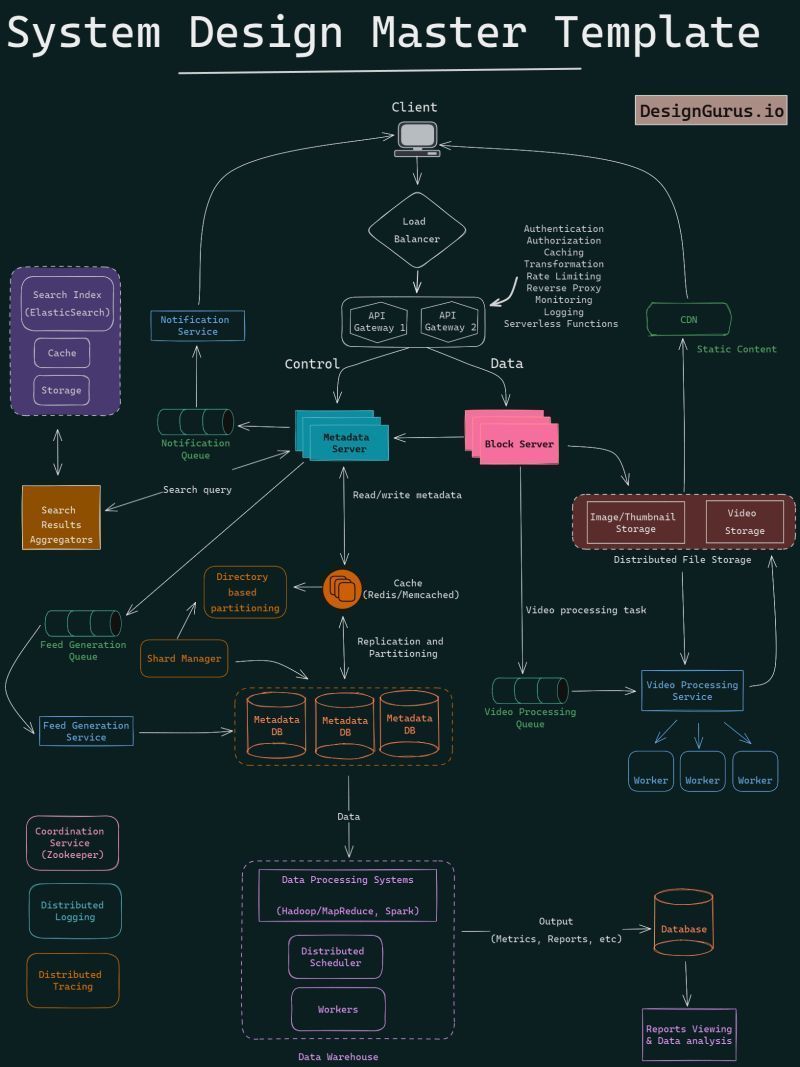
𝟗𝟓% 𝐨𝐟 𝐞𝐧𝐠𝐢𝐧𝐞𝐞𝐫𝐬 𝐟𝐚𝐢𝐥 𝐬𝐲𝐬𝐭𝐞𝐦 𝐝𝐞𝐬𝐢𝐠𝐧 𝐢𝐧𝐭𝐞𝐫𝐯𝐢𝐞𝐰𝐬 — not because they lack knowledge, but because they lack structure.
At https://t.co/NBz4pvxJYj, I’ve built the 𝐒𝐲𝐬𝐭𝐞𝐦 𝐃𝐞𝐬𝐢𝐠𝐧 𝐌𝐚𝐬𝐭𝐞𝐫 𝐓𝐞𝐦𝐩𝐥𝐚𝐭𝐞 — a universal blueprint that helps you answer any design question calmly and confidently.
It simplifies everything into 3 flows:
1️⃣ Control Flow – How requests move
2️⃣ Data Flow – How data moves
3️⃣ Coordination Flow – How services talk
Once you think in terms of flows, not features, system design becomes easier.
Read the full framework and learn how to master system design:
👉 Download the System Design Master Template: https://t.co/RoAEcAE0WO
FAANG Interviews in 2025: What Changed, What to Study, and How to Win
Google, Meta, Amazon in 2025:
--> Higher bar,
--> System design at L4,
--> AI in interviews,
--> Behavioral interview is a deal breaker.
Read the full article: https://t.co/NQNfIFGAs4
#designgurus #systemedesign #codinginterview