The most important briefings of the day.
Karl Deisseroth, professor of bioengineering and of psychiatry and behavioral sciences, shares the news of his Nobel Prize with his kids.
I evaluate AI in health for a living. At home, on the Upper West Side with two teenage daughters, I am stubbornly analog. Paper grocery pad. Lights on a radio remote that never touches the internet.
And yet, over the last six months, a few AI tricks have been sneaking in to replace some of the unpaid work of running my family.
The Economics of AI in an Analog Household https://t.co/ClSXUto0Uj
I'd like to share one of my favorite stories about a discovery we made at @LilaSciences.
We’ve been working for a while on catalysts for clean hydrogen. One day, our AI proposed chemistry that a scientist who’d studied this exact reaction for 12 years thought had to be wrong.
That composition became our strongest lead, sustaining more than 1,000 hours of oxygen evolution with little loss of catalytic performance.
The scientist is John Gregoire (known as JG to us), who left his Caltech research professorship to become our Chief Autonomous Science Officer, and has been working to build some of the world's most sophisticated automated labs at Lila.
Making clean hydrogen from water requires electricity to drive two reactions: one produces hydrogen, the other oxygen. The oxygen-producing half, the oxygen evolution reaction (OER), is particularly difficult.
In proton-exchange-membrane electrolyzers, the catalyst must drive that reaction efficiently while exposed to strong acid and high voltage. Most materials either corrode or require too much energy to serve as an effective catalyst. Iridium oxide is the industry standard, but iridium is one of the rarest metals on Earth. Depending on it creates a supply constraint on scaling this technology.
JG’s former group at Caltech spent 12 years exploring catalysts for this reaction. He knows how unforgiving these conditions are.
Early in this project, the scientists checked the AI’s suggestions closely, occasionally overruling them. The choices were mostly familiar and sensible. As the experiments progressed, the team stepped back, retaining safety review while letting the system choose what to try.
By the second campaign, which took just four weeks, it was producing results they hadn’t expected.
The system had started exploring palladium-based oxides. When JG and Rafael Gómez-Bombarelli, our physical sciences CSO and an MIT professor, saw the results, they thought the model had gone astray. These were combinations that JG would have told his grad students weren't even worth testing.
But the measurements were promising, so the team kept testing.
Across 2,942 catalysts spanning 53 material systems and 26 elements, the platform uncovered an unexpected family of palladium-based oxides with a promising combination of activity and durability. It screened around 240 catalysts a week, an order of magnitude faster than a standard lab by our team’s estimate.
The best contained tiny additions of indium and manganese, together accounting for about 0.09% of its metal atoms.
At 10 mA/cm² in 1 M sulfuric acid, it maintained an overpotential below 0.5 V for more than 1,000 hours and retained 96% of its palladium. Unmodified palladium oxide crossed that voltage threshold after only 200 hours.
Under the microscope, the team saw a needle-like structure that developed during operation and appears to be associated with the improved durability. We’re still working to understand exactly why it works.
Palladium is also a precious metal, but its supply base is much larger than iridium’s. These catalysts contain neither iridium nor ruthenium, potentially giving us another option.
Giving the AI control over which experiments to run was decisive. The system combined predictive models that learned from our experimental data with LLM reasoning that helped decide where to search next. It could pursue chemistry our scientists would have passed over, have the lab make and test it, and use the measurements to choose its next experiments. Each round of results changed where it looked next.
More than 90% of the screening workflow was automated, with scientists providing oversight and transferring samples between instruments.
These are laboratory results. There’s still substantial work ahead to establish performance under industrial conditions.
People ask when AI and automated labs will start accelerating science. For us, it’s already changing what gets tested and how quickly we learn.
We can make hundreds of materials a week, test them, and use the results to decide what to try next, including ideas our own experts would have passed over.
I want a lot more of this: AI helping us discover things we can actually use to make the world better.
Full story and preprint below 👇
Important to hear from @abe_verghese today that the most important thing we need to protect is the time between those who care for patients and those who are suffering.
This is the guiding principle.
"I am passing the mic to someone who saved my life."
And quite honestly, there are so many of you out there that donated in the past to the Jimmy Fund Telethon that I will never get a chance to meet or thank.
Ten years ago, I didn’t know how much time I had.
Today, I know just how precious that time is.
Cancer research and clinical trials have given me something I will never take for granted, more time.
Time to watch my four daughters grow up. Time to celebrate milestones we once weren’t sure I’d see. Time to become “Pop” to my grandson Charlie. ❤️
That’s why moments like this and @TheJimmyFund Telethon mean so much to me.
Behind every breakthrough is a researcher who had an idea, a doctor who refused to give up, a patient willing to try, and a donor who made the work possible.
I’m incredibly grateful to @DanaFarber, @DrChoueiri, my family, and everyone who has helped give me these years.
But there are still patients waiting for their breakthrough.
More time. More memories. More tomorrows.
They don’t happen without all of you.
And we still have work to do. ❤️
Let's Break a New Fundraising Record Tonight!
https://t.co/xQfsogfYey
But more importantly, THANK YOU!!
#KCANCER
https://t.co/dJMeKvj1KR
rare disease patients are a leading indicator of what medicine could become.
out of necessity, they have quietly prototyped the system we all want by:
- solving multi-specialist interop
- tracking symptoms and biometrics longitudinally
- bridging that gap between clinicians and scientists
- contributing data to accelerate discovery
- turning their own care into a learning engine for the n+1 patient
now it's our turn to scale it
“Every birthday since my cancer diagnosis in 2015 has taken on new meaning. It’s a reminder that behind every research breakthrough is a patient like me, who has been given more time, more memories, and more milestones." – Chuck, 59, a @DanaFarber patient
Donate now to support cancer care and research for patients like Chuck: https://t.co/SCuTNOSc1s
Oncology lost a hero recently and I missed it.
A quarter of a century ago, Maura Gillison saw an epidemic coming. She was the first to see that HPV was causing a lot of head and neck cancer cases.
At the time head-and-neck cancer -- we really mean cancer of the throat here -- was a disease people mostly got in old age because of risk factors like smoking and drinking, which damaged the cells that line the throat. But Gillison published a paper in 2000 showing that a quarter of head and neck tumors were positive for HPV.
"She totally changed our understanding of the etiology of head and neck cancer and demonstrated that one person can make a difference," the oncologist Otis Brawley told @TheCancerLetter.
This was not a small thing. Over the past two decades, HPV head and neck cancer went from being a blip to a common occurrence. CDC estimates now put the annual number of cases in the U.S. at 19,000 and growing. Changing sexual habits -- namely oral sex with more partners -- are the most likely reason. The condition affects men more than women.
Recently we had news that the HPV vaccine has eliminated cervical cancer deaths in women aged 20 to 24 in the U.K. But the FDA label also indicates that the HPV vaccine, Gardasil, is approved to prevent head and neck cancer. That was something Gillison fought for.
Here are some links for Maura Gillison.
.@GrantWahl Should Be Covering this World Cup
The 2026 World Cup has no public health command. The Ebola outbreak has reached 350 cases. And the journalist who would have asked the hardest questions isn’t here.
https://t.co/wxomk4wT4D
Congratulations to Dr. @dmljmd, longtime volunteer leader and cherished champion of healthier lives, on receiving the @American_Heart Gold Heart Award. Through decades of service and groundbreaking population science expertise, Don's leadership helped define ideal cardiovascular health and shape how the world understands, measures, and improves heart health. His extraordinary contributions have advanced our mission and improved countless lives.
Learn more about his remarkable impact: https://t.co/5qlpuLOgLL
Recently came across some notes I jotted down during intern orientation 5 years ago from the legendary Dr. Loscalzo and Dr. Marshall Wolf
As I begin the year as @BrighamMedRes Chief Resident, these lessons feel just as relevant today!
There has ALREADY been a lot written about NYU @openevidence@UpToDate Expert AI study but wanted to give my perspective as what counts for an "expert" in human-computer interaction these days. Especially when I see Twitter debates about item response theory. 🤣
A 🧵⬇️
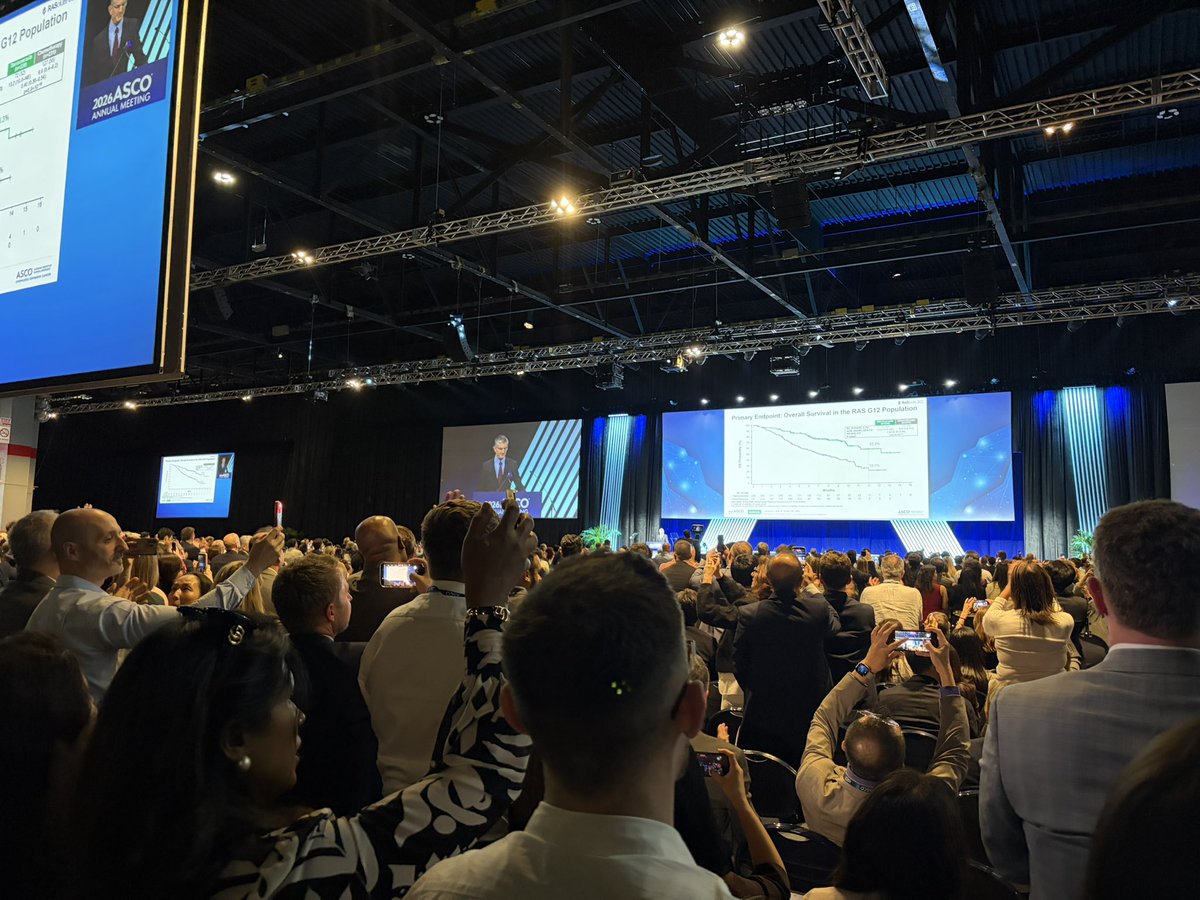
This standing ovation totally brought me to tears.
On Thursday, my dad (stage 4 pancreatic cancer) started a Revolution Medicine trial building upon these results — RMC 5127, which uses the drug celebrated here, Daraxonrasib, with another drug targeting his specific KRAS mutation, G12V.
He’s nearly 2 years into his fight with pancreatic cancer and we have personally felt the impact of this watershed moment. It is a lifeline.
To the incredible, stalwart, brilliant researchers and folks bringing these discoveries to life - thank you. Thank you thank you thank you.
I'm very excited to share that I will be joining @Amgen, overseeing cardiometabolic research and human genetics, starting Aug 3!
I am excited to shape target identification, biology, and drug discovery as the therapeutic area head for cardiovascular disease, obesity, and general medicine. And I will lead the human genetics efforts, spanning Amgen deCODE genetics (a subsidiary of Amgen), that drive target discovery and biology across all therapeutic areas.
I have been incredibly fortunate to interface with truly remarkable individuals and culture across @MassGenBrigham, @broadinstitute, and @harvardmed, where I could not have asked for a more meaningful and enjoyable academic career.
Being able to build on my prior work, discover and clarify therapeutic hypotheses, and now carry them through to medicines that reach millions is an opportunity I'm grateful for. I'm very excited for what comes next.
Incredible #ASCO26 moment.
Dr. Brian Wolpin, presenter of the daraxonrasib study, received a standing ovation DURING his talk after he stated the survival benefit for PDAC patients. It was sustained. Cheering. I have never see anything like it in the middle of a talk. $RVMD
Think of the hundreds of hours each doctor will spend on online ethics training courses. Now, invest for our future a few minutes filling out the survey developed by the team lead by @payal_chandak to inform AI (and human) clinicians of the range of principlist values in clinical decision making. More international response will also help identify regional variation. Just go to https://t.co/KIryQ6OIQs and get involved