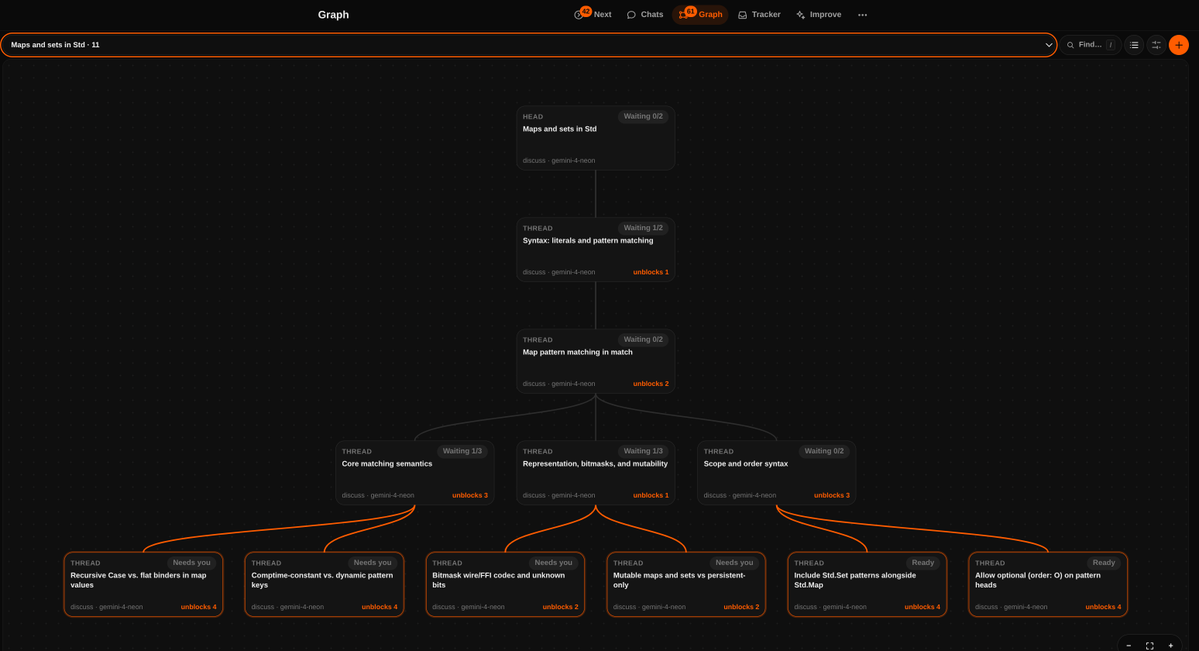
In the context of AI prompts and agents, tree visualizations turn linear prompt chains into hierarchical diagrams. The root is the main goal. Branches represent sub-prompts, decision points, refinements, or alternative paths. You see the full structure, flow, and dependencies at a glance instead of scrolling through walls of text. Makes complex agent workflows much easier to understand, edit, and iterate.
@valigo@xakpc Researches about using ensembles of stupid models with great harness that can outperform smart models are popping here and there periodically.
I like where it’s going, because most of the times people prefer cutting costs over quality.
After 10 years of extensive debates type inference proposal was accepted.
At this rate, in another 10 years, hopefully, Go will get proper pattern matching.
@HSVSphere@neogoose_btw Untill impl FnOnce is stabilized for user types, I do custom DropGuard with custom
trait OnDrop<S> {
fn on_drop(self, val: S)
}
@OmarAbcXyz123 I don't know how people could not understand this would never work and won't gain any adoption. It's not high level abstract math or quantum physics, it's very simple — this is not integratable with huge ecosystem of products we have now.
@eeuoss@abdimoalim_ We talk about same things using different languages. This conversation quickly converges to conclusion that functionally they are equivalent (which is true), matter of personal preferences at the end of the day.
@eeuoss@abdimoalim_ “Defer is trivially emulatable with a scope guard pattern” someone once said “if we think long enough, maybe we’ll convince ourselves that they are the same”
@eeuoss@abdimoalim_ But with automatic destructors you need to "hook" in the flow to redirect destruction when you actually needed it.
Or at least to research specific object documentation and probably source code to understand how it manages own lifetime.
@eeuoss@abdimoalim_ I would frame it the other way around :)
If your object HAPPENS to have tricky lifetime — it will be more obvious with defer (because it'll be absent and linter will complain). And if it has predictable simple lifetime (usually current scope) — it's a bit more verbose than RAII.