The search to define a Chinese order is raising questions beyond liberal political theory. Jiang Shigong has offered a new vision of the question of political space–pointing towards the reconstruction of world empire. My latest for @palladiummag: https://t.co/NNVt7Z5B7o
Gonna be a long rant. am extremely fed up with being a China researcher in the so-called "western world" and its academia. This started years ago when I was still writing my PhD, but I am at a tipping point. I just hope I can go to Nanjing next year to carve seals in small stand.
Amodei's last essay feels like an odd artifact. Has the same sensibility as a patriotic 18th-century technician talking about the grandeur that industrial technology will bring to this or that European dynasty.
@etscrivner I've heard someone suggest it's better to think of constraints than patterns. Constraints are more concrete things and you can meaningfully ask what you get out of following them.
Reading Hobbes and then reading Locke is like going from fine whiskey to hypersaturated sweet tea. It honestly feels like you’re reading something written for children.
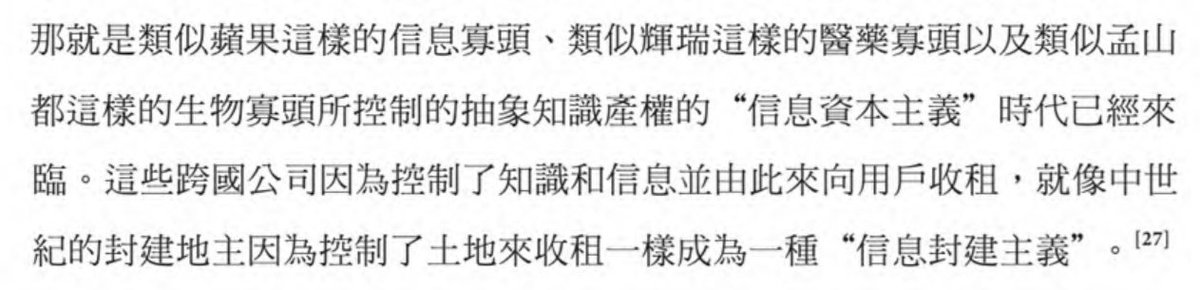
(Tbf, "technofeudalism" per people like Varoufakis is not really the same thing as Drahos and Braithwaite's "information feudalism" which was making a more rigorous point about IP rentierism in an international trade context, which is what Jiang is talking about here)
Also came across this unexpectedly in Jiang Shigong's book on World Empire where he invokes "information feudalism", citing Drahos and Braithwaite, though fortunately only in passing and apparently without treating it as postcapitalist. A rare miss either way?
This is still one of my favorite papers, since it takes a stand against the intellectual shortcuts that have become so popular lately. It has been far too easy for people on both the left and the right to claim that capitalism is over and that we have somehow slipped back into++
@1hilltracker Yeah about 400 pages long at that. I've been working thru the chapter on trade wars where so far he's managed to go from the origins of the British Empire through jealousy of trade, American federalism, origins of US hegemony, GATT, up to the transition to IP rentierism
@1hilltracker Jiang Shigong has a long section in his World Empire book about the emergence of IP rights as a tool of US economic hegemony from 1980 on, which I happened to be reading over the last week lol
@Aristocles69183 I emailed them about an error some years back when I was an active Latin Wiktionary contributor and they actually replied and corrected their online edition so I can't really fault them lol
There's a broader pop historiography about Mao in the West that presents him as an illiterate peasant cult leader, which also has no particular basis in reality. He was a college librarian and studied both Chinese classics and modern European philosophy.
One of the odder persistent misunderstandings of Mao. The basic idea of the Great Leap Forward was hyperrapid industrialisation. Even the rustication of youths was partly about the countryside being a new developmental frontier (and using it to solve urban unemployment).
Chiang had visions of China as an industrial superpower, Mao envisioned an egalitarian agrarian utopia.
"One can imagine Chiang Kai-shek's ghost wandering around China today nodding in approval, while Mao's ghost follows behind him, moaning at the destruction of his vision."
@HumanLevelJen@bognamk "Nation" (huge can of worms in itself in English) can kind of be set aside here, though I mentioned it in the chapter to point out that modern guojia is even more polysemous. Chinese dictionaries tend to give 3 separate definitions of it, something like state, nation and country.
@HumanLevelJen@bognamk IMO the most important point is probably that "state" has two different axes: a political community defined vs. other states (fine for classical guo), and a corporate entity separate from civil society (not fine). People using the word are often sliding between these.
@HumanLevelJen@bognamk The concept of the state does heavy lifting because Han Feizi stands in as an advocate of things like "the universal bureaucratic state" which are made to invoke an entire Western metaphysics of the state-as-secular-God that he really has nothing to do with.
@HumanLevelJen@bognamk Tao Jiang's book about the history of moral philosophy in China, which is the one I was thinking of, ends up in a narrative where Chinese thought was tending towards liberalism (yay!) but then the nasty legalists and assorted "authoritarians" got in the way and deformed it.