A ten-principle checklist for socio-technical design
by Albert Cherns, quoted by Jackson in Critical Systems Thinking
paraphrased by me, with commentary for software teams 🧵
“Attempts to optimize for either the technical or social system alone will result in the suboptimization of the socio-technical while.”
- Trist, quoted by Jackson in Critical Systems Thinking
This is why Agile without XP coding practices doesn’t make sense.
A shift to Open Systems Theory “imposes the additional task on [an organization] of aligning their own purposes with the purposes of the wider society and also with the purposes of their members.”
- Trist, quoted by Jackson in Critical Systems Thinking
"Nobody's watching the first season. We should cancel it!"
The reason we're not watching them is because you keep cancelling them. You've got cause and effect the wrong way round, @Netflix.
Thanks to @JerryWeinberg and Donella Meadows for the ideas we’ve stolen above. Thanks to all our students for immediate feedback. The above is all subject to change, but then so is everything.
As part of our Invitation to Systems Thinking workshop, we’ve drawn LOTS of systems. None of the systems notations were:
* Clear
* Simple
* Teachable
* Drawable with ordinary tools
So we’ve invented our own. What follows is a pedagogical tool. Season to taste.
That’s it for now. Play with it. Draw systems over and over. Notice what you want to say about them that you can, and what requires notational improvisation.
4/5
#systemsthinking
Systems Thinking does not claim any monopoly of good ideas but is an approach which embraces families of interconnected good ideas and prompts the thinker to recognise and exploit the better ideas for their situation.
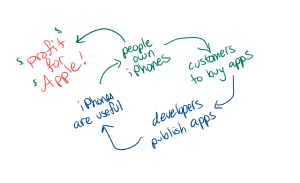
Linear causality is a tiny pinhole through which to observe the universe. Circularity helps us make sense of things even as it makes our picture more complicated: https://t.co/TEb2IroG4O