Hello everyone, this is a message from inside prison, from a young Iranian woman who is about to be executed. Please help me to amplify her voice before they hang her. 💔
«Remember my name, maybe I will not be able to speak again.»
This is the voice of Najmeh Amini, a 23 year old accounting student, speaking from Vakilabad Prison in Mashhad. In her voice message she says: «Be my voice. I am an innocent girl, a young woman full of hopes and dreams.»
Najmeh is one of the detainees of the January uprising .
She spent months in detention without a verdict, denied access to a lawyer of her choice and pressured during interrogation. In August, her trial was held at the Revolutionary Court of Mashhad on charges of «assembly and collusion» and «insulting sacred values.»
She said in her voice message that her death sentence was issued on September 16, 2026.
In her own words: «People, I only want justice and the chance to defend myself.» And this is her dream: «Before the rope ends my life, let me see my Iran prosperous and free.»
Be her voice and all of political prisoners, especially those at risk of execution.
#NajmehAmini
#StopExecutionsInIran
Welles Crowther was 24 years old.
An equities trader working on the 104th floor of the South Tower. A young guy with a career ahead of him, who was also a volunteer firefighter.
On September 11th, after the plane hit, he covered his nose and mouth with a red bandana and went to help.
He found a stairway. Guided injured people through the smoke. Carried a badly wounded woman on his back.
Then he went back upstairs.
That’s the part I keep coming back to. He had helped people find a way down, and he turned around to reach the people still waiting for help.
I try to imagine that decision. The noise, the smoke, the fear. I can’t honestly say I know what I would have done.
Welles kept going back.
He died when the South Tower collapsed.
The people he helped didn’t know his name. They remembered the man in the red bandana. Later, they would learn who he was.
I think about how young 24 really is. How much life he should have had left. And about the people who got to go home to their families because he was there.
When we say “never forget,” these are the stories we need to keep telling.
His name was Welles Crowther.
He was 24. And he deserves to be remembered.
Please share so we don't forget this hero.
To jest obrzydliwe
Islamski burmistrz NY Mamdani i lewaczka demokratka Ocasio Cortez zostali przyłapani na chichotaniu w chwili, gdy inni płaczą podczas odczytywania nazwisk ofiar zamachów z 11 września, w trakcie ceremonii upamiętniającej w Nowym Jorku
The Jason Arday of the art world has just dumped another state-approved diversity idol onto Trafalgar Square and the whole country is now expected to line up, and pretend we have witnessed a civilisational event rather than another publicly funded act of aesthetic and moral vandalism.
We have to pretend the thing is profound. We have to pretend that installing an anonymous identity mascot in the middle of the capital is bravery, rather than the safest, most cowardly commission imaginable: a work that cannot be criticised without the critic being treated as a moral defective.
That is the real sculpture. Not the figure on the plinth. The ritual around it. The demand that you clap. The demand that you lie. The demand that you look at something ugly, opportunistic and ideologically pre-chewed and call it magnificent because the alternative is being marked down as one of the bad people.
It is yet another tiresome, expensive, unignorable nod to a country that has decided its highest cultural achievement is to keep announcing that it is ashamed of itself.
In the Yookay, everyday is a humiliation ritual.
Let me introduce you to a brave young woman from my country, Iran.
Her name was Hadis Najafi. She was only 22 years old.
The morality police in Iran killed Mahsa Amini over a few strands of hair. Hadis Najafi responded by taking off her hijab entirely and going into the streets to protest the Islamic Republic.
Before going out to protest, Hadis filmed herself walking in the street. She said:
“I hope that years from now, I can look back and be happy that I went out to protest, because everything changed.”
She never got to see those years.
In September 2022, after Iran’s morality police killed Mahsa Jina Amini because they decided her hijab was “improper,” Hadis went into the streets of Karaj to end this barbaric regime.
She went for Mahsa. She went to demand freedom from a murderous regime.
Hadis was unarmed. Her voice was her only weapon. But Security forces opened fire.
I spoke to her family. They told me how they saw the pellet wounds all over her body her face, her neck, her chest.
Hadis was killed. And killing her was not enough.
The authorities pressured her family to say she died naturally. They withheld her body and tried to silence them.
Her family refused.
Even at her funeral, security forces surrounded them. They could not even mourn their 22-year-old daughter in peace.
Think about this:
First, they killed a 22-year-old woman, Mahsa, over a few strands of hair.
Then they killed another 22-year-old woman, Hadis, for protesting her killing.
They tried to erase Hadis.
Instead, she became a symbol.
Today, more women across Iran walk publicly without compulsory hijab.
Hadis dreamed that one day she would look back and see that everything had changed and Iran will be free from Islamic Republic.
That dream is not dead.
What shocks me is how many young people I meet at universities and colleges across the free world who have never heard her name. They know so many heroes from history, but they don’t know the heroes who are making history right now.
That is why I tell these stories.
🚨 🇩🇪 GERMANY: Her name was Maria Landenburger, a 19-year-old medical student from Germany.
One day, while she was in a park, she was attacked by an Afghani migrant, Hussein Khavari. He chased her, pushed her to the ground, and knocked her off her bicycle.
As she lay there, he strangled her and repeatedly raped her before leaving her unconscious on the riverbank, where she ultimately drowned.
Police later identified him through DNA evidence. He was eventually convicted and sentenced to life imprisonment for rape and murder.
It later emerged that, before arriving in Germany, he had already served time in Greece for attempting to rob and murder another young woman.
Women aren’t safe in Germany 🇩🇪
They hanged him at dawn.💔
The Islamic Republic executed rapper Erfan Mirzaei on Sunday, September 6, at the morning adhan, in Dastgerd Prison in Isfahan. No warning. No last call to his family. The rope and the silence.
He was a young rapper. His crime was standing against a regime that kills to survive. He sang of freedom and hope in a country where a song can cost your life. Those who knew him remember a young man full of fire, art, and big dreams. The regime stole all of it in a single dawn, while the world slept.
He was arrested during the January protests and executed in secret, while the Islamic Republic continues slaughtering January protesters in Iran's prisons under a total news blackout.
His funeral is today, Say his name. Do not let the gallows have the last word.
🚨‼️THIS IS NOT SANCTUARY, IT IS SLAUGHTER: Teenage Boy R*PED in Portsmouth Alleyway By IRAQI NATIONAL!!!‼️🚨
A 14-year-old child was r*ped in an alleyway off London Road in Portsmouth.
The attacker had spoken to the child on a bus. The assault happened between 7pm & 8pm on Thursday 6th August.
Police received the report on 11th August.
Separately, a woman in her 20s reported that a man had been stalking her for a year & had criminally damaged a family member’s car. Enquiries LINK the two cases.
Sadiq Farhad Azad, 33, an Iraqi national of NO FIXED ADDRESS, has been arrested & charged with:
- R*pe of a boy aged 13/14/15
- Section 4a stalking
- Criminal damage to property valued under £5,000
He has been remanded in custody.
This is NOT an isolated incident. This is ANOTHER one of OUR children in Portsmouth, on a local road, just getting off a bus, attacked in an alleyway by a man who should have NEVER have crossed paths with him. A man who should have NEVER stepped foot in England.
A teenage boy r*ped. A woman stalked for a year. A family car damaged. An Iraqi national with no fixed address... We do NOT have to live like this.
Parents in this city are watching their children grow up under a system that keeps telling them “sanctuary” is compassion. What they see instead is repeated serious sexual offences involving illegal aliens who should NEVER have been free to move around OUR streets.
The police have charged him, but the IRREVERSIBLE damage is already done. The subhuman filth with no fixed address & no right to be here in the first place has done his damage. Just another child to sacrifice on this councils alter of diversity.
This is not sanctuary.
This is slaughter.
Enough IS Enough.
The most heartbreaking moment of the funeral in Ostrówki was the burial of 26 tiny coffins containing the remains of innocent children.
It was in Ostrówki and Wola Ostrowiecka that one of the most tragic episodes of the Volhynia genocide took place on 30 August 1943.
Within just a few hours, Ukrainians murdered around 1,050 Poles. The villages were then looted and burned, and the victims’ bodies were thrown into mass graves, wells and ditches.
Following exhumations carried out by Poland’s Institute of National Remembrance in July and August 2026, a funeral was held for 55 Polish victims, including those 26 children.
[*]
📷 Mirosław Gębski
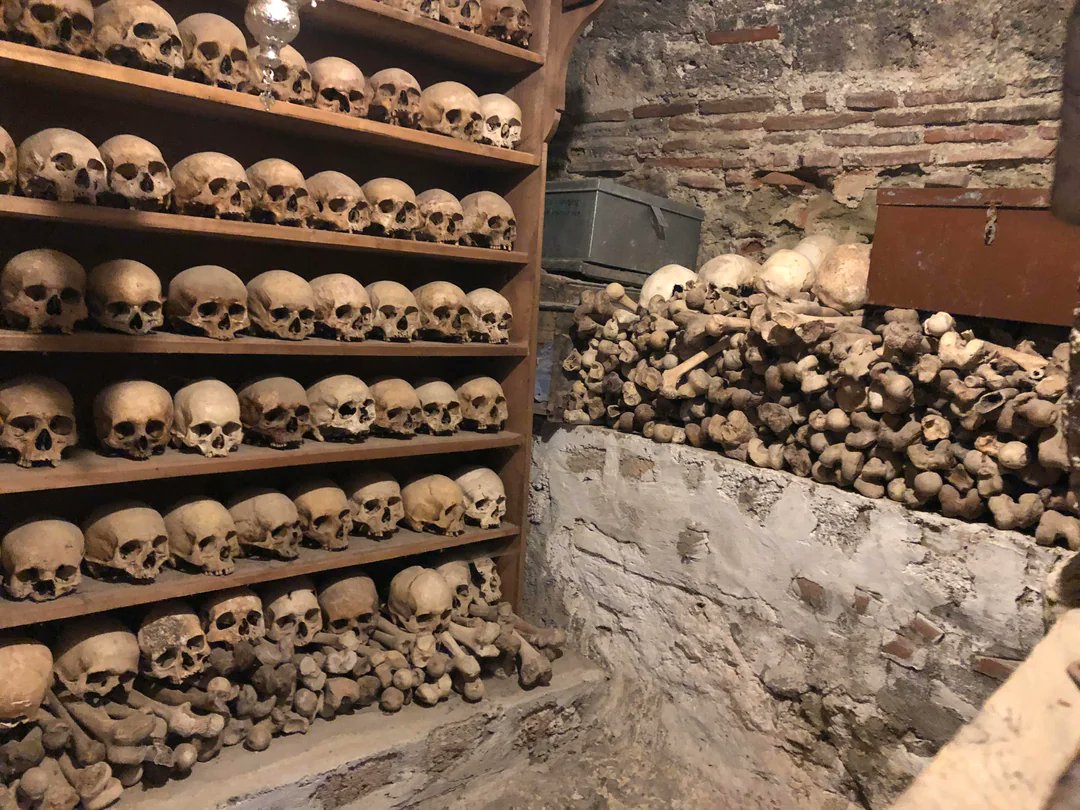
Muslim Turks, under the commands of Mustafa Kemal, sold the bones of the murdered Greeks and Armenians.
After the genocide and expulsion of the Greeks from Asia Minor, ships loaded with the remains of Greeks and Armenians sailed on their way to Western Europe.
Turkey sold the bones of the dead. Industries used them to bleach sugar and tobacco. They ground them into fertilizer.
At least 400 tons. More than 50,000 dead.
Thousands of men, women, and children fell into the hands of the Kemalist army and the irregulars. Women were raped in groups. Men were tortured without limit.
Entire villages that stayed behind, hoping their Turkish neighbors would show mercy, were executed.
The hostages were driven on death marches across thousands of kilometers. Barefoot. Nearly naked. Beaten by villagers along the way. Many died of thirst in the ravines of Magnesia. Those ravines supplied the bones Kemal later sold.
The survivors were sent to labor battalions. They rebuilt the infrastructure of the new Turkish state under conditions designed to finish them.
After Lausanne, 1.5 million refugees arrived in Greece searching for relatives who never came home.
This is not ancient history. This is the century that produced us.
They want us to forget.
They want the bones to remain fertilizer and the names to remain numbers.
We do not forget.
We never forget the Genocide of the Greeks of Pontus & Asia Minor by the Muslim Turks. The genocide was orchestrated by Mustafa Kemal & the Young Turks, & it was racially and religiously motivated in order to create their pseudo-nation 100 years ago. They butchered, tortured, raped, burnt and starved to death through the death marches millions of Greeks, Armenians and Assyrians.
The true barbarian is the one who turns the dead into raw material and then lectures the living about civilization.
Homer Pavlos
50 years have passed since this photo was taken.
Palestinian terrorists stormed the Christian town of Damour in Lebanon and killed 582 Christian civilians.
A priest who survived described it as “the end of the world.”
He said: “They came by the thousands, shouting, ‘Allahu Akbar! Kill them for the Arabs. Let us offer a sacrifice to Muhammad!’ They slaughtered everyone in their path: men, women and children.”
Men were lined up against their homes and shot. Women were tortured and repeatedly raped. Infants were shot in the back of the head. Fetuses were torn from pregnant women’s wombs.
This was one of many massacres by Palestinian terrorists against Christians.
Share so the world knows. #FuckPalestine
Let me introduce you to a brave hero from my country, Iran.
She was 16 years old. Just a girl. And on the streets of Iran, she did something braver than most people do in a lifetime: she took off her hijab and burned it in public. Right in front of the regime. Right in front of the world.
That was her crime: civil disobedience. A teenage girl refusing to obey men who claimed authority over her hair, her body, her life.
Her message spoke for millions of Iranian women:
To every man who rules over women in the name of religion, honor, or culture: We do not obey you. Your laws were never made for us.
This is what real power looks like: unarmed, unafraid, unbowed.
For that defiance, she was arrested. Her family says she was tortured and killed after falling into the hands of security forces. The Iranian authorities denied responsibility and gave a different account of her death.
Her name was Nika Shakarami. She was 16.
Now ask yourself: How many women in the West know her name? How many know what she risked for a freedom they have never had to fight for?
Say her name: Nika Shakarami.
In 2007, an album of photographs showing how the Nazis at Auschwitz spent their leisure time came into our Museum’s collection. Learn more about these rare photographs and get to know the real people who inspired the play Here There Are Blueberries, opening on Broadway this fall.
27 August 1920 | A German Jewish woman, Peppi Dora Spira-Artmann, was born in Remscheid. She emigrated to The Netherlands.
In November 1942 she was deported to #Auschwitz with her 6-month old son Arthur. They were murdered in a gas chamber after the selection.
This is England… where the rights of women matter less than the rights of foreign men.
Where a convicted rapist can claim “sexual entitlement” and win the right to remain here and claim benefits here …
because deporting him would breach his human rights.
✨The special talent of the red-haired boy and the cover that stopped the entire street
There are performances that make you stop in the middle of the crowd—not because of a big stage, but because something unexpected and sacred is ringing out. The video of Allie Sherlock and the red-haired boy Fionn Wheelan singing “Hallelujah” on the street is one of those. Allie stands with her acoustic guitar, her voice clear yet deep. Beside her is a boy of about twelve, wearing a red Arsenal jersey, bright red hair, eyes focused, lifting the high notes in a way so natural it’s almost unbelievable. The crowd gathers, phones are raised, yet no one makes a sound. For me, it raises the question: how could an unknown boy and a street busker turn Leonard Cohen’s song into a moment that feels almost holy?
The answer lies in Fionn’s voice. He doesn’t try to imitate anyone. He simply sings. His voice is clear, slightly raspy on the high notes, carrying a sincerity and innocence that cannot be faked. When he sings “Hallelujah…,” the noise of the street seems to fall away. Allie supports him with gentle chords, never overpowering. That is the moment the song explodes—not through technique, but through pure clarity.
For me, the focus is always on Fionn. He stands steady before the crowd, his voice rising on the repeated lines, creating an immediate energy right in the middle of the street. Allie turns the corner into the place where the song is happening, while Fionn turns it into the place where emotion is set free.
Allie Sherlock began her career busking on the streets of Ireland. She returned to a familiar corner and met a boy whose voice made her call him “the next Ed Sheeran.” “Hallelujah” has always been a song about faith, love, and moments that are both sacred and earthly. When these two sing it on the street, it becomes an unexpected prayer in the middle of everyday life. No church or grand stage is needed.
Many people ask whether this is the best cover of “Hallelujah.” Compared with polished studio versions, it lacks “cleanliness.” But that very lack of perfection is its strength. It asks you to face the pure clarity of a boy and the gentle support of an adult.
The most admirable thing is that this moment has never accepted becoming a forgettable video. Every time the red-haired boy’s voice rises amid the crowd, I am pushed back into the right place: not someone being entertained, but someone forced to look straight at a talent burning brightly in the most natural way. This song does not need to be loved in the ordinary way. It only needs to be remembered—and for me, it has done that.