From Jane Street:
> The questions we ask software engineers today are the same style of question we’ve been asking for years: sit down with an interviewer or two, program through a problem together, and talk as you go. That style has served us well and the key goals remain the same: we want to see how you solve problems, structure your work, communicate, and collaborate in the pursuit of excellent software development.
> ...this summer we started trialing some new kinds of interviews in our onsites for campus candidates. Broadly, they involve less code-writing, and lean more higher-level... Not every onsite includes these new rounds yet, and when you come on-site we’ll give you a heads-up about what to expect.
> You shouldn’t feel like you need to have a highly worked out methodology for working with agents in order to do well in our process. In the end, we’re looking for people with great instincts for building software, and we don’t feel like we need an LLM to evaluate that.
If you're trying to get a job, your fundamental ability to code without ai is way more importantT than having the perfect agent setup, all the trendiest skills downloaded, or an up-to-date opinion on the latest models.
glhf
@Tutrural المعونه العسكرية المصرية حاجة اكبر من اي عضو في الكونجرس
فكرة الضغط الخارجي او التغيير الخارجي حاجة مش مقبولة شعبيا
وصعب تحصل لان الدولة او النظام علاقته كويسة جدا مع مصالح الدور الخارجية سواء اوربا او امريكا
HOLY: Anthropic's Claude Code engineer Addy Osmani is warning about a brutal AI paradox: the more coding you hand to agents, the more you risk losing the very skills needed to supervise them.
He calls it "cognitive surrender." AI-generated code looks pristine, tests pass, and engineers start approving work they no longer understand.
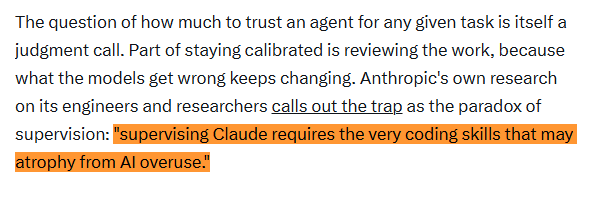
Anthropic's own research warns: "supervising Claude requires the very coding skills that may atrophy from AI overuse."
Osmani makes a striking observation: "When you're producing more than you can stand behind, you're no longer reviewing. You're hoping."
You might have 1–5 years to contribute intellectually to the world before AGI. What should you do with them?
Excellent advice from @jaschasd (Anthropic) at Stanford. Skip Netflix tonight and watch this instead.
I put a lot of heart into my technical writing, I hope it's useful to you all.
📌 Here's a pinned thread of everything I've written.
(much of this will be posted on the Claude blog soon as well)
timelapse #83 (22 hrs):
- it was very easy to dive super deep into anything i needed to (this is what i focused on today because not all days are like this)
- finding the grok code fast 1 + grok 4 for deep thinking and verification combo to be super useful in cursor. speed was solid
- hard to imagine myself spending many more mental clock cycles in a 24 hr period
- had to pull out qwen3-next’s gated deltanet + linear attention from bleeding edge hf transformers to begin implementing a multi-gpu fp8 trainer from scratch. this is so damn bleeding edge and i underestimated how much effort this has and will require lol
- lots of diet coke and oats
- shipped the template which the core chapters of my book will be built on: https://t.co/faabDy61Sv
- all im missing now is flash attention 1/2 mastery (fa2 tmrw), intuition on making topk faster (for arbitrary row length), what i should and shouldnt teach in cutlass/cute, hopper/blackwell gemm kernel mastery (down to fp4) — shoutout to @pranjalssh for making this easier for me. his blog post is amazing
- caught up w/ @matiroy
- im feeling great mentally but not so good physically as im writing this and about to pass out
A lot of infrastructure problems are networking problems wearing a different costume.
These 6 resources can help you build stronger networking fundamentals:
1. Beej's Guide to Network Concepts: https://t.co/JJpJ8YHBJF
2. Cloudflare Learning Center: https://t.co/y7R4lcwzEZ
3. Computer Networking: Principles, Protocols and Practice: https://t.co/XF4UxMGR23
4. Wireshark User's Guide: https://t.co/8c31M6qZ9f
5. Practical Networking: https://t.co/XFIK5Crf9Y
6. OverTheWire Bandit: https://t.co/Vtyo7a6KLq
Learn DNS, TCP, routing, TLS, ports and packet analysis.
Then troubleshoot a real connection failure using `dig`, `curl`, `ss` and Wireshark.
That's how networking knowledge starts paying off in DevOps.
Better architecture?
No, not at all.
All architecture is design, but not all design is architecture. Architecture represents the set of significant design decisions that shape the form and function of a system where significant as measured by cost of change.
I would argue that code agents are not even good at design: they are simply choosing implementations based upon pattern matching, and even that being done at the most superficial of levels.
Architecture and design to a lesser degree are things that humans do, not coding agents.
Hot take: you don't understand pointers until you've implemented malloc.
You don't understand compilers until you've written a parser.
You don't understand OSes until you've written a scheduler.
Reading doesn't get you there. Building does.
479+ micro-tasks to build them: https://t.co/j4SHev30Jm
The more you complain about something, the stronger your brain gets at noticing things to complain about. Complaining feels like a release, but actually you are just teaching your brain to find things to complain about.