for the love of god, never ever decide to deploy a full "omnichain" token that enshrines a 3rd party bridge into the token itself. bridge risk should always be confined to bridged assets. if rsETH was omnichain, like AUSD, the entire supply on L1 would have been compromised too
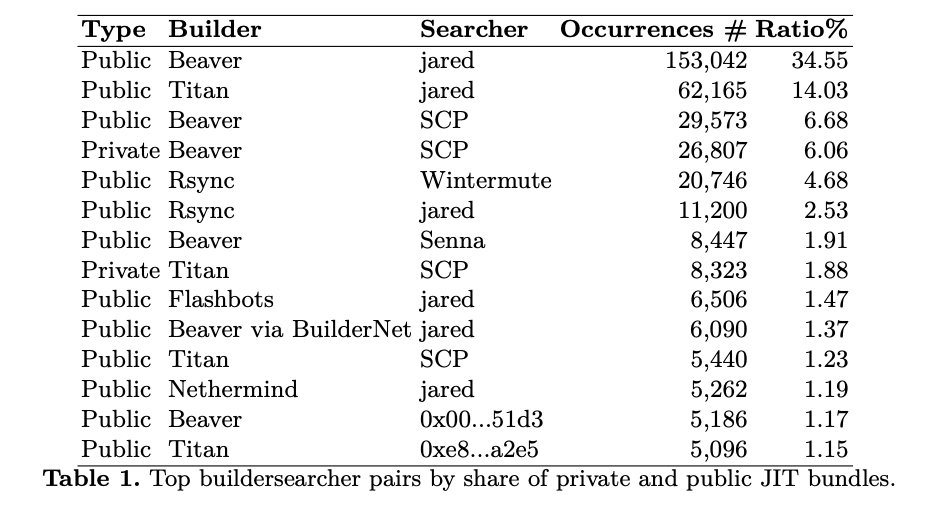
1/ “Who is the top JIT liquidity searcher in Ethereum?” → a question answer by our paper w/ @0xAlphaist (accepted to a FC workshop: https://t.co/yprg9mHuO3)
We mapped JIT activity in Uniswap v3 and linked searchers <-> builders from Jan 2024 to Sept 2025.
One name dominates: jared accounts for >50% of all observed public JIT execution.
In 2025, interop accelerated.
In 2026, interop is crypto.
Interop now sits at the core of crypto: chain connectivity, asset issuance, liquidity movement.
The State of Interop 2026 is a snapshot of where we are, what’s next, and why it matters.
Read: https://t.co/HujEbRyqDY
We’re excited to announce a $29M Series A extension funded by Multicoin & CoinFund, bringing total capital raised to ~$52M!
LI.FI is building the universal market for digital assets.
This capital lets us bring our vision of making any onchain action possible closer to reality.
With the recent announcement of EIL, I feel that its cross-chain approach conflicts somewhat with OIF, but I also find it a very interesting initiative.
I hope we can continue discussions on how to combine OIF and EIL from an intent-centric perspective to further improve UX.
I joined OIF (Open Intents Framework) catalyst the past few days.
We built applications, settlement with Optimistic Oracle and TEE, and worked on integration with ERC7683.
Thanks to @barnabemonnot for hosting the event.
Here’s a summary of what I worked on and my thoughts:
This reaffirmed the importance of protocol-level solutions such as shortening the withdrawal period for optimistic rollups, transitioning to zk rollups, or improving Ethereum finality.
We are thrilled to announce the zERC20 testnet today!
This is an ERC20nized version of EIP-7503 (a.k.a. zkWormhole), enabling a sophisticated UX that was unimaginable with traditional privacy protocols. It's an ERC20 that works on many L2s, such as Arbitrum and Base.
1. You can make private transfers using the usual transfer function in your favorite wallet.
2. Those transfers are cross-rollup and chain-agnostic by default.
3. Once you know how, you can do all this without connecting to dapps or web pages.
Let's turn $ETH into a privacy coin. Let's turn your friends into privacy guys without them even noticing😁
Full details here:
https://t.co/FPvf06hfDt
Ethereum L1 is painfully slow 😩
Can devs PLEASE fix this?!?
For 2+ years, the @primev team has been grinding to supercharge Ethereum mainnet.
Today: MILLISECOND preconfirmations... ON L1! 🚀watch me send ETH blazing fast in this 18s vid
Open Intents Framework -- endgame for intents-based interop across Ethereum 🪧
Modular, open source, integrates latest tech, & permissionlessly extends to any chain + secure, trustless settlement
few big wins/updates from past few weeks:
- audits for core contracts recently completed, h/t @lifiprotocol + @OpenZeppelin
- The Compact from @Uniswap@z0age integration
- Crosschain broadcaster from @offchain integration for trust-minimized settlement for OIF
- PRs open for add'l oracles: @axelar, @chainlink, and @LayerZero_Core
- Revamping ERC-7683 to rollout major improvements and better OIF support (h/t @AcrossProtocol + @frangio_)
- @RelayProtocol and @Polymer_Labs joined as core contributors to OIF
- OIF catalyst event at Edge City Patagonia (Nov 11-15)
- Continued contributions and support across the ecosystem @hyperlane@wonderland@coinbase@ambire@rhinestonewtf@t1protocol
I compared the slippage settings for USDC-WETH pair on Uniswap and 1inch Aggregator. Both currently default to auto, but lately Uniswap’s looks better optimized.
https://t.co/PCs1X15nNf
🧵We’ve talked a lot about the state growth problem on Ethereum. Yet, about 80% of Ethereum’s state looks stale—or simply garbage.
👇 A few highlights from our analysis on Ethereum’s state:
> Among users who provided liquidity of $1 or more over the past four years, only 28% had positive cumulative PnL, approximately 10% of liquidity providers exceeded $10, and only about 5% surpassed $100.
In this article, I evaluate the performance of liquidity providers (LPs) using markout analysis and measure what percentage of LPs are profitable and how much money they actually make.
https://t.co/Wdyw29riVG