🚀 Thrilled to release the JanusCoder series!
We're dropping 4 open models (JanusCoder-8B/14B & JanusCoderV-7B/8B) to create a unified visual-programmatic interface for multimodal code intelligence.
⚙️ Code: https://t.co/6SDUiATGc7
🤗 HF Paper: https://t.co/8oiPQy9CmI
🧵[1/4]
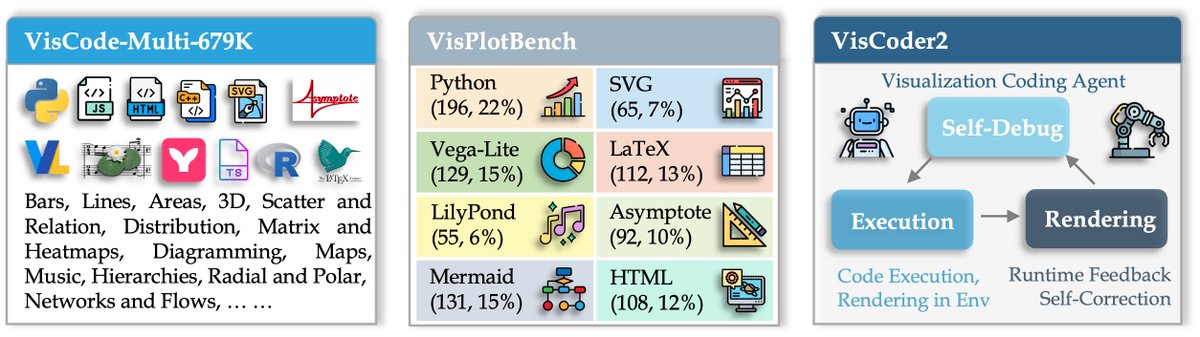
📢 Introducing VisCoder2: Building Multi-Language Visualization Coding Agents!
Existing LLMs often fail in practical workflows due to limited language coverage, unreliable execution, and a lack of iterative correction mechanisms.
We introduce 3 resources to address this:
VisCode-Multi-679K: A 679K dataset across 12 languages.
VisPlotBench: A benchmark spanning 8 languages with multi-round self-debug protocols.
VisCoder2: A model family that iteratively executes, renders & self-debugs, approaching GPT-4.1 performance (82.4% pass rate).
🌐 Project Page: https://t.co/Otdg27tN1N 📄 Paper: https://t.co/tVVPaJk1HZ 🤗 HF Collections:https://t.co/Prnckxa8kM
More below 👇 (0/7)
Meet LLaMAX2!
✨ SOTA Translation: Excel in both high- and low-resource languages.
✨ Lightweight Pipeline: Built on a powerful Qwen3 instruct models, it requires parallel data only through smart layer-selective tuning.
✨ Elite Reasoning: Performance on par with Qwen3-Instruct.
Welcome to use our models. More Details:
🎉 Paper: LLaMAX2: Your Translation-Enhanced Model also Performs Well in Reasoning (https://t.co/MreGvYXheT)
🎉 Code: https://t.co/rnU6k1oXV9
🎉 Model: https://t.co/DJLGGabf21
Why do Long Context Language Models (LCLMs) excel at needle-in-a-haystack tasks but struggle with real-world applications?
Can we evaluate them in a fully controlled setting?
🎉 Introducing our latest work: "A Controllable Examination for Long-Context Language Models"
TL;DR:
🧠 Synthetic benchmark with a strict task difficulty hierarchy;
🪡 Seamless needle insertion to prevent pattern hacking;
🔍 Evaluated 18 LCLMs on understanding, reasoning, and trustworthiness across long-context tasks.
🤗 Huggingface: https://t.co/dJzbOfcIFJ
🏠 Github: https://t.co/HkNAFQ6h3C
🧵[1/6]
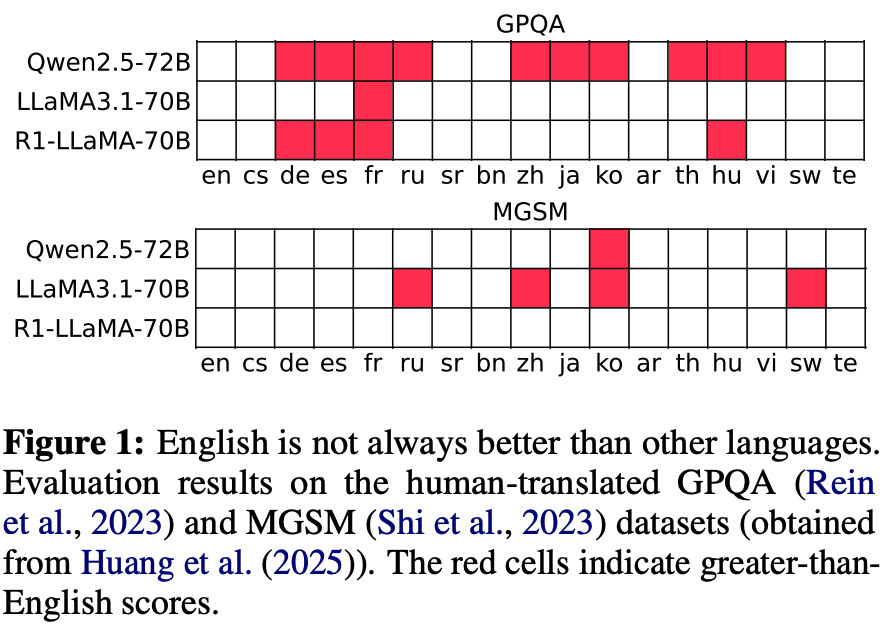
New paper alert! Could thinking multilingually empower LLM reasoning?
Exploring the potential for multilingualism in reasoning tasks, and finding it offers significant and robust advantages over English-only approaches.
📢 Happy to bring our new paper! 🤩
> Non-En can exceed En in reasoning tasks
> Ensembling 4+ langs in inference can bring about 10% more theoretical gain than En
> Gain robust to lang choice and translation quality
Paper: https://t.co/u2aTV9UBfc
Repo: https://t.co/36Fbikvn1S
Pleased to introduce our latest finding: https://t.co/g77crZeWjZ
We analyze several key points of data synthesis in long-context instruction tuning and show that these insights can lead to significant performance improvements.
🎉 Excited to share “Generalizing from Short to Long: Effective Data Synthesis for Long-Context Instruction Tuning” 📄 (https://t.co/XalrVjmxg7)
We propose "context synthesis": instead of generating instructions from long texts, we synthesize contexts for instructions—drawing inspiration from "back-translation" in MT.
This ensures high-quality instruction-output pairs while enabling control over context length, difficulty, and composition, boosting long-context learning. Results show it outperforms prior methods and approaches human-annotated data! 🚀
Here’s the thread 🧵 (1/n)
We recently published a new paper [https://t.co/KecWwQWJCb] about comprehensive multilingual evaluation, collaborating with researchers from NJU, Shanghai AI Lab, and CMU.
💥To maintain high quality, three distinct native-speaking annotators independently annotate each sample.
🤩Excited to announce our new work BenchMAX!🥳
BenchMAX: A Comprehensive Multilingual Evaluation Suite for Large Language Models
Paper: https://t.co/g3VQ5W6tzn
Repo: https://t.co/olxFagOlGa
Datasets: https://t.co/PZUm1tu3SM
Congratulations to @t_feyuan! KS-Lottery is accepted by #NAACL2025.
We provide a theoretical guaranteed solution for finding lottery tickets for multilingual LLM. The results are stunning: fine-tuning the embedding of 18 tokens would be enough for learning new multilingual tasks.
📰 paper link: https://t.co/lEq3kgmAkH
Long-context is central to models like OpenAI o1, but rare to see in natural data. Extension methods grow context by post-training open LLMs.
A tutorial and controlled study of this area of long-context extension.
https://t.co/MWN3aHu1O5
https://t.co/FlvN1kflxn
[1/4] RSA is accepted by #EMNLP2024 main track 🥳
- Enhance Any protein understanding model with lightning-fast retrieval.
- 373x faster than MSA, on-the-fly computation, achieves comparable performance.
Preprint link: https://t.co/DxE9IjqRfE
Code: https://t.co/PD1ozjleMQ
#ACL2024NLP Fei Yuan (@t_feyuan) is presenting a work on analyzing the vocabulary’s impact in LLM’s multilingual capability. We compare the translation performance of LLaMA and bilingual parallel corpus fine-tuned LLaMA., and evaluate their performance of 100 languages. Guess ?
@Xianbao_QIAN@AnnioDance@lileics We are also uncertain as we have not specifically researched these parameters. The results reported in the paper are based on beam search with a temperature of 0.1 and a beam size of 4.
@AnnioDance@Xianbao_QIAN@lileics I find it challenging to recall the full names of languages, and I struggle to remember all the languages supported by LLaMAX.
@AnnioDance@Xianbao_QIAN@lileics Thank you for your recognition. We are continuously working to optimize LLaMAX and strive for further capability improvements.
Meanwhile, I have a small suggestion. It would be even better to change the blank fields of "target lang" to drop-down menus.