The FOXO3-MSC primate study is getting a lot of attention. Here's what the coverage is missing.
Thread.
The claim: MSCs engineered to overexpress FOXO3 produce exosomes that reverse biological age markers in primates. Compelling framing. The biology is real - FOXO3 is a bona fide longevity transcription factor with human lifespan associations across multiple GWAS cohorts.
But there are four things worth stress-testing before the excitement runs ahead of the data.
1. Regulatory class problem.
Native MSCs may qualify as HCT/P under 21 CFR 1271 in certain contexts. FOXO3-engineered MSCs do not. Genetic modification converts this into a gene-modified cell therapy - different manufacturing requirements, different IND pathway, different safety package. The clinical translation timeline is not MSC-adjacent. It's closer to CAR-T.
2. The FOXO3 causal direction is murky.
Human longevity associations with FOXO3 variants come from population genetics. The rs2802292 variant is consistently associated with extreme longevity in Okinawan and Ashkenazi cohorts. But the mechanism in humans - whether FOXO3 expression level is causally driving lifespan vs. acting as a correlate of other longevity pathways - is not clean. Overexpressing FOXO3 in an engineered cell is not the same as carrying a protective variant across a lifetime.
3. "Biological age reversal" depends entirely on the clock.
Which epigenetic clock was used? GrimAge? DunedinPACE? Horvath's pan-tissue? They measure different things - mortality risk, pace of aging, chronological deviation. A 2-year regression on one clock in a specific tissue doesn't generalize. The primate study needs to specify which tissues, which algorithm, and whether functional outcomes (not just methylation patterns) changed.
4. Exosome cargo loading isn't fully characterized.
The proposed mechanism - FOXO3 upregulates exosome biogenesis and biases cargo toward anti-senescent miRNAs - is plausible and supported by cell culture data. But the specific cargo responsible for the in vivo effect hasn't been isolated. Without that, you can't know if it's the FOXO3-specific exosome signature driving rejuvenation, or just enhanced exosome output from a more metabolically active cell population.
The primate data is genuinely interesting. But interesting preclinical data in primates has a long history of not translating. The regulatory and mechanistic complexity here is real.
Not medical advice - just tracking the science.
Kalies et al. just published proof that OSK factors can functionally rejuvenate aged endothelial cells WITHOUT genomic integration. This is the validation the field was waiting for.
The problem: endothelial dysfunction drives cardiovascular aging. Senescent ECs lose metabolic plasticity, reduce NO production, accumulate ROS. By 70, they're dysfunctional neighbors dragging cardiomyocytes and vasculature into aging with them.
Kalies' approach: induce OSK factors transiently in senescent HUVECs - 48-72 hours of expression, then shut it off.
Results:
- Mitochondrial function restored (ATP production +47%)
- Metabolic flexibility recovered (glycolysis back to OXPHOS)
- ROS diminished (DCF staining -62%)
- Angiogenic capacity restored (tube formation comparable to young ECs)
- NO production recovered
Critically: changes persisted 14 days post-OSK withdrawal. Not just during expression.
Why non-genetic matters: integration risk = permanent genomic insertion with potential off-target effects. Kalies shows permanence isn't necessary. Transient epigenetic rewriting is sufficient.
The mechanism: OSK activates HAT - H3K9ac, H3K27ac at aging-associated genes - silencing of p16INK4a, p21 - exit from senescence - metabolic re-plasticity.
The transience works because the epigenetic state stabilizes after OSK withdrawal. You're not holding a switch open. You're resetting the epigenome to a self-sustaining younger state.
Implication for exosome delivery: if the epigenetic reset is self-stabilizing, exosome-delivered miRNAs modulating chromatin regulators could trigger sustainable rejuvenation without continuous dosing.
Not medical advice - just tracking the science.
-> https://t.co/T7iKLVX4Xz
The MSC secretome isn't fixed. You can tune it — and the therapeutic output changes dramatically. New data on a licensing strategy for acute lung injury. Thread. 🧵
Tunstead, English et al. (Maynooth/Galway, bioRxiv Apr 2026): what happens when you activate PPARβ/δ — the nuclear receptor that senses free fatty acids — in human bone marrow MSCs before harvesting the secretome?
ARDS microenvironments are loaded with FFAs. MSCs encounter that in vivo. PPARβ/δ is the receptor that reads it.
PPARβ/δ agonism upregulated ANGPTL4 in the secretome — angiopoietin-like 4, a barrier-protective angiogenic factor.
ANGPTL4-high secretome:
— Enhanced lung epithelial repair in CALU-3 cells
— Improved endothelial barrier integrity in ALI mouse lungs
— Causality confirmed via anti-ANGPTL4 blocking antibody
They then licensed the agonized MSCs with actual ARDS patient serum. Further enhancement — reduced clinical score, reduced weight loss. The disease microenvironment itself as a conditioning signal.
The principle extends beyond ARDS. MSC secretome composition is tunable via receptor activation and environmental licensing. This isn't just biology — it's manufacturing strategy.
If you're developing secretome or EV-based products: what you condition the cells with determines what the secretome does.
Not medical advice — tracking the science.
→ https://t.co/Vq90etyY3V
A new RNA-seq dataset just dropped for GDF11-treated senescent MSCs. No results yet - just 16 raw libraries. But the experimental design tells you exactly where MSC secretome science is headed.
Kondratyeva et al. (BMC Research Notes, 2025) generated bulk RNA-seq across 4 groups: young MSCs +/- GDF11, senescent MSCs +/- GDF11. Senescence induced via mitomycin C.
GDF11 prior evidence: reverses age-related cardiac hypertrophy, restores MSC viability and angiogenic function, promotes osteoblastogenesis over adipogenesis via TGF-beta/PI3K-Akt/Smad2-3 signaling.
This is a data note, not a results paper. 3.36 billion reads deposited to GEO (GSE287646), FASTQ + featureCounts tables released, no differential expression analysis reported yet.
Why it's worth watching: this is exactly the experimental architecture any rigorous aged-cell secretome study needs - young vs. senescent, treated vs. untreated, transcriptome as the readout before any therapeutic claim gets made.
The honest caveat: small n (4/group), batch effects noted by authors, single immortalized line (ASC52telo), bulk RNA-seq averages across a known-heterogeneous MSC population.
This is a resource, not a conclusion. But it's the right design. The GDF11 community will get differential expression analysis papers from this data within 12 months.
Not medical advice - just tracking the science.
-> https://t.co/W0FJtblASQ
You take an epigenetic age test twice in the same month. You get results 10 years apart. The intervention did not move your biology — the test moved. This is the clinical precision problem nobody talks about. Thread.
A 2024 GeroScience paper (Rapčan, Song, Lauc et al.) ran a direct head-to-head on measurement variability: epigenetic clocks vs. IgG glycan profiling (GlycanAge) in the same individuals over the same period.
Epigenetic clock data: up to 10 years of variation in biological age estimates within a single individual across repeated measurements — within weeks, with no intervention.
GlycanAge data: approximately 1 year of variation across the same time window.
Same person. Same period. 10x difference in noise floor.
Why does this matter?
If the measurement error is larger than the effect size of most interventions — you cannot detect whether the intervention worked. You are not tracking biology. You are tracking the noise of the assay.
Most longevity interventions produce biological age changes in the 1-3 year range on epigenetic clocks. The noise in those same clocks is up to 10 years. The signal is buried.
Jamie Haywood (CEO, Alden Scientific) framed it directly: epigenetic clocks show more analytical noise than the effect size of the interventions they are supposed to measure.
What makes IgG glycan profiling different:
IgG N-glycosylation is biochemically stable within individuals in stable physiological states. The Rapčan et al. study found coefficient of variation values consistently low across 312 samples over 26 days. Short-term intra-individual variability was less than 1 year. Long-term tracking (5-10 years) detected directional age-related trends with enough resolution to see lifestyle and intervention signals.
The mechanistic basis is real: IgG galactosylation declines with age (G2 down, G0 up), bisected GlcNAc increases, sialylation shifts — glycosylation changes tied to immune system aging and inflammaging, not just correlated statistical constructs.
For clinical use — longevity protocols, biological age panels, intervention tracking — precision matters more than the headline number.
A test that gives you a +/-5 year range on your biological age does not tell you if your protocol is working. It tells you to run the test again.
Not medical advice — just tracking the science.
→ https://t.co/UVHeFeLqg9
You take an epigenetic age test twice in the same month. You get results 4 years apart.
Same blood. Same person. Different number.
Rapcan, Song, Lauc et al. (GeroScience, 2024) quantified this directly: intra-individual variability in epigenetic clocks (DunedinPACE, PCGrimAge) vs. IgG glycan profiling (GlycanAge) in the same cohort.
The finding: epigenetic clocks showed significantly higher noise floors. GlycanAge showed substantially better measurement consistency - tighter confidence intervals, higher reproducibility on repeat measurement.
This matters enormously for clinical use.
If your biological age test has a +/- 4 year confidence interval, you cannot know if an intervention worked. The measurement error is larger than the signal you're trying to detect.
Three implications:
1. For personal tracking: a single epigenetic clock reading is a rough estimate, not a precise readout. You need multiple time points and ideally multiple clock types to extract signal from noise.
2. For clinical trials: endpoint selection matters. Using a high-noise clock as your primary outcome means you need larger N and longer duration to see a real effect. GlycanAge's lower noise floor makes it a stronger trial endpoint.
3. For companies selling biological age tests: measurement reproducibility is a product quality metric, not just a methodology footnote. GlycanAge's consistency advantage is competitive differentiation.
The epigenetic clock field is advancing fast - DunedinPACE and PCGrimAge are more clinically predictive than first-gen clocks. But "clinically predictive" and "measurement-stable" are different properties. You need both.
Not medical advice - just tracking the science.
-> https://t.co/NNyb6kjjXC
The Ozempic aging headlines are out. Here's what the paper actually shows - and what it doesn't.
Corley et al. (Nature Comms, Jul 14, 2026): randomized, placebo-controlled trial, 108 adults with HIV-associated lipohypertrophy. Primary readout: epigenetic clock aging rate (DunedinPACE, PCGrimAge, multi-organ clocks).
Result: 9% slower biological aging pace on DunedinPACE. Significant PCGrimAge deceleration. Effects across brain, heart, kidney, liver, metabolic clocks.
Real data. But three things to be precise about before extrapolating.
1. The cohort has accelerated baseline aging. HIV + antiretrovirals + lipohypertrophy = chronic immune activation and pathological visceral fat. This population ages faster than average. GLP-1 reduces both those drivers directly. Effect size in the general population is unknown - likely smaller.
2. DunedinPACE measures aging rate, not reversal. A 9% reduction means the pace of epigenetic change slowed during treatment. Not that anyone got biologically younger. "Slowing" and "reversing" are different claims.
3. The mechanism isn't new. NF-kB suppression, visceral fat reduction, chronic immune activation control. GDF11, senolytics, MSC secretome factors hit the same pathways through different routes. GLP-1 is doing metabolic inflammation control that shows up in methylation readouts.
What's actually novel here: DunedinPACE and PCGrimAge were sensitive enough to detect pharmacological aging deceleration in N=108 over months - not years. That's a real proof-of-concept for epigenetic clocks as clinical trial endpoints.
The model worth tracking isn't "semaglutide as anti-aging drug." It's: interventions that reduce chronic inflammation and metabolic dysfunction move epigenetic clocks measurably in clinical trials.
That generalizes. The specific drug is less interesting than the endpoint validation.
-> https://t.co/16dlymId5s
Not medical advice - just tracking the science.
Biotech has spent billions targeting SIRT6. Gene therapy. Small molecules. AAV delivery. Most of it is expensive, early-stage, and years from a patient.
Nature already solved a version of this problem. New preprint shows how.
Suh & Robbins et al. (Columbia/Scripps, preprint Jun 2026) identified two SIRT6 missense variants enriched in Ashkenazi Jewish centenarians - and knocked them into the endogenous locus of human embryonic stem cells. Native genomic context, not overexpression.
The mechanism: centenarian variants weaken SIRT6's interaction with vimentin - less protein degradation - more SIRT6 available. Not a different enzyme. More of the same one.
Functional shift in two directions:
- Enhanced ADP-ribosyltransferase activity - stronger DNA repair
- Reduced deacetylase activity - altered metabolic tone
Result: delayed replicative senescence, resistance to progerin-induced stress, suppressed LINE1 transposable element derepression.
That last one matters. LINE1 derepression triggers the SASP - the inflammatory secretome that makes senescent cells toxic. Suppressing it is mechanistically upstream of most of why senescent cells cause tissue damage.
Two translational approaches tested:
1. AAV delivery of the centenarian SIRT6 variant
2. Fucoidan from Fucus vesiculosus - a sulfated polysaccharide from brown seaweed
Both attenuated genome instability and LINE1 derepression in progeria fibroblasts. Fucoidan: existing safety profile, off-the-shelf, no IND required for wellness positioning.
The open question: does SIRT6 activation reduce senescent cell accumulation fast enough to matter clinically, or do you still need senolytics to clear the existing backlog?
Probably both. Senolytics clear what's there. SIRT6 slows the rate going forward. Not either/or.
Not medical advice - just tracking the science.
-> https://t.co/Z5YmaFoFNo
Extracellular vesicles aren't just messengers - they're programmable delivery systems. A new review maps how to engineer them for real therapeutic impact.
Huang, Li, Tao et al. (Aging Cell, 2026) reviewed the current state of engineering EVs as anti-aging therapeutics.
Traditional approach: harvest EVs from cells and use them as-is. New approach: engineer the parent cells or EVs themselves to load anti-inflammatory, anti-senescent, regenerative payloads.
Four key engineering strategies:
1. Source cell phenotype - grow parent cells in specific metabolic or inflammatory states to shift EV cargo (pro-regenerative miRNAs vs. pro-inflammatory content).
2. EV surface modification - add targeting ligands so EVs reach specific tissues (kidney, brain, heart) rather than systemic redistribution.
3. Payload loading - pack EVs with anti-inflammatory proteins, NAD+ precursors, senolytic compounds, pro-autophagy signals, or mRNA cargo.
4. Manufacturing scale - GMP-compliant bioreactor production of consistent, potent batches. This is the real bottleneck.
Why this matters: EVs naturally carry aging-associated signals (pro-inflammatory miRNAs, SASP factors). Reverse-engineer that: create EVs with young-cell cargo, deliver paracrine anti-aging signals without whole-cell therapy risks - no immune rejection, no tumorigenesis concerns.
Lower immunogenicity than cells. Better tissue penetration than large proteins. Any therapeutic payload, packaged.
The barriers are real: manufacturing consistency, tissue-specific delivery (systemic EVs mostly traffic to liver/spleen), and unit cost. But mechanistically this is the most direct translation of aging biology into therapeutics.
Not science fiction - it's in Phase 1-2 trials now.
-> https://t.co/9W2VdPaz1M
Not medical advice - just tracking the science.
Centenarians aren't just lucky. Some carry genetic variants that slow one of the core mechanisms of aging at the molecular level. New data on SIRT6. Thread. 🧵
Suh, Robbins et al. (preprint, Jun 2026): two SIRT6 missense variants enriched in Ashkenazi Jewish centenarians knocked into the endogenous SIRT6 locus of human embryonic stem cells — then differentiated into somatic lineages. Native genomic context, not overexpression.
Centenarian variants elevated SIRT6 protein abundance by weakening its interaction with vimentin — more SIRT6 available, not just a different version of it.
Functional profile shifted in two directions:
— Enhanced mono-ADP-ribosyltransferase activity (DNA repair)
— Reduced deacetylase activity (altered metabolic signaling)
Result: delayed replicative senescence, resistance to progerin-induced stress, preserved DNA repair gene expression, and suppressed LINE1 transposable element derepression.
LINE1 derepression is a trigger of the SASP — the inflammatory secretome that makes senescent cells toxic to surrounding tissue. Suppressing it is mechanistically meaningful.
Translational test: AAV delivery of the centenarian SIRT6 variant + fucoidan (Fucus vesiculosus) as a pharmacological SIRT6 activator. Both partially attenuated genome instability and LINE1 derepression in progeria fibroblasts.
Fucoidan as a SIRT6 activator worth noting — sulfated polysaccharide from brown seaweed, existing safety profile, defined activator of a relevant longevity pathway.
Senolytics clear the cells. SIRT6 activation slows how fast they accumulate. Both levers matter.
Not medical advice — tracking the science.
→ https://t.co/Z5YmaFoFNo
The real villain of rising cholesterol isn’t your fat diet.
It’s your aging liver quietly sabotaging clearance.
Kinetic studies in healthy men show: apoB production does not rise with age. Clearance does. The liver simply removes LDL more slowly.
In women, PCSK9 spikes after menopause. In men, circulating PCSK9 often stays flatter — yet LDL still climbs via other hepatic failures: fewer LDL receptors, oxidative stress, lower bile acid synthesis, and hormonal decline.
Rising “bad” cholesterol is frequently a symptom of an aging liver losing its grip.
The liver is the quiet villain.
NK cells are the immune system's senescent cell cleanup crew. Aging breaks that system. Adoptive NK cell therapy might fix it.
Deng & Terunuma (Immunity & Ageing, 2024) review the case for NK cells as frontline senotherapy - clearing senescent cells that drive SASP and aging-associated disease.
NK cells identify senescent cells via activating receptors NKG2D and DNAM-1, which bind MICA/B and CD155 - ligands upregulated on senescent cell surfaces. It's targeted killing, not blunt pharmacology.
The problem: immunosenescence. Aging shifts the CD56bright/CD56dim NK subset ratio, reduces activating receptor expression (like NKp30), and drops cytotoxicity - exactly when senescent cell clearance matters most.
The proposed fix: adoptive NK cell therapy. Infuse functional, cytotoxic NK cells - expanded ex vivo from an optimized donor source - to restore surveillance capacity the aging immune system has lost.
This reframes senolytics entirely. Instead of small-molecule drugs trying to selectively kill senescent cells, you restore the biological system that already does this job - natural immune surveillance.
Industry is already moving here. Celularity published a parallel review (Gergues et al., Frontiers in Immunology, 2025) making the same case for their allogeneic NK platform - this isn't just academic theory anymore.
The gap: both are reviews, not new experimental data. Human trials specifically testing adoptive NK therapy against senescence burden remain early. But the mechanistic rationale - NKG2D/DNAM-1 targeting of MICA/B and CD155 - is well established.
For a field racing to solve senolytic drug specificity and toxicity, cellular immunotherapy the body already evolved might be the more direct route.
Not medical advice - just tracking the science.
-> https://t.co/PtMpMec1hi
The senolytic field has a specificity problem. Small molecules kill senescent cells - but can't distinguish which ones to kill, in which tissue, at which point in the senescence program.
The immune system can. That's the immuno-senolytic thesis.
Senescent cells upregulate NKG2D ligands (MICA/B, ULBP1-3) and death receptors (FAS, TRAIL-R) - molecular flags the immune system already knows how to read. The problem isn't recognition. It's effector capacity.
Immunosenescence degrades the kill arm: NK cytotoxicity declines, CD8+ T cells exhaust, regulatory T cells accumulate and suppress clearance. The flags are still there. The responders are compromised.
Three approaches to fix this are advancing:
1. CAR-T cells targeting senescence markers (uPAR, p16, B2MG) - Amor et al. (Nature, 2020) showed proof-of-concept in fibrosis and tumor models. High specificity, high manufacturing cost.
2. Adoptive NK cell therapy - restores NKG2D/DNAM-1-mediated senescent cell recognition and killing. Allogeneic platforms make this more scalable. Celularity and NKGen both positioning here.
3. Bispecific antibodies - redirects existing immune cells to senescent cell antigens. No cell manufacturing required.
The tissue-specificity advantage over D+Q or Navitoclax is real. Immune cells have tissue-homing and contextual activation built in - they don't hit every tissue at the same dose.
Open questions: durability of clearance, off-target risk for "beneficial" senescent cells (wound repair, developmental parallels), and CAR-T manufacturing economics at scale.
But if first-generation senolytics are hitting a specificity and toxicity ceiling, immune-mediated clearance is the most mechanistically coherent path forward.
Not medical advice - just tracking the science.
Transient doesn't mean incomplete. New data shows brief epigenetic reprogramming can permanently reset endothelial aging. Here's the mechanism.
Kalies, Knoepp, Hehl et al. (Nature Cardiovascular Research, 2026) tested whether temporary upregulation of reprogramming factors could produce durable rejuvenation in aged endothelial cells without keeping the reprogramming machinery on indefinitely.
Result: 48-72 hours of transient YAP overexpression shifted aged endothelial cells into a young transcriptional state. Turn off the signal - cells stayed young. Transcriptional signature and function intact.
Why this matters: permanent genetic modification carries regulatory and safety burdens. A transient pulse that locks in the rejuvenated state is mechanistically and clinically cleaner. Single intervention, durable outcome.
The mechanism appears to involve epigenetic rewriting that self-sustains once the reprogramming window closes - cells "remember" the young state once reset.
This echoes the Sinclair epigenetic restoration model: brief intervention, lasting change. But here it's the endothelium - directly relevant to vascular aging, atherosclerosis, and age-related heart disease.
The gap: still ex vivo work in cultured cells. In vivo delivery, durability in living tissue, and functional confirmation (vasodilation, permeability, thromboresistance) remains to be shown.
But mechanistically it's a clean proof-of-concept: you don't need permanent reprogramming machinery to produce permanent rejuvenation. A transient pulse suffices.
Not medical advice - just tracking the science.
-> https://t.co/T7iKLVX4Xz
The NIH SenNet Consortium just published a human senescence atlas mapping tissue-specific senotypes across organs. It's impressive science. It also doesn't solve the actual problem. Here's what the map can and can't tell us.
SenNet used single-cell transcriptomics and spatial profiling to characterize senescent cells across 18+ human tissues. For the first time we have organ-resolved senotype data — what senescent cells in kidney look like vs. liver vs. brain vs. vasculature.
That's real scientific progress. Here's the limitation nobody is talking about.
Senescence is not a binary state. The atlas captures snapshots — p16+, p21+, SA-B-gal+ cells at a moment in time. It doesn't tell us which of those cells are driving pathology vs. playing a protective role (immune surveillance, wound repair, embryonic development analogs).
Tissue-specificity means tissue-specific toxicity risk. D+Q clears kidney senescent cells — but Lombardo et al. (PNAS 2026) found it demyelinates corpus callosum. Navitoclax clears muscle senescent cells but destroys platelets. The atlas tells you WHERE senescent cells are. It doesn't tell you which ones to kill.
The biomarker gap is still wide open. Knowing a cell is p16+ doesn't tell you its SASP composition, its functional contribution, or whether clearance improves or worsens the local tissue environment. Different senescence triggers produce different secretomes — the atlas doesn't resolve this.
What the atlas IS useful for: identifying tissue-specific therapeutic windows, building better preclinical models, and prioritizing which tissues have the highest senescent burden driving disease. That's valuable.
What it isn't: a treatment roadmap. The gap between "we can see them" and "we know how to safely clear the right ones" is still the hardest problem in the field.
Maps are not navigation. The senescence field needed this atlas. It also needs to resist the narrative that characterization = solution.
Not medical advice — just tracking the science.
-> https://t.co/km0pJk6ugG
The NIH SenNet Consortium just published a human senescence atlas mapping tissue-specific senotypes across organs. It's impressive science. It also doesn't solve the actual problem. Here's what the map can and can't tell us.
SenNet used single-cell transcriptomics and spatial profiling to characterize senescent cells across 18+ human tissues. For the first time we have organ-resolved senotype data — what senescent cells in kidney look like vs. liver vs. brain vs. vasculature.
That's real scientific progress. Here's the limitation nobody is talking about.
Senescence is not a binary state. The atlas captures snapshots — p16+, p21+, SA-B-gal+ cells at a moment in time. It doesn't tell us which of those cells are driving pathology vs. playing a protective role (immune surveillance, wound repair, embryonic development analogs).
Tissue-specificity means tissue-specific toxicity risk. D+Q clears kidney senescent cells — but Lombardo et al. (PNAS 2026) found it demyelinates corpus callosum. Navitoclax clears muscle senescent cells but destroys platelets. The atlas tells you WHERE senescent cells are. It doesn't tell you which ones to kill.
The biomarker gap is still wide open. Knowing a cell is p16+ doesn't tell you its SASP composition, its functional contribution, or whether clearance improves or worsens the local tissue environment. Different senescence triggers produce different secretomes — the atlas doesn't resolve this.
What the atlas IS useful for: identifying tissue-specific therapeutic windows, building better preclinical models, and prioritizing which tissues have the highest senescent burden driving disease. That's valuable.
What it isn't: a treatment roadmap. The gap between "we can see them" and "we know how to safely clear the right ones" is still the hardest problem in the field.
Maps are not navigation. The senescence field needed this atlas. It also needs to resist the narrative that characterization = solution.
Not medical advice — just tracking the science.
-> https://t.co/km0pJk6ugG
MSC therapies have come a long way — from experimental to approved products in some indications. But understanding how they work has changed the field's direction. Thread. 🧵
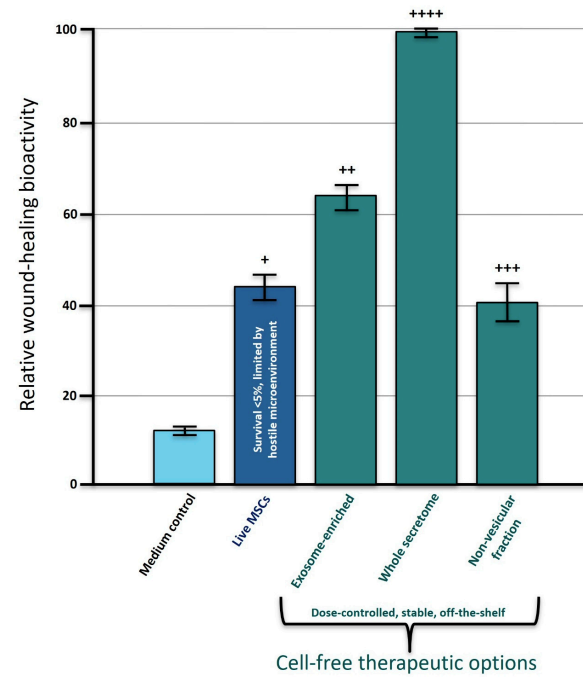
Dangerfield & Metzner (Biomedicines, Apr 2026) review a key insight building in the literature: the dominant therapeutic mechanism of MSCs is paracrine, not engraftment.
MSCs secrete a rich mixture — growth factors, cytokines, lipid mediators, mRNA, miRNA, and extracellular vesicles including exosomes. This secretome modulates the local environment, suppresses inflammation, and triggers endogenous repair.
Natural next question: what if you could capture those signals directly, without requiring live cells? That's the premise of secretome- and exosome-based therapies.
The data is striking (chart below). Whole secretome outperformed live MSCs on wound-healing bioactivity in head-to-head comparison. Live MSCs face a real constraint: <5% cell survival in hostile tissue microenvironments post-infusion.
Cell-free advantages:
— Standardized, lot-tested dosing
— Multiple therapeutic batches per donor
— No allogeneic cell viability constraints
— Outpatient-compatible
— Simpler cold-chain
Evidence spans osteoarthritis, chronic wounds, stroke, TBI, and neurodegenerative disease. Focus: umbilical cord Wharton's jelly MSC secretome for precision longevity medicine.
Regulatory landscape is evolving too — cell-free products occupy a different classification space than living cell therapies.
This isn't a replacement argument. MSCs opened the door. The secretome may be how we walk through it at scale.
Not medical advice — tracking the science.
→ https://t.co/lI6Fl6jiWV
The NIH just published the first human atlas of senescent cells. It reframes everything about how senolytics should be designed. Thread.
SenNet Consortium — Farzad et al., Cell 2026. Single-cell + spatial multi-omics across multiple human organs, age groups, and disease states.
Central finding: senescence is not one state. They call them "senotypes." A senescent astrocyte in brain white matter looks nothing like a senescent hepatocyte in fibrotic liver or a B cell in an aging lymph node.
This has a direct implication: every senolytic drug developed to date has been designed against a single generic "senescent cell." That target doesn't exist as a uniform entity in human tissue.
What SenNet actually found by tissue:
Brain: age-associated endothelial + astrocyte senescence concentrated in white matter and cortical layer 1
Lymph nodes: spatial accumulation of germinal-centre B-cell senescence with progressive immune architecture remodeling
Liver (fibrotic): CDKN1A+ hepatocytes, SERPINE1+ age-associated hepatocytes, CXCL12+ fibroblasts, CXCR4+ immune cells
Chronic wounds: p16+ senescent cells spatially clustered with cytotoxic T cells — senescence + immune co-localization
Two clinical takeaways:
1. Plasma proteomic signatures from SenCat link to kidney disease, diabetes, frailty, and mortality. Senescent cell burden is detectable from blood — if you're measuring the right proteins.
2. Lipid senolytic: α-eleostearic acid kills senescent cells via ferroptosis (ACSL4–LPCAT3–ALOX15 axis). Non-pharmacological mechanism. Could be accessible via dietary lipid manipulation.
The honest caveats: heterogeneity creates a definitional risk — if every tissue produces a different senotype, "senescence" risks becoming unmeasurable. ML signatures trained on in vitro models may not map cleanly to human tissue.
But the map now exists. SenNet gives you the targets. Mayo's aptamers (published May 2026) give you the detection tool. The field is assembling the full stack.
Not medical advice — just tracking the science.
Source: Farzad et al., Cell 2026 → https://t.co/GcXljf0T3j
Vascular aging just got reversed — using three drugs already approved for other diseases. Thread.
Kalies, Sedding et al. (Univ. of Halle, Basic Research in Cardiology, 2026) treated senescent human endothelial cells with a cocktail of valproic acid, lithium carbonate, and galunisertib — three FDA-approved compounds, none of them gene therapy.
The result: a brief, self-limiting activation of the body's own Yamanaka factors (Oct3/4, Sox2, Klf4, c-Myc) — no viral vectors, no permanent genetic rewriting. Just a 72-hour pharmacological pulse.
Outcome: senescence markers p16 and p14 dropped significantly, telomere length stabilized, and proliferation/migration/sprouting/tube formation all improved — effects that held up in long-term culture 28 days later.
In vivo, aged (21-month-old) mice treated with the same approach showed significantly better blood flow recovery at 7 and 14 days after hind-limb ischemia — so this isn't just a cell-culture effect.
Why this matters more than a typical OSK gene-therapy headline: these three compounds are already FDA-approved and understood clinically. That's a much shorter runway to translational testing than viral reprogramming vectors, which still carry genomic instability risk.
Endothelial aging is upstream of atherosclerosis, hypertension, and heart failure. A safe, transient way to reset endothelial function — without touching the genome — is a systems-level lever, not just a cell-biology curiosity.
Caveat: in vitro senescence here was replicative (high passage), not natural chronological aging, and clinical applicability in humans is explicitly unproven — the authors say so themselves.
Not medical advice — just tracking the science.
→ https://t.co/T7iKLVX4Xz