I am excited to share our latest pre-print as part of my thesis investigating altered glia-neuron communication in Alzheimer's Disease and how it affects WNT, p53, and NFkB signaling!🧠🧬
1/🧵
https://t.co/kt3XI8JdCh
#Alzheimers#CellCommunication#snRNAseq
1/🧵 I’m excited to share the next portion of my dissertation work examining alternative splicing in a rare disease is now on bioRxiv! 🎉
https://t.co/EKZrpMFos5
Thanks to my coauthors @tchowton@tabea_soelter@bnlasse and also @jordan_whitlock for generating this great dataset
I am thrilled to announce I will be continuing in the rare disease space and have become the latest member of the SETBP1 Society Medical & Scientific Advisory Board. I am truly honored to be working with the @setbp1 team this 2024!
1/🧵 Excited to announce my first first-author research article in the Lasseigne Lab is now available on bioRxiv! ✨🧬🧠
https://t.co/EOY2bdLKUc
Many thanks to coauthors @tchowton@vlflanary_mstp@Dr_AClark@bnlasse
I am excited to share our latest pre-print as part of my thesis investigating altered glia-neuron communication in Alzheimer's Disease and how it affects WNT, p53, and NFkB signaling!🧠🧬
1/🧵
https://t.co/kt3XI8JdCh
#Alzheimers#CellCommunication#snRNAseq
7/ Overall, our results suggest that cell-cell communication between glia and neurons is altered in a cell-type-specific manner and affects canonical signaling pathways like WNT, p53, and NFkB in AD inhibitory neurons.
6/ We found that transcription factors functioning as signaling mediators showed differential activity in AD, and the canonical signaling pathways WNT and p53 showed decreased activity, while NFkB activity was increased in inhibitory neurons.
5/ We confirmed that interactions altered in AD were mostly cell-type-specific. We predicted 17 high-confidence interactions conserved across datasets, which included 2 AD-risk genes (APP and APOE). We also predicted interactions involving semaphorins and plexin receptors.
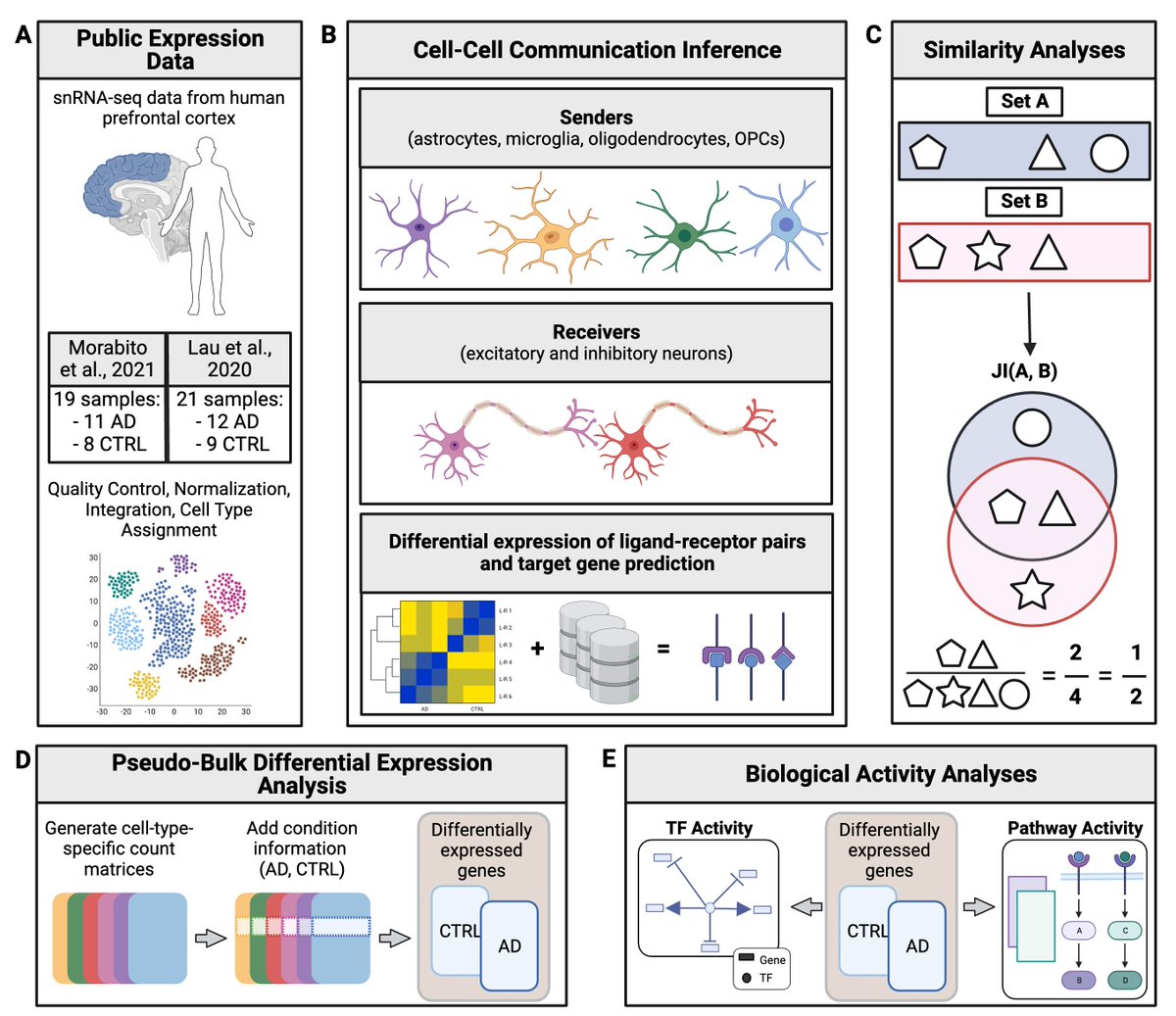
4/ We used two publicly available AD snRNA-seq datasets from human postmortem prefrontal cortex to infer altered communication between glia and neurons. We explored the downstream effects of interactions conserved across datasets through transcription factor and pathway activity.
3/ Although neuronal loss is a primary hallmark of AD, non-neuronal cell populations are ultimately responsible for maintaining brain homeostasis and neuronal health through intercellular communication.
2/ In this study, we predicted altered cell-cell communication between glia and neurons and their downstream effects on transcription factor and canonical signaling pathway activity in Alzheimer’s disease (AD).
Super excited to share our latest pre-print part of my thesis work investigating cell-type-specific gene expression and regulation in atypical Setbp1 (p.S858R) Schinzel Giedion Syndrome (SGS) mice
🧬/1
https://t.co/FZsnwXNMTw
#RareDisease#snRNAsreq#networks#celltypespecific
August 1st: provides an excellent opportunity for a reset, planning, and preprinting and submitting my first author research article on my thesis work!
Hint: 🖱️+ 🧠🫘🦓 + 🧬👩🔬 + 🔨👩💻🐼🦙🎯🧐 = 📃
Thread incoming
Kudos to Reviewer #3, who closed w/ this:
"Praise for the authors:
I try to end all of my reviews with areas of the paper I really liked because I know reviews can be hard to read. So here are a few areas of the paper where I thought the writing really shined."
1. __
2. __
3. __
1/ 🧬 Delighted to share our new paper CINmetrics, an #Rpackage for analyzing copy number aberrations as a measure of chromosomal instability. Oza et al. 2023. PeerJ 11:e15244. Check it out: https://t.co/k9SJi08Dun #Genomics#Bioinformatics#CancerResearch#R
1/🧬🔍 Late to the party but excited to share our paper in PLOS Computational Biology! We provide essential guidelines and best practices in form of 10 simple rules for making the most of publicly available biological data. https://t.co/lNIdjxO30P