I'm excited to share our new paper, “Self-Assessment Reinforcement Learning for Search-State Awareness in Retrieval-Augmented Large Language Models (SARL).”
📄 Paper: https://t.co/zN8st2HGmK
#SearchAgents#LLM#AI#RAG#Agents
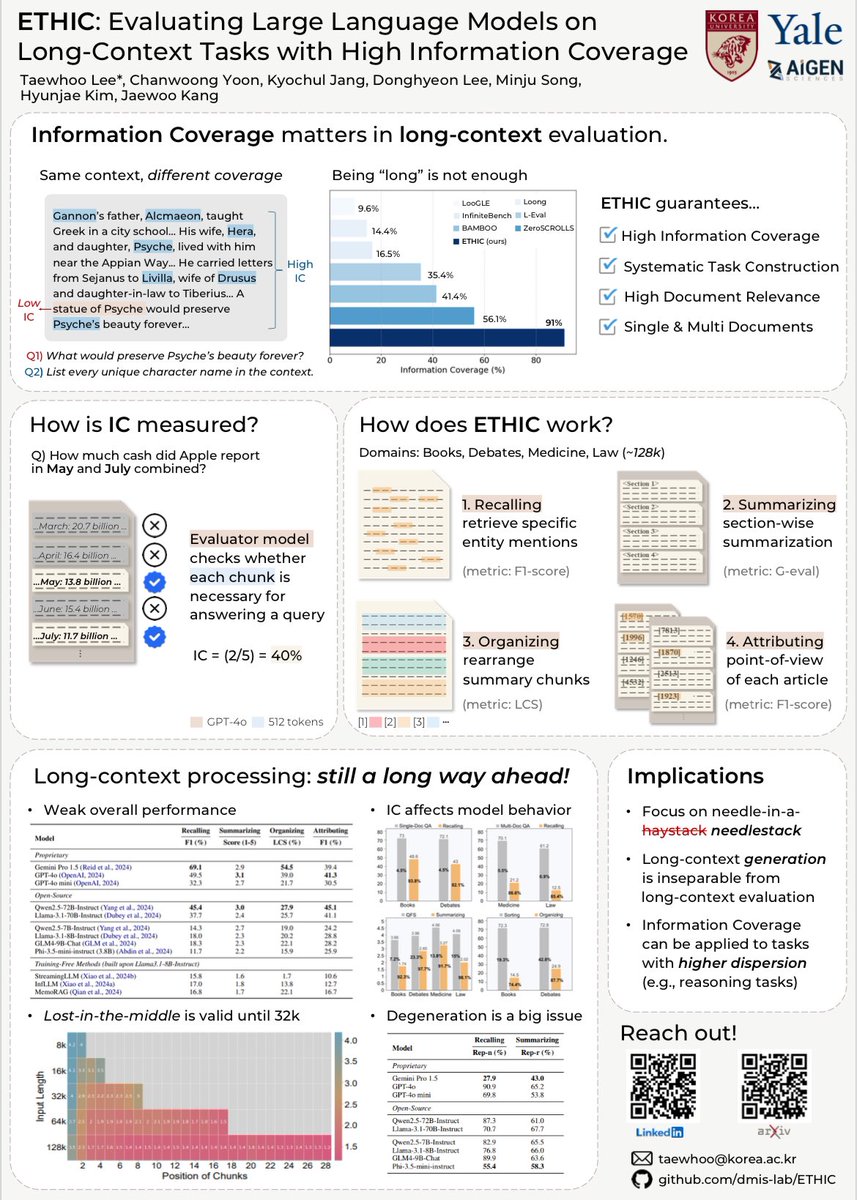
Excited to present 𝐄𝐓𝐇𝐈𝐂 at #NAACL2025 ! Looking forward to open discussions on long-context modeling, evaluation, or anything else :)
🗓️ Friday, May 2, 11:00-12:30
📍 Hall 3, Session K, Poster Session 8
🤔Modern LLMs are known to support long text, but can they 𝐟𝐮𝐥𝐥𝐲 𝐮𝐭𝐢𝐥𝐢𝐳𝐞 the information available in these texts?
💡Introducing 𝐄𝐓𝐇𝐈𝐂, a new long-context benchmark designed to assess LLMs' ability to leverage the entire given context.
https://t.co/uffrKOFr7h
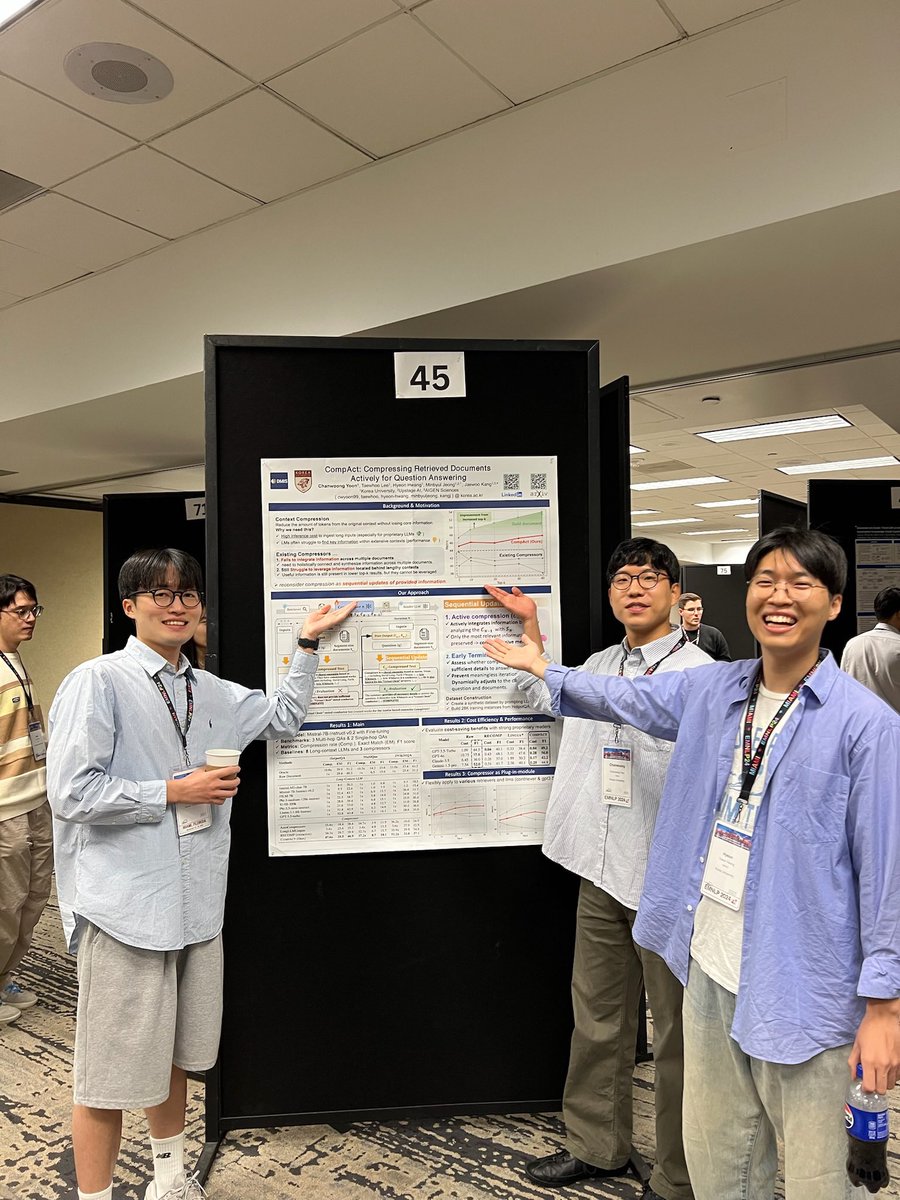
Had so much fun attending #EMNLP2024 ! Every conversation I had with fellow researchers was truly inspiring and insightful. Big thanks to @cw_yoon99@HyeonHwang8@jeongminby98858 for the amazing teamwork over the past several months. Moving on to the next one!
Happy to share that CompAct has been accepted to EMNLP 2024 Main 🎉
Congratulations to our team @cw_yoon99@HyeonHwang8@jeongminby98858 , and see you in Miami !
🚀Looking for an advanced compressor for multi-hop QA tasks while leveraging increased top-k documents effectively? Introducing ✨CompAct✨, a novel framework that employs an active strategy for compressing extensive documents. [1/5]
paper: https://t.co/0KAXndZTrk
# On the "hallucination problem"
I always struggle a bit with I'm asked about the "hallucination problem" in LLMs. Because, in some sense, hallucination is all LLMs do. They are dream machines.
We direct their dreams with prompts. The prompts start the dream, and based on the LLM's hazy recollection of its training documents, most of the time the result goes someplace useful.
It's only when the dreams go into deemed factually incorrect territory that we label it a "hallucination". It looks like a bug, but it's just the LLM doing what it always does.
At the other end of the extreme consider a search engine. It takes the prompt and just returns one of the most similar "training documents" it has in its database, verbatim. You could say that this search engine has a "creativity problem" - it will never respond with something new. An LLM is 100% dreaming and has the hallucination problem. A search engine is 0% dreaming and has the creativity problem.
All that said, I realize that what people *actually* mean is they don't want an LLM Assistant (a product like ChatGPT etc.) to hallucinate. An LLM Assistant is a lot more complex system than just the LLM itself, even if one is at the heart of it. There are many ways to mitigate hallcuinations in these systems - using Retrieval Augmented Generation (RAG) to more strongly anchor the dreams in real data through in-context learning is maybe the most common one. Disagreements between multiple samples, reflection, verification chains. Decoding uncertainty from activations. Tool use. All an active and very interesting areas of research.
TLDR I know I'm being super pedantic but the LLM has no "hallucination problem". Hallucination is not a bug, it is LLM's greatest feature. The LLM Assistant has a hallucination problem, and we should fix it.
</rant> Okay I feel much better now :)