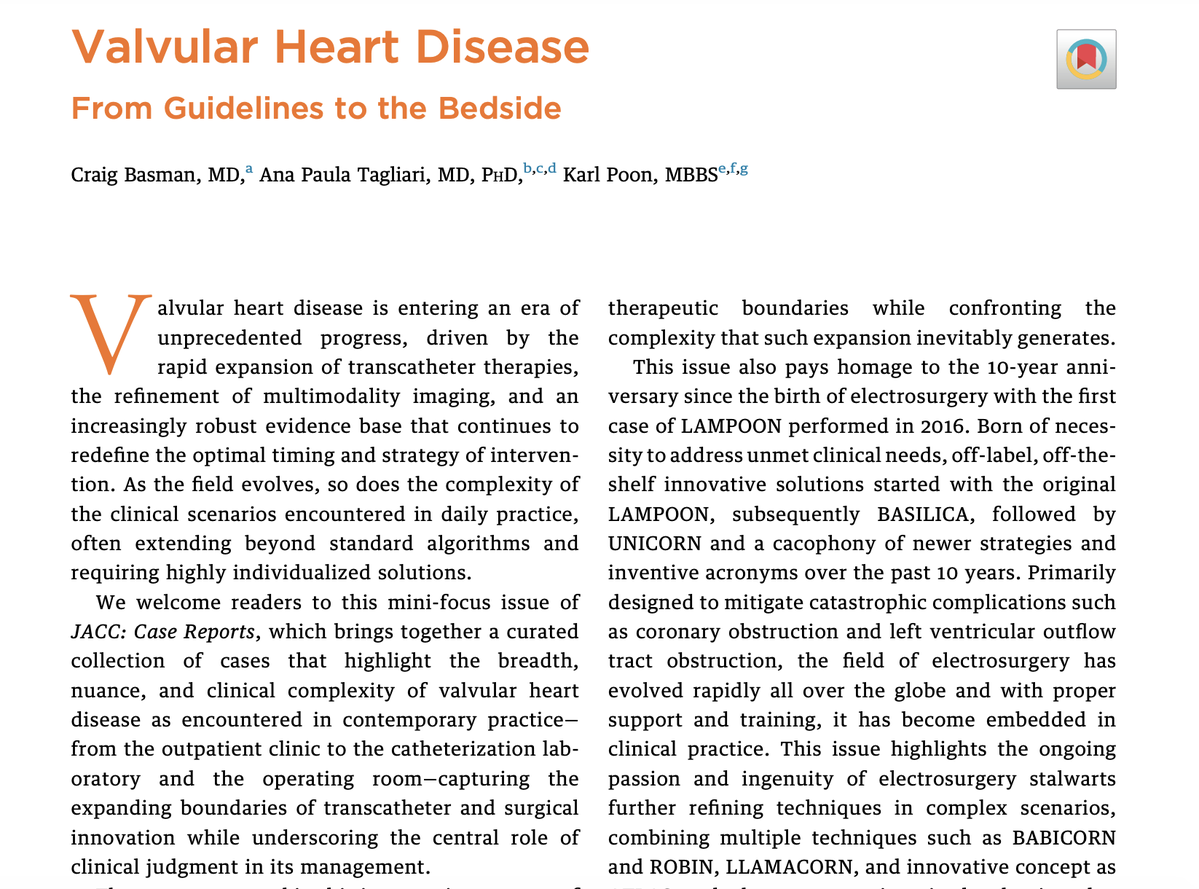
In one of the greatest issues, this edition of #JACCCasereports features leaflet modification, valvular shock and innovative surgical/transcatheter techniques. (see my editorial below)
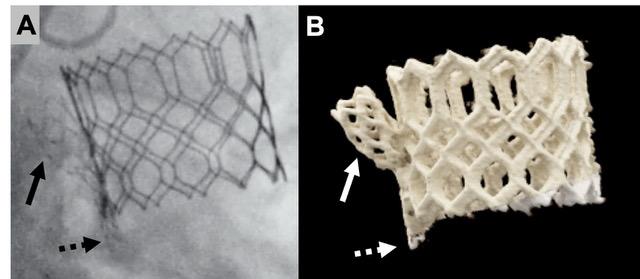
My personal favorite coming from @ShaareZedekMed hospital with @DvirDanny@AnnaTuryan@TaiebPhil describing the ATLAS technique to help secure #TAVR in patients with little calcium and high risk of embolization.
https://t.co/husKD8q803
Congrats @JACCJournals for an outstanding mini-focus on leaflet modification and valvular heart disease.
#structuralheart #cardiotwitter
Honored to share our Optimize PRO study at #EuroPCR, highlighted by @JACCJournals.
Largest collaborative evaluation of implantation depth in #TAVR. Higher Evolut implantation was linked to a 2.3% 1-year pacemaker rate, improved valve function in men, and no added safety concerns
Excited to share our editorial just published in JACC: Clinical Electrophysiology:
🔗 https://t.co/dhwKTyt8h8
Lead Jailing or Lead Liberation?
An editorial on Traynor et al. reporting outcomes of patients with transvalvular CIED leads undergoing TTVR from the TRIPLACE registry.
Key takeaways: • Lead jailing is often feasible with acceptable short–mid term outcomes
• Lead dysfunction remains relatively low (~6%) but clinically relevant
• Higher residual PVL observed with jailed leads, but early clinical outcomes were similar
• Lead extraction should be preferred when it can be safely performed; otherwise, lead jailing is a reasonable strategy
As TTVR expands, careful patient selection and multidisciplinary heart-team decision making are critical—and long-term data on lead durability are urgently needed.
#Cardiology #EPeeps #TTVR #StructuralHeart #Electrophysiology
@JACCJournals@escardio@PCRonline
CORRECTION: I mistakenly reported the procedural mortality. I was looking at the table in supplement and for some unclear reason there it states 2/155 (1.3%) but it should be 2/446 (0.44%), which is around expected periprocedural mortality. My apologies.
Here are my reservations on the CLOSURE-AF findings:
I would have no difficulty accepting a trial showing that LAAO is inferior to medical therapy. But if a trial fails, the reason for that failure should make clinical sense — whether due to lower efficacy for stroke prevention or a lack of meaningful bleeding reduction.
What I struggle with is the reflex to blindly accept evidence uncritically when it appears to contradict clinical logic so directly.
A few points stand out:
1. The medical arm does not reflect true high-bleeding-risk practice.
More than 85% of patients in the medical therapy arm were treated with DOACs or even more intensive antithrombotic regimens. That is difficult to reconcile with the population the trial is supposed to represent: patients at truly high bleeding risk or with contraindications to anticoagulation.
Are we really supposed to believe that this group experienced fewer bleeding events than patients in the device arm, most of whom were on SAPT or no antithrombotic therapy after 3–6 months?
2. Crossover was substantial.
Thirty-two patients crossed over to the medical arm, representing about 7% of the trial population. That is not trivial and complicates interpretation.
3. Procedural safety was unexpectedly poor.
A periprocedural complication rate of 6.2% is strikingly high — more than 3 to 4 times higher than what has been reported in contemporary practice, including SURPASS (~1.3%) and even randomized data such as Amulet IDE.
A periprocedural mortality rate of 1.2% is frankly alarming. For so-called expert centers, this is difficult to ignore.
The 4.3% rate of periprocedural bleeding is also difficult to accept as representative of modern LAAO practice. In experienced hands, venous access with a 12–14 Fr sheath — especially when closed with ProGlide or even a figure-of-8 stitch — should rarely lead to clinically significant bleeding in patients who are not anticoagulated.
It is also notable that no meaningful subanalysis was presented by device type, despite prior signals suggesting differences in procedural safety between platforms.
4. The bleeding signal may actually favor LAAO over time.
Bleeding beyond 3–6 months was lower in the device arm than in the medical arm. That is exactly what one would expect biologically. LAAO exchanges an upfront procedural risk for a lower cumulative long-term bleeding burden.
If so, the benefit should become more apparent with longer follow-up and the benefits might still appear after longer follow-up.
In addition, this makes the loss to follow-up particularly important. As roughly 25% of patients were lost to follow-up after the first 6 months, that creates a meaningful bias against demonstrating the long-term advantage of LAAO.
5. The excess in cardiovascular death also raises mechanistic questions.
The device arm showed more cardiac arrests and more MIs. But what is the plausible mechanism?
A device-related embolic explanation seems unlikely given that ischemic stroke rates were similar between groups, and strokes account for the vast majority of AF-related systemic embolic events.
A more plausible explanation would be procedural factors — air embolism, tamponade, thromboembolism — but if that is the case, then the issue is again procedural quality, not a true indictment of the LAAO strategy itself.
I am very interested to see the results of CHAMPION-AF. This may end up being a situation similar to COAPT vs MITRA-FR: same concept, very different trial signals, and a very different interpretation once the dust settles.
When data contradict common sense, the answer is not to abandon common sense immediately — it is to examine the data more carefully.
#Cardiology #CardioTwitter #EPeeps #Afib #LAAO
#StrokePrevention #ClinicalTrials #MedTwitter #StructuralHeart
@NEJM@DFCapodanno@drjohnm@AsherElad@escardio
you're absolutely right. I was looking at the table in supplement and for some unclear reason there it states 2/155 (1.3%) but you are right it should be 2/446 (0.44%), which is around expected periprocedural mortality. Thank you for pointing it out and sorry. Will correct it in my post.
My presentation has been accepted for #EuroPCR this year. 🎉 Thrilled to share my insights and dive into vibrant discussions with my peers in Paris, on 19-22 May 2026! Can't wait for this inspiring experience! #PCRPresenter@PCRonline https://t.co/wvL06IAT1A
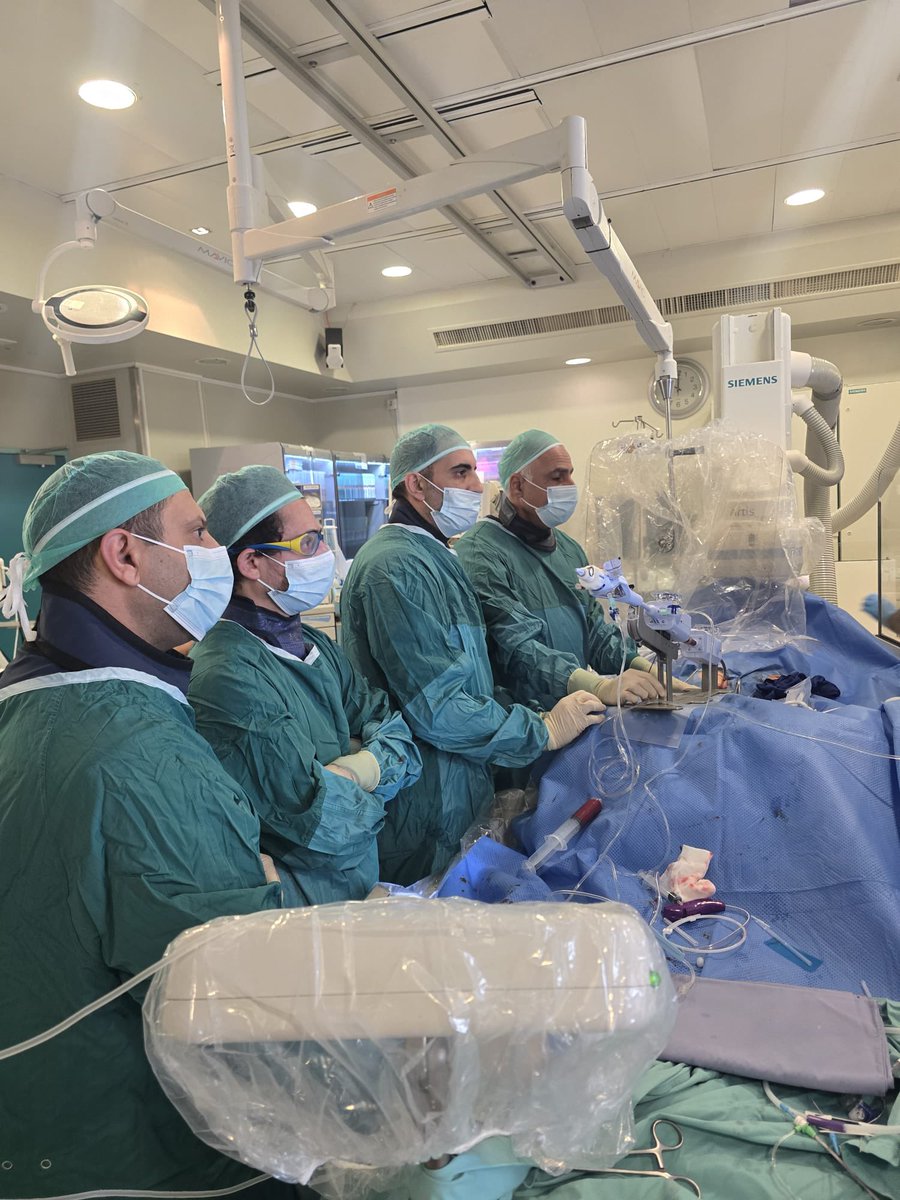
🚀 First in Israel – 3D ICE–Guided TriClip
A major milestone at Shaare Zedek Medical Center:
The first 3D ICE–guided TriClip procedure performed in Israel.
Kudos to:
•Prof. Mony Shuvy
•Dr. Mohammad Carmi
•Dr. Philippe Taieb
•Echo expert Amjad Abu Salman