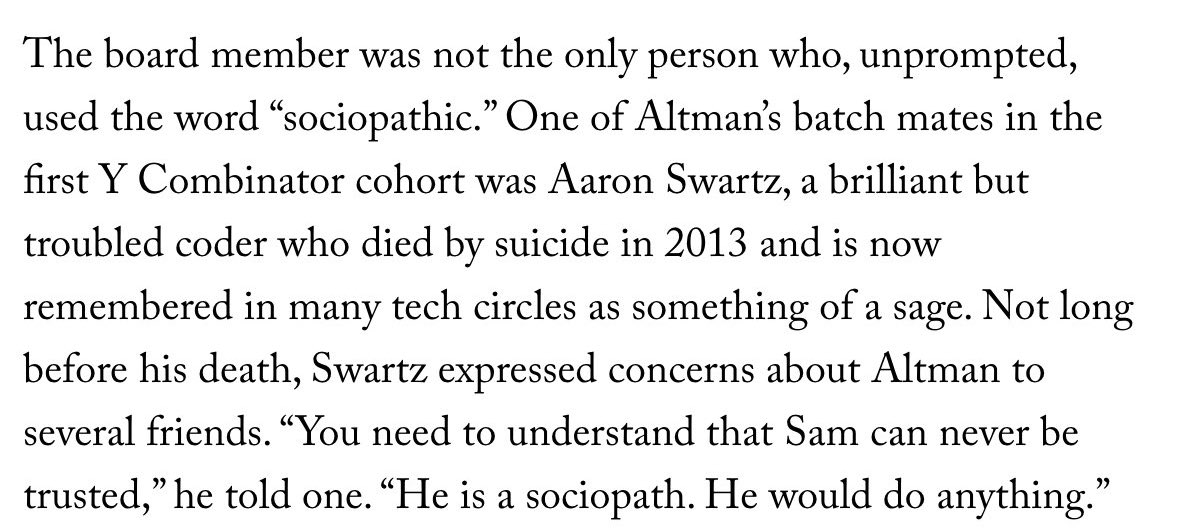
"You need to understand that Sam can never be trusted."
"He is a sociopath. He would do anything."
- Aaron Swartz on Altman, shortly before he took his own life
FFmpeg is moving to Rust 🦀
Our use of C and Assembly in FFmpeg has been an unacceptable violation of safety.
FFmpeg will be running 10x slower - but we're doing it for your safety.
All your videos will appear green - safety first, working software later.
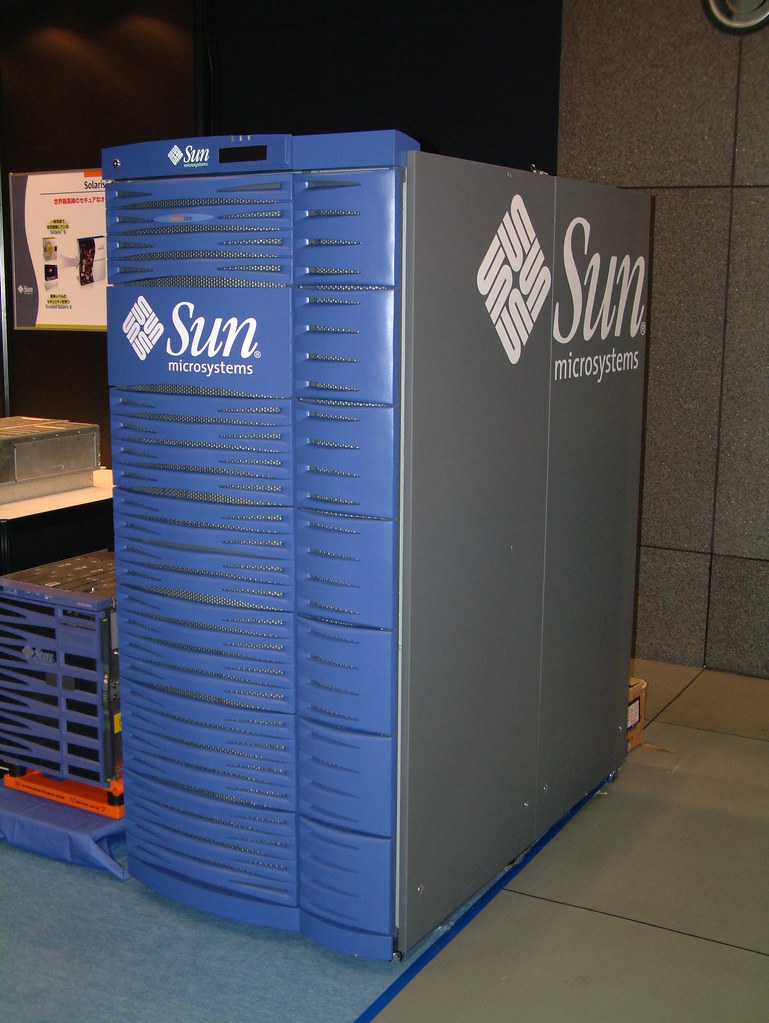
In 2004 the Sun Fire E25k was the apex predator of computing. This was the largest single-image Unix machine that money could buy ($2M fully loaded).
This bad boy had:
• 36 UltraSPARC IV processors (72 cores)
• 576 GB RAM
• 18 fully hot swappable CPU/memory boards
• gigabit ethernet and fibre channel HBAs
• Redundant power supplies, cooling zones, draw 15kW of power
I deployed software to these things. Uptime was measured in years. This was THE ONE.
Man I miss Sun.
Incase you missed it, incredible things are happening in the front end design world:
https://t.co/uVta2yqJmh
https://t.co/XXBe8Gevyc
https://t.co/9UoKZggg0E
https://t.co/ApgrljN8Zf
https://t.co/VpsLKPC6oZ
https://t.co/waXFJl7KQ4
"Fast Car" - by Tracy Chapman.
It is literally the story of life. Ambition, hope, romance, marriage, economics, heartbreak, acceptance & re-discovery.
How the man she married ended up becoming the very father she was running from. Couldn't outrun her past but still trying
If you want to future-proof your career as a distributed systems programmer, stop chasing frameworks and start mastering the primitives that every large system is built on.
These are the things that will still matter 30–50 years from now, regardless of language, cloud, or hype cycle:
1. Concurrency & Parallelism
Threads, async, event loops, actors, scheduling.
Understanding how work actually runs on CPUs is non-negotiable.
2. Networking Fundamentals
TCP vs UDP, congestion control, TLS, HTTP/2 & HTTP/3, gRPC.
Distributed systems are just computers failing to talk to each other.
3. Failure Models
Timeouts, retries, partial failures, cascading failures, split-brain.
Real systems fail by default — resilience is the product.
4. Consistency & Coordination
CAP theorem (beyond slogans), quorum systems, leases, fencing tokens.
When state is shared, correctness becomes a design problem.
5. Distributed Storage Internals
Logs, LSM trees, B-trees, replication, sharding, compaction.
Data durability and performance shape everything upstream.
6. Time & Ordering
Logical clocks, vector clocks, monotonic vs wall time, clock drift.
If you don’t model time correctly, your system will lie to you.
7. Messaging & Streaming
At-least-once vs exactly-once, backpressure, consumer lag, replay.
Data in motion is harder than data at rest.
8. Load, Backpressure & Flow Control
Rate limiting, queues, bounded buffers, admission control.
Good systems degrade gracefully instead of falling over.
9. Observability as a First-Class Concept
Tracing, metrics, logs, SLOs, error budgets.
If you can’t see the system, you can’t operate it.
10. Security as a Distributed Problem
Identity, auth, key rotation, zero trust, blast-radius reduction.
Security failures scale just as fast as data does.
11. Operational Simplicity
Boring architectures, predictable failure modes, easy rollback.
Systems survive decades because humans can operate them.
12. Resource Economics
Latency vs throughput, memory vs CPU, network vs compute.
Every design decision is a cost trade-off, whether you admit it or not.
These aren’t trends.
They are physical laws of computation at scale.
Languages change. Clouds change. Tools come and go.
But distributed systems will always be about coordination, failure, and trade-offs.
Pick one of these areas.
Go uncomfortably deep.
Build systems that break and then learn why.
Do that, and you won’t worry about being replaced by AI.
You’ll be the person AI systems depend on.
You spend some capital and buy goats as "mhesh" has advised.
Kidogo, you are raided by your neighbour who steals your goats, because raiding is "cultural" and govt does nothing.
Then, by some miracle, your goats mature and you get a client in Dubai. You realize the govt has placed a million hurdles for export of agricultural produce.
Somehow, you overcome the hurdles and sell your goats for a fat cheque.
6months later, KRA is at your door asking for their "cut". Their cut is almost half your net profit.
You still think it's a profitable business, until "mhesh" steps in and starts his own goat export business. All over sudden, you are being harrassed by local authorities, and are forced to sell to the "mhesh" as a broker.
Realities of venturing out as a farmer