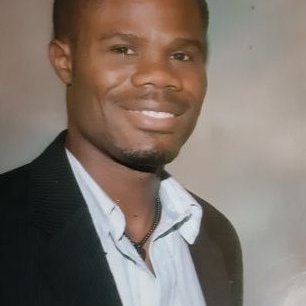
Legal/devt practitioner, law teacher, poet, author, and rights activist. Believes in emancipation of his race from clutches of underdevelopment/neocolonialism.
Before many Nigerian men could dream of becoming pharmacists, a Yoruba woman had already made history.
Meet Oreoluwa Green, the first female pharmacist in West Africa.
Born in Lagos in 1885, she traveled to London to further her education and returned with several professional qualifications in pharmacy, midwifery, and medicine.
In 1916, she became the first West African woman to earn a practical pharmaceutical qualification, breaking barriers for generations of African women.
She later returned to Lagos, where she served her people as a pharmacist, nurse, and midwife, dedicating her life to helping others.
The Green family house still exists today, the house is located in Adekunle, Yaba.
#YorubaHistory #NigeriaHistory #AfricanHistory #LagosHistory
Have you thought about the future of Agentic AI?
We have too, so AWS and @OpenAI leaders recently came together to discuss where agents are working today, and what your organization needs next to lead with AI.
Check out the full stream below.
mentioned you:
Drop your ACCOUNT details. Sharing N10M to the first 1k likes & Repost
Once I see your comment, l'll credit you.
It's weekend let's do something massive
Turn on my notifications 🔔
On March 21, 2007, 30-year-old Christianah Oluwatoyin Oluwasesin was stabbed to death and burnt in her car by Muslim students for allegedly desecrating the Qur'an at a secondary school in Gandu, Gombe State, North-East Nigeria.
A mother of two, Oluwasesin, was assigned to supervise an Islamic Religious Knowledge exam when one of the students wanted to enter the exam hall with books. Oluwasesin collected them and threw them outside.
The students, who claimed that one of the books was a copy of the Qur'an, started to chant "Allahu Akbar" (Allah is Great) and chased her to the school principal's office.
They dragged her out of the office, stripped her naked, slit her throat, stabbed her to death and cut her mutilated body into pieces. They then burnt her corpse in her car, beat up the school principal, a Muslim, for offering refuge to her, and burnt down three classroom blocks, the school clinic, the administrative block and the library. A kind woman rescued her 10-month-old son, Emmanuel, who the mob would have killed.
The marauding students were between 12 and 14 years old and were supposedly joined by members of a gang called Yan Kalare.
The day Oluwasesin was killed was to be her last day in that school, and then she would join her husband in Abeokuta.
Gombe State Governor, Mohammed Danjuma Goje, ordered the immediate closure of all secondary schools in the state and the deployment of soldiers and policemen to strategic points, especially churches.
Three people were arrested in connection with the murder. They were arraigned before the Federal High Court in Gombe, which had not yet delivered judgment on the matter as of this day. Even as we write this. #HistoryVille #CrimeStories
90% of tech founders build enterprise networks but structure their company like an open Wi-Fi node.
If your operational risk & proprietary IP sit in the same container, you are one lawsuit from total failure.
This interview is the holy grail of insight needed to rehabilitate the human race.
Watch Australian biologist Jeremy Griffith explain his revolutionary breakthrough in understanding human behaviour we've been waiting for.
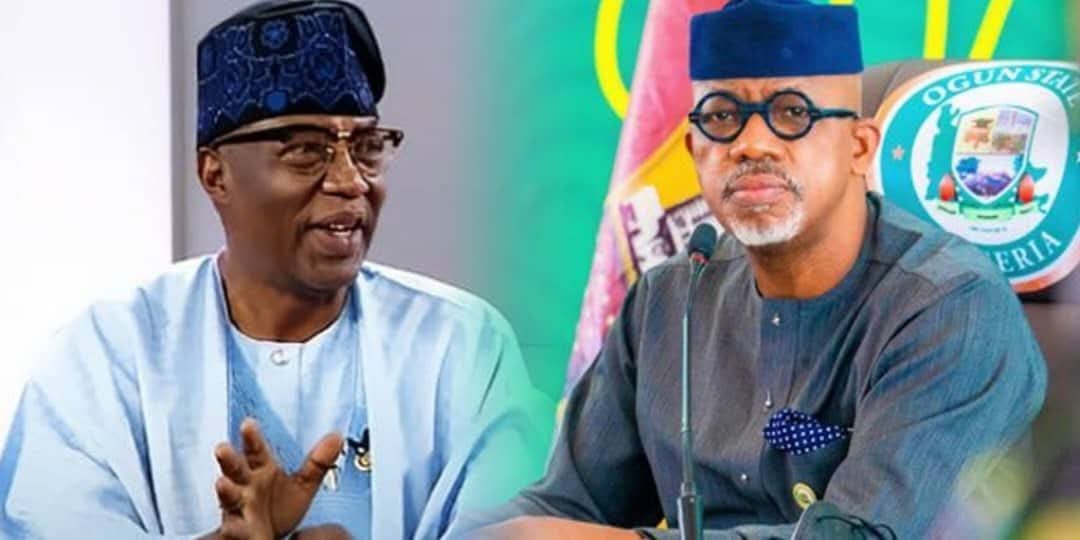
Breaking the Silence: The Truth Behind the Lies Against Me — OGD Speaks
I have maintained a stoic silence, especially on political matters, out of respect for what I considered to be the overall interest of the Ijebu heritage. However, I will respond to this particular issue in order to set the record straight.
*Ref: Video Recording by Governor Dapo Abiodun*
As has become typical of our Governor, his account was riddled with mischief and outright falsehoods. I have remained muted until now out of respect for the office of the Governor of Ogun State, a position I was privileged to occupy. Unfortunately, that respect appears undeserved by the current and outgoing occupier of that office, Prince Dapo Abiodun, whom I will refer to as PDA for the purpose of this exposition. Please read patiently.
*Act 1, Scene 1: December 2002 – PDP Primaries, Abeokuta*
Results:
OGD – 178 votes
PDA – 32 votes
Okupe – 31 votes
Shoda – 10 votes
Adefulu – 1 vote
PDA had led a coalition of the other contestants, arguing that I was not a “pure Remo” man but an Ijebu man. At the time, the rule required a candidate to secure at least 51% of the votes to emerge winner. In PDA’s calculation, even if I led, I would fall short of that threshold, forcing a rerun where the others would unite with him against me.
However, with 178 out of 250 votes, I secured over 70% and was duly declared winner, despite numerous underhanded efforts against me. I hope I will not be compelled to open that chapter fully.
*Act 1, Scene 2*
PDA did not hand over any political structure to me; in fact, I doubt he had any structure to hand over. On the contrary, it was Sen. Jubril Martins Kuye who handed over his structure, and I ensured that members of that group were well accommodated.
Notable individuals included Mrs Apampa, Alhaji Lekan Mustapha (later Honourable and Distinguished Senator under my watch), Alhaji Sarafa Tunji Ishola (later SSG, Minister, and then Ambassador through Gov. Amosun), and Hon. Segun Adekoya (Attacker), one of my finest commissioners.
While other contestants accepted the outcome of the primaries, PDA disappeared to Abuja. I must acknowledge Prince Emma Shoda (rtd. Colonel), who played an exceptional role in reconciling stakeholders and supporting my administration without seeking any appointment.
When the opportunity arose, I appointed PDA to oversee our Olokola Free Trade Zone initiative. The full story of how we lost the Dangote Refinery to Lagos will be told someday if necessary.
Notably, one of PDA’s loyalists, Koye Ijaduoye, publicly criticized me harshly. Yet, I still appointed him as my Special Adviser and carried him along till the end of my tenure. I made deliberate efforts to integrate PDA’s associates. Therefore, the claim that PDA handed over any structure to me is false.
*Act 2, Scene 1: 2003 Elections*
The 2003 election against an incumbent was intense. Senator Ibikunle Amosun fought alongside me in Ogun Central, although he had already begun his own gubernatorial ambition before I was sworn in.
PDA later aligned with Amosun (SIA), but instead of fostering peace, his role reportedly worsened tensions between us. This became evident years later when Amosun visited me and revelations were made regarding PDA’s conduct.
It is clear that the bitterness from the 2002 primaries never truly subsided.
*Act 2, Scene 2: 2015*
Buruji Kashamu offered me the PDP senatorial ticket for a fee, which I rejected. In 2019, he offered it again without charge after I assisted him in a legal matter. Before his passing, he reportedly instructed his structure to support me and expressed regrets over past misinformation.
Back to 2015: one night at Asoludero Court, a mutual friend Kashim Imam visited me and brought along a surprising guest, PDA. He had secured the APC senatorial ticket and didn’t know how to approach me for support. He specifically mentioned some of my loyalists in Odogbolu, including Bisi Ogunde and Deji Kalejaiye.
@HighChiefOkoro One of the marks that make Yoruba who they are. It is part of Yoruba culture to say thank you the next day when you help them. It is rendered in the proverb 'thank or praise your helper to get helped the next time (Yinni Yinni ko le se emin).
Cynthia Temitayo Ogunsemilore Oshoba, she remains unbeaten in her professional career so far. She's an indigene of Ogun state.
She had 9 professional fight in total in which 5 of it are complete knockout
Her record is currently9-0-0 (9 wins, 0 losses, 0 draws).
#YorubaGreatness
@SegunShowunmi@fkeyamo Most comments on the cargo airport often forget the pioneering lead of Otunba Gbenga Daniel. He laid the foundation. Better to always put such a historical perspective in the narration.
Anglican Bishop Samuel Ajayi Crowther and his son Dandeson, c. 1870.
Following in the footsteps of his father, Dandeson Coates Crowther translated the Anglican Book of Common Prayer, "Dusk to Dusk," into Igbo. He also translated a portion of the Bible book of Jeremiah into Yoruba.
Archdeacon Dandeson Coates Crowther (September 24, 1844 - January 5, 1938) was a distinguished clergyman and a pivotal figure in the Anglican Church across West Africa. The son of Archbishop Samuel Ajayi Crowther, he played a crucial role in the Christianisation of the Niger Delta and the establishment of an independent African-led church.
Born in Sierra Leone, Crowther was drawn to the ministry from an early age. He joined the Church Missionary Society (CMS) in 1870 and, by 1876, had been appointed Archdeacon of the Niger Delta. He is widely credited with spearheading the "mass movement" towards Christianity in the region during the 1870s. His leadership ultimately led to the first significant African-led secession from the Anglican Church when he founded the Niger Delta Pastorate.
Dandeson Coates Crowther was ordained at St Mary's Parish Church by his father, Samuel Ajayi Crowther. Before assuming his archdeaconry, he served in various capacities, including as his father's secretary and chaplain, as well as Senior Pastor in Bonny, in the Niger Delta.
Educated across three countries, Crowther studied in Sierra Leone, Nigeria, and England. He attended the CMS Grammar School in Lagos before moving to London, where he studied at the Church Missionary Society College in Islington, graduating in 1863. His contributions to the church were later recognised with the award of a Doctorate of Divinity at Lambeth in 1921.
Crowther's missionary work formally began in 1870 when he was ordained by his father. On June 19 of that year, he became a deacon at St Mary's Parish Church in Islington, before returning to the Niger Delta in 1871 to join the CMS Niger Mission. He was made a priest in Lagos on March 12, 1871, and remained in Bonny until his appointment as Archdeacon of the Niger Delta in 1876.
As Archdeacon-often referred to as "Venerable"-he oversaw the CMS's Lower Niger and Delta stations, leading the Southern Nigeria Province of the mission.
A man of great resolve, Crowther travelled extensively between West Africa and Britain, often aboard Elder Dempster Line ships. Though he moved frequently between London and Nigeria, he sought refuge in Freetown, Sierra Leone, whenever his health deteriorated.
Crowther faced significant opposition throughout his ministry. Many within the CMS hierarchy resisted the idea of African-born clergy assuming leadership roles, and this hostility intensified after the Niger Crisis of 1890. The institutional racism of the time not only undermined his work but also contributed to the immense strain that led to his father's death in 1891.
Letters written by Crowther reveal his awareness of attempts to remove him from the CMS, yet he remained steadfast in his mission. He served as Archdeacon of the Niger Delta until 1926.
In recognition of his lifelong dedication to the church, he was awarded the Order of the British Empire in 1935 and was knighted by the King, becoming "Sir" Dandeson Coates Crowther. He passed away on January 5, 1938, in Freetown, Sierra Leone He was 93.
Source: HistoryVille
Sandra Des Vignes-Millington, popularly known across the Caribbean and the African diaspora as Singing Sandra, remains one of the most intellectually powerful and spiritually grounded voices ever to emerge from Trinidad and Tobago’s calypso tradition. Born in East Dry River, Port of Spain, and raised in Morvant communities shaped by resilience, migration, and ancestral memory she transformed personal struggle into prophetic artistry, using music as both testimony and cultural resistance.
Emerging in the 1980s within a genre historically dominated by male performers, Sandra did not simply compete, she redefined the moral purpose of calypso itself. Her voice carried unusual authority firm yet compassionate confronting social injustice, gender inequality, poverty, and political hypocrisy with fearless clarity. Songs such as Voices from the Ghetto, Song for Healing, and One Destiny One Heart elevated calypso beyond carnival entertainment into a platform for national conscience and community restoration. Her victories as National Calypso Queen, and later as Calypso Monarch becoming the first woman to win the title twice symbolized not only artistic excellence but also the breaking of cultural barriers within Caribbean performance history.
Beneath her musical activism lay a profound spiritual foundation deeply connected to African cosmology. Though baptized within the Spiritual Baptist faith, Sandra later embraced Òrìṣà traditions a sacred inheritance rooted in Yorùbá religious philosophy carried to Trinidad through enslaved ancestors from West Africa. Within this spiritual framework, music was not merely performance but invocation. Rhythm became prayer, melody became healing, and the stage transformed into a ritual space where ancestral voices could speak through contemporary struggle.
Her celebrated composition Ancient Rhythm stands as perhaps the clearest expression of this consciousness a meditation on diaspora identity that echoes Yorùbá understandings of memory, destiny, and communal belonging. Like the praise singers and akéwì of Yorùbá society, Singing Sandra used song to challenge power, honor dignity, and remind people of shared humanity. In her performances, one hears the distant resonance of bàtá drums, the ethical teachings of the òrìṣà, and the enduring belief that sound itself can restore balance.
More than a calypsonian, Singing Sandra was a cultural philosopher of the Caribbean a woman who fused feminism, spirituality, and African diasporic identity into lyrical storytelling. Her work affirmed that the Atlantic did not sever Yorùbá civilization but reshaped it into new languages and rhythms. Through her voice, the sacred continuity between West Africa and the Caribbean remained unmistakably alive, reminding generations that music can be both resistance and remembrance.
#Yorùbá
#ÌwàPẹ̀lẹ́
#Ọmọlúàbí
#YorùbáPride
#YorùbáRoots
#YorùbáDiaspora
#BiggerThanAfrica
#BlackHistoryMonth
#TrinidadAndTobago
#YorùbáAcrossOceans
Researchers at Obafemi Awolowo University (led by Dr. Olatomide Fadare) just achieved the FIRST fully Nigerian-authored crystal structure of Plasmodium falciparum transketolase bound to an inhibitor — deposited in the Protein Data Bank! This could be game-changing in the fight against malaria & artemisinin resistance.
🌍🔥 WHY DOES Switzerland WHICH DOES NOT CULTIVATE COCOA, MAKE $16 BILLION FROM IT… WHILST GHANA GETS CRUMBS? 🔥🌍
Let that sink in.
The small European nation of Switzerland — a country that doesn’t even grow cocoa — makes over $16 BILLION a year from chocolate.
Meanwhile, Ghana — one of the world’s largest cocoa producers — earns only a fraction of that from exporting raw beans.
How is this possible? 🤔
Because Africa exports raw materials…
And the West exports finished products.
🍫 Ghana grows the cocoa.
🏭 Europe processes it.
💰 Europe brands it.
🛍️ Europe sells it.
And Europe keeps the REAL money.
For decades, Africa has been stuck at the bottom of the value chain — doing the hard work but earning the smallest reward.
But now… something is changing. 👀🔥
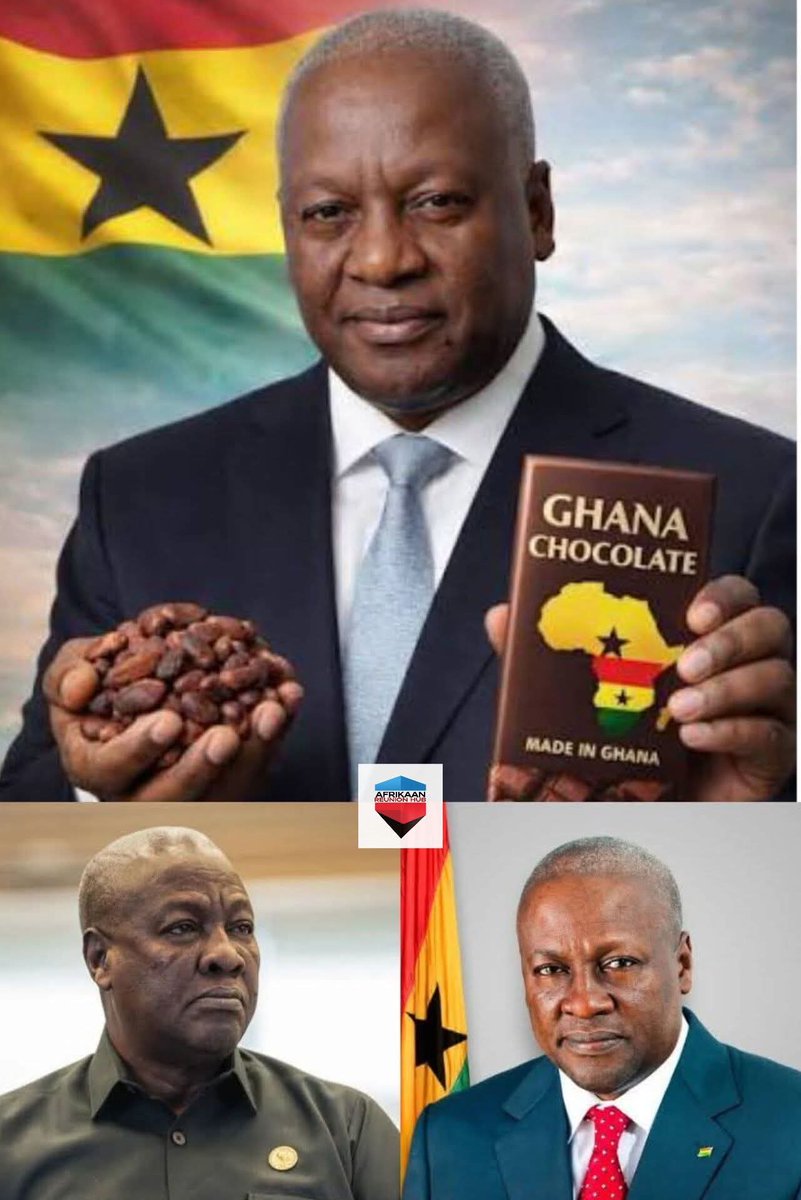
🇬🇭 Ghanaian President John Dramani Mahama has declared that Ghana will stop simply selling cocoa to foreign countries.
Instead, Ghana will start producing its own chocolate.
This is not just about sweets.
This is about sovereignty.
This is about economic power.
This is about breaking free from a colonial trade system designed to keep Africa dependent.
Imagine this:
Instead of exporting cocoa beans for $2,000 per ton…
Ghana exports premium African chocolate worth $10,000+ per ton.
Instead of foreign brands dominating shelves…
African brands compete globally.
Instead of jobs in Europe…
Jobs in Accra, Kumasi, and Tamale.
This is how nations rise.
Switzerland became rich not because it had cocoa farms — but because it controlled processing, branding, and global distribution.
Africa must do the same.
The real wealth is not in the soil.
The real wealth is in VALUE ADDITION.
If Ghana succeeds, it could inspire Ivory Coast, Nigeria, Cameroon, and beyond to stop exporting raw materials and start exporting finished power.
This is bigger than chocolate.
This is about Africa finally owning its resources.
This is about rewriting the rules.
This is about economic liberation.
🔥 The question is no longer “Can Africa produce?”
The question is “Will Africa keep giving away its profits?”
The era of raw material dependency must end.
One Africa. One Voice. One Future.