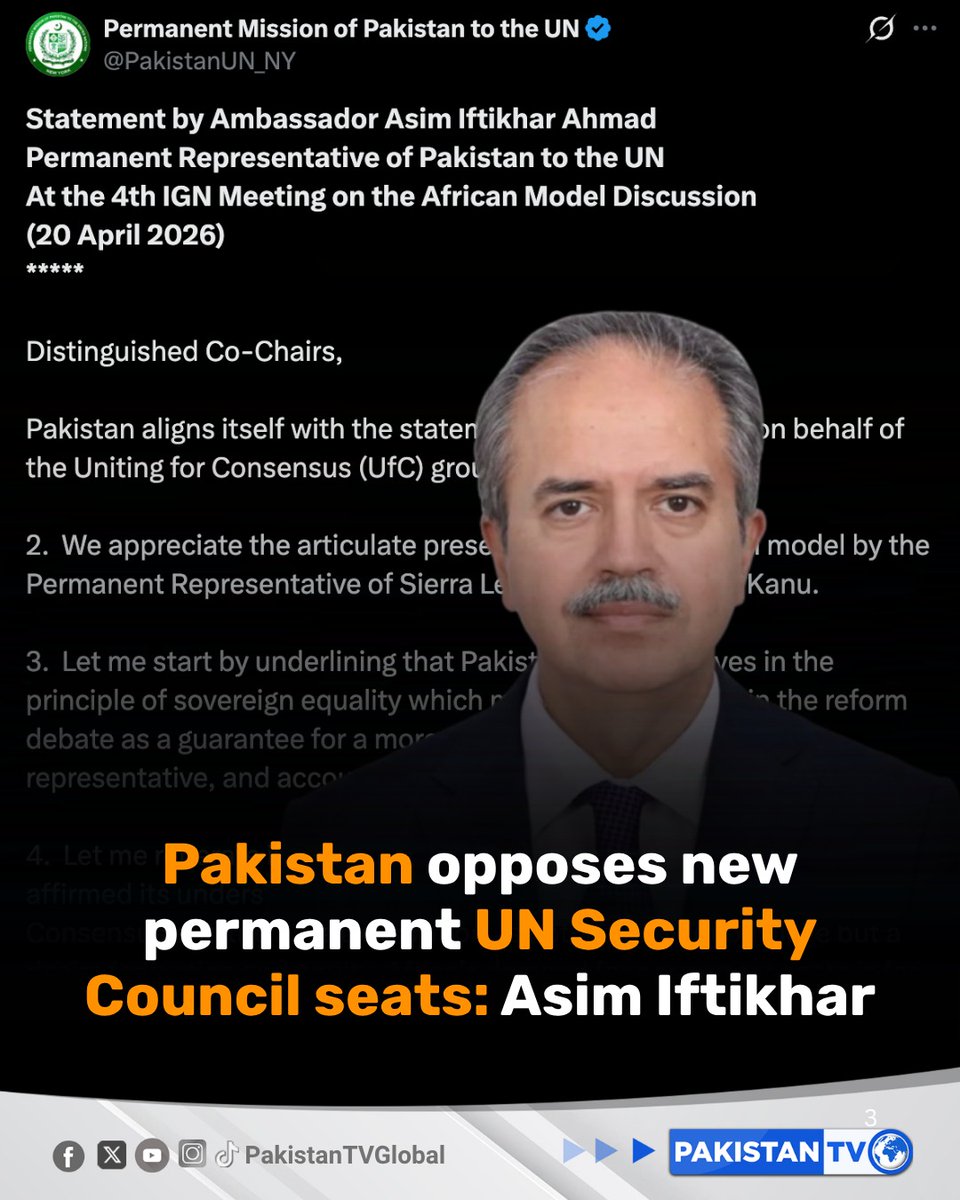
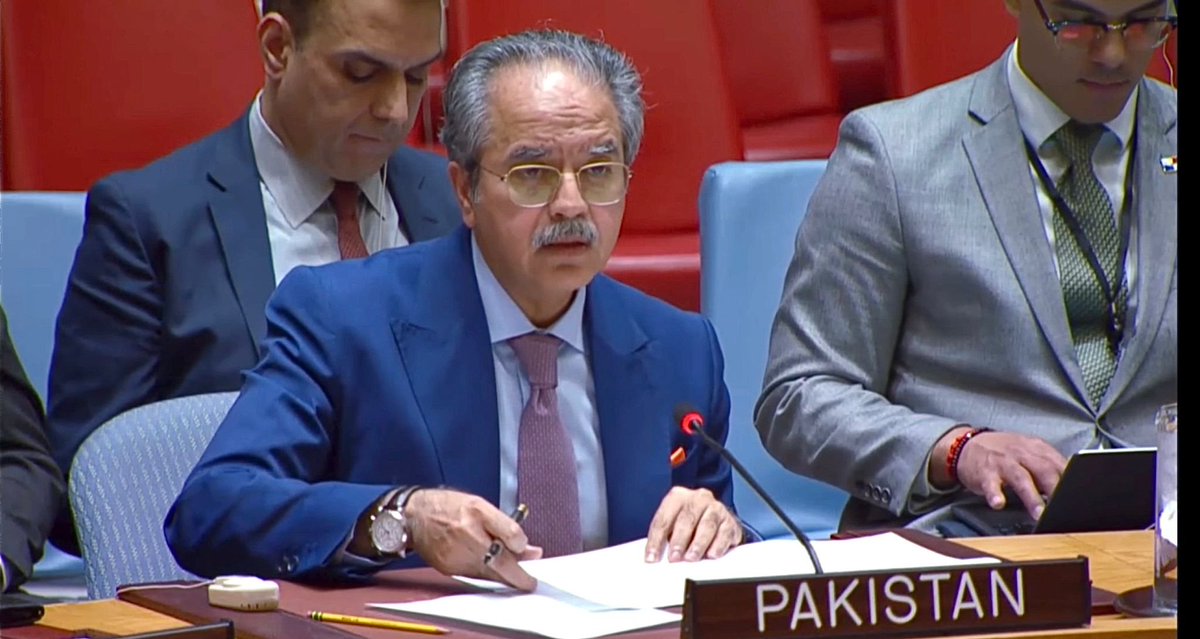
Pakistan’s Permanent Representative to the UN, Ambassador Asim Iftikhar Ahmad, at the 4th IGN meeting on the African Model Discussion, said Pakistan opposes the creation of new permanent seats as it is contrary to the universally agreed principles of democracy, accountability and transparency, stressing that reform should democratize the Security Council and reflect the interests and aspirations of all UN Member States.
@PakistanUN_NY@Asimiahmad
#UN #PakistanAtUN #SecurityCouncilReform #Diplomacy #PakistanTV
Further Statement by Ambassador Asim Iftikhar Ahmad,
Permanent Representative of Pakistan to the UN,
In Response to Remarks of Representatives of India and Afghanistan
At the UNSC Meeting on the Situation in Afghanistan
(9th March 2026)
************
Thank you Madam President,
I have been compelled to take the floor again after listening to remarks from the representatives of Afghanistan and India.
Madam President,
The so called representative of Afghanistan, who in fact does not represent anyone but himself, must not abuse this forum to pursue his personal agenda. Sequestered in New York, Mr. Faiq, my friend, is completely cut off from ground realities, and he chose to selectively comment on some aspects of the situation, particularly with reference to Pakistan. Therefore, the value and credibility of his remarks are in serious doubt.
Pakistan's legitimate counter-terrorism operations are not directed against the brotherly people of Afghanistan, and are only meant to neutralize the persistent threat of terrorism emanating from Afghan soil, and our actions are in full conformity with the right to self-defense and international humanitarian law.
So it was not surprising that Mr. Faiq had nothing to say about the cross border terrorism from Afghanistan that is so heavily impacting Pakistan in terms of casualties among civilians, among our armed forces, law enforcement agencies and infrastructure.
Madam President,
Given India's animosity towards Pakistan and the sole objective of its Afghan policy being to destabilize Pakistan, including by actively supporting and sponsoring terrorist groups, operating from Afghan soil, such as TTP and BLA, the remarks of the Indian representative come as no surprise.
India's representative deliberated at length on the security situation in Afghanistan. He mentioned civilian casualties and border clashes, but had not a word about the terrorist threat emanating from Afghanistan, which has targeted Pakistan and which many Council members have highlighted in their statements. But there is a reason for that. It is India's complicity in all of this. We have provided irrefutable evidence of India's collusion with terrorist groups that are engaged in orchestrating violent attacks against Pakistan.
One can sense India's pain in seeing its heavy investment in the Afghan terrorist franchise going to waste as a result of Pakistan's precise and effective action against terrorist camps and support bases inside Afghanistan.
And the world needs no lectures from a serial violator of international law like India, a state that illegally occupies territory, violates UN Charter and Security Council resolutions, perpetrates state terrorism in the Indian Illegally Occupied Jammu and Kashmir and beyond, systematically marginalizes its minorities, spreads hate, even weaponizes water with the express goal of starving Pakistan's population, and continues to use disinformation as a state policy. And the list goes on.
Madam President,
While India has always played the role of a spoiler in Afghanistan, Pakistan has engaged responsibly in promoting peace, stability and prosperity in Afghanistan. But these goals can only be promoted if the Taliban regime fulfills its commitments with respect to counter terrorism, inclusive governance and upholding the rights of Afghan women and girls, three key areas that were highlighted by the Council members in today's discussion.
India, in particular, must seize and desist from its policy of stoking terrorism inside Pakistan from Afghan soil, now together with their new found friends in the Taliban regime. While India has long played this dangerous game, we will not allow their sabotage and subversion from Afghan soil to nourish and harm Pakistan.
Thank you
The Pakistan Mission wishes Pakistani-Americans as well as all Muslims on the festive occasion of Eid-ul-Fitr, the day of celebration, empathy, and peace.
On this occasion, let us pray for all those oppressed people who are struggling for their right to self-determination as enshrined in the UN Charter.
Let us especially remember the people of Gaza in our prayers!
"Pakistan’s position on the Ukraine conflict has been consistent. Pakistan has enjoyed friendly relations with both Russia and Ukraine. From the outset we have advocated dialogue and diplomacy, immediate cessation of hostilities and peaceful resolution of this conflict. We believe that the security concerns, which remain at the center of this conflict, can only be addressed through an inclusive approach, which in turn would ensure the sustainability and durability of peace in the wider region."
Ambassador Asim Iftikhar Ahmad, Permanent Representative-Designate of Pakistan, delivers statement at the UNSC Meeting on Humanitarian Situation in Ukraine
@Asimiahmad@ForeignOfficePk@MoIB_Official@epwing_official
Statement by Ambassador Munir Akram
On behalf of the OIC at the Informal Plenary Meeting of the General Assembly on International Day to combat Islamophobia
(14 March 2025)
***
Bismillah hir Rahman nir Raheem
Mr. President,
I have the honor to deliver this statement on behalf of the Organization of Islamic Cooperation (OIC). We extend our sincere appreciation to you, Mr. President, for convening this important informal plenary meeting.
2. Three years ago, the General Assembly decided in resolution 76/254 to observe 15 March as the International Day to Combat Islamophobia. Fortuitously, this day falls this year in the holy month of Ramadan. Pakistan is proud to have steered the adoption of this historic resolution together with the OIC Member States.
3. This resolution’s unanimous adoption represented the first recognition by the international community of the phenomenon of Islamophobia – a phenomenon with its roots in history – a history of conquests and crusades, atavistic fear of Islam and embedded prejudice and hostility towards Muslims in several parts of the world.
4. Over the course of history, we have witnessed the consequences of religious intolerance, mass expulsions, inquisitions, pogroms and genocide. Today, Islamophobic postures, policies and actions follow the same dangerous – hate and intolerance have proliferated in recent times, especially against Muslims. We witness political narratives that seek to exclude, disenfranchise, and demonize Muslims – even in societies that have acted as champions of tolerance, pluralism, democracy and human rights.
5. The manifestations of Islamophobia are multiple acts of desecration Islam’s sacred symbols and sites; defamation of its revered Prophet (PBUH); the suppression of Muslim identity – such as hijab bans; the marginalization of and discrimination against entire Muslim communities. In many places, prejudice against Muslims is being stoked rather than suppressed; resentments are being revived rather than reconciled; and discrimination is being legitimized by policies and pronouncements.
6. The Christchurch massacre of 15 March 2019 was the inevitable consequence of a political environment poisoned by anti-Muslim propaganda. The slaughter we have witnessed in Gaza is another vivid illustration of Islamophobia, hatred and racism.
7. Islamophobia is not restricted to one region. It is resurgent in the West and the East. Islamophobia is now being used as an avenue for political advancement and popularity, feeding the worst human instincts of fear, prejudice and hate. In some countries, Muslims are being systematically marginalized and suppressed.
Mr. President,
8. The adoption of resolution 76/254 was a defining moment. The world finally recognized the danger posed by Islamophobia. This acknowledgement must be accompanied by action. To this end, Pakistan and the OIC initiated the adoption of General Assembly resolution 78/264 last year. This resolution requested the UN Secretary-General to appoint a Special Envoy on Islamophobia. We are grateful to the Secretary-General that he has indicated his intention to nominate H.E. Mr. Miguel Moratinos as his Special Envoy.
9. Resolution 78/264 has also requested the Secretary-General “to prepare and submit a report” to the next Assembly session “on the implementation” of the resolution “and on measures taken by Member States and the United Nations pursuant” to the resolution “to combat Islamophobia in all its forms and manifestations”. We call for the early approval of the financial resources required to enable the Secretary-General and his Special Envoy to implement the provisions of this General Assembly resolution on combating Islamophobia.
10. The OIC looks forward to working with the Secretary-General and his Special Envoy to develop a Plan of Action to combat Islamophobia. Such a Plan of Action could include: a definition of Islamophobia and its manifestations; a mechanism to monitor and compile acts of Islamophobia; a template for national legislation criminalizing acts of Islamophobia; an accountability mechanism as well as media and education programmes to counter Islamophobia and propagate tolerance and harmony in societies.
Mr. President,
11. The international community must act decisively. Governments must ensure that their policies and laws reflect an unambiguous commitment to religious tolerance; that media and disinformation are not used to fuel hate; that no law is weaponized to curtail Muslim identity or discriminate against Muslims; and that no citizen of any State is relegated to second-class status based on their faith. No nation can claim to be a true democracy while it systematically alienates and marginalizes its Muslim citizens.
Mr. President,
12. We appreciate the efforts of some Western countries – including Sweden and Denmark – which have enacted laws to address Islamophobia – including criminalization of acts of desecration of the Holy Quran, and to ensure that freedom of expression is not misused to propagate hate and intolerance. Canada has appointed a Special Representative to combat Islamophobia, while the United States launched a national strategy against anti-Muslim hate. Australia also appointed a Special Envoy to promote interfaith dialogue. We urge other nations to follow suit.
13. Our aim must be to promote a collective effort to combat Islamophobia with unity and empathy. We should commit to utilizing the positive messages of peace, justice, tolerance and compassion that Islam – and indeed all religions – offer to combat Islamophobia and all other manifestations of hate, bigotry and intolerance.
I thank you, Mr. President.
@MIshaqDar50@PakistanPR_UN@Asimiahmad@ForeignOfficePk@MoIB_Official@epwing_official@PTVNewsOfficial@appcsocialmedia@GovtofPakistan@RadioPakistan@TararAttaullah@PakPMO@OIC_OCI@OICatUN
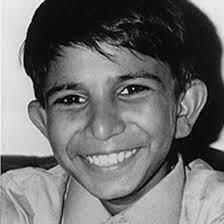
This is Iqbal Masih. As a child, he was was sold into bonded labor for less than $15 and was forced to work 12 hour days, 7 days a week for pennies.
At age 10 he escaped the carpet factory where he worked and then he helped free 3000 children from slavery.
He went on to tour various cities in Pakistan so he could raise awareness about child bonded labor.
He was murdered at age 12 for speaking out.
Extremely sad news from #PeshawarPolicelines. KP police had remained at the forefront of our fight against terrorism. May Allah bless the martyred bravehearts of our police force.
#Peshawar