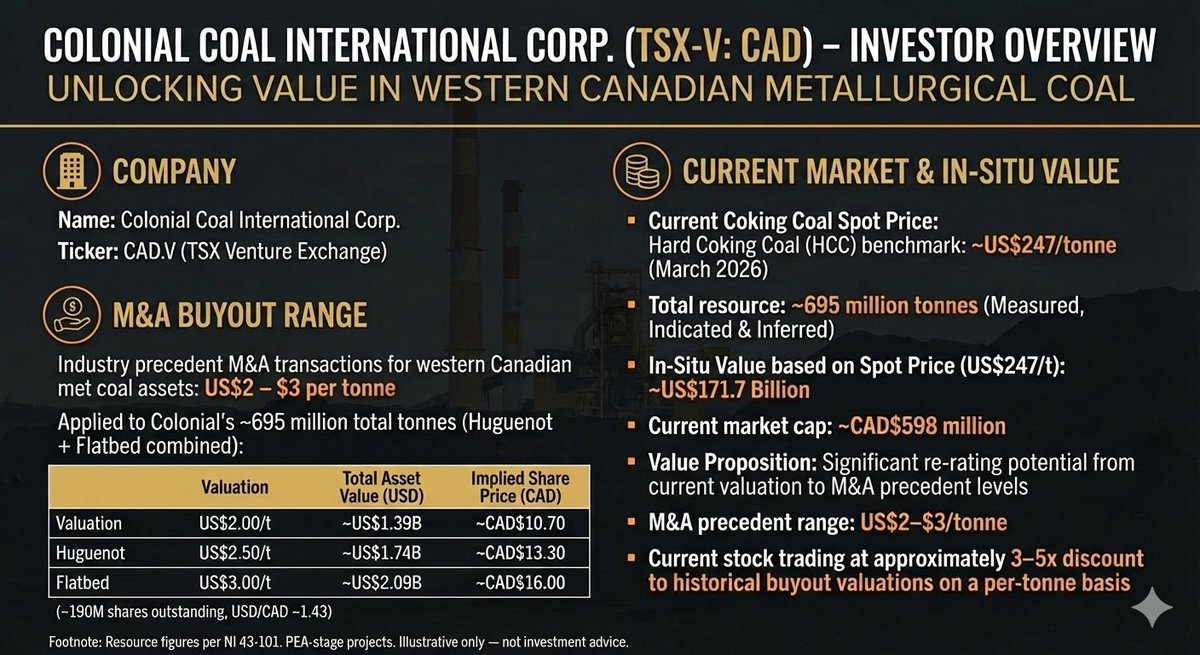
Is that Philip Gunst back with another post about Colonial Coal $CAD.V without sharing a news release about a halt?!
Yes sir 🫡
But Mark Carney just talked about Met Coal in an official release in the same sentence as India on a government-to-government level.
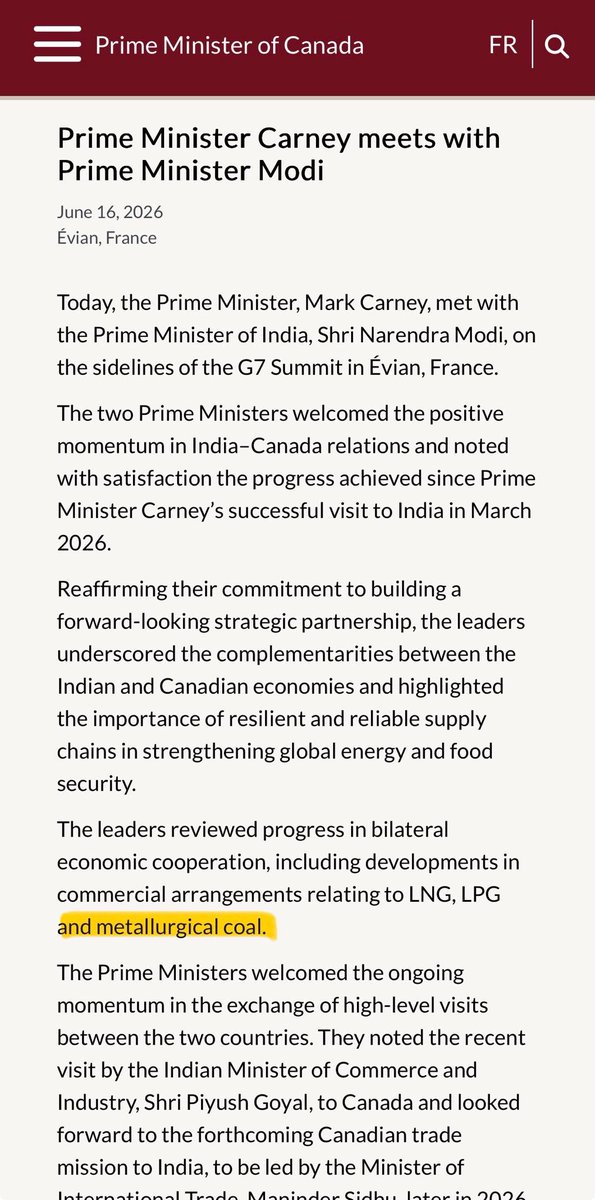
On June 16, the Prime Minister’s Office released an official readout of the meeting between Mark Carney and Narendra Modi at the G7.
Buried in the release was a sentence that caught my attention:
“The leaders reviewed progress in bilateral economic cooperation, including developments in commercial arrangements relating to LNG, LPG and metallurgical coal.”
When was the last time you saw metallurgical coal specifically mentioned in an official communication from the Prime Minister of Canada following a meeting with the Prime Minister of India?
I honestly can’t remember it happening.
And it comes only days after reports that BC Premier David Eby is preparing to travel to China as part of a broader effort to rebuild economic ties and strengthen investment relationships. By end of next week.
Viewed individually, these may seem like unrelated political events.
Viewed together, they tell a much larger story.
Over the past year, Canada has been systematically rebuilding relationships with both India and China after years of strained diplomatic relations.
Now we have both the Prime Minister of Canada and the Premier of British Columbia personally engaging with the two countries that happen to be the largest strategic buyers of metallurgical coal in the world.
That is not something I would have expected to see even 12 months ago.
For Colonial Coal investors, I think this is important because the discussion has gradually shifted from being purely corporate to increasingly geopolitical.
Large state-owned enterprises do not deploy billions of dollars based solely on geology.
They need long-term investment certainty, Confidence around permitting, etc.
That is why the political backdrop matters.
Many investors understandably focus on the absence of a bid.
I (try to) look at the broader trend.
And whether you’re bullish or bearish on Colonial Coal, it’s difficult to argue that the political and geopolitical backdrop is not materially stronger today than it was at the beginning of the year.
When something happens?
Nobody knows.
But it is hard not to conclude that we are further along today than we were last week, and further along last week than we were the month before.
Patience remains the hardest part of this story.
https://t.co/GGhlzcvted
“Union Minister of Commerce and Industry Shri Piyush Goyal will visit Canada from May 25-27 to advance the ongoing negotiations of the Comprehensive Economic & Partnership Agreement (CEPA) between India and Canada and hold official, business & industry interactions. Senior representatives from over 100 Indian businesses are accompanying Shri Goyal from sectors like metals & mining…”
Colonial Coal $CAD.V is on the agenda of the meetings in the coming week.
Let’s hope that Coal India or NMDC has representatives amongst the 100 joining the Commerce minister on the visit starting tomorrow. That would make sense.
Hopefully Carney, Eby and the remaining governmental stakeholders from Canada can calm the concerns of DRIPA. I can only see that being the remaining barrier for an Indian bid.
Question is then what about China…
Canada just confirmed that one of the largest Indian delegations will visit in May to explore investments in energy and mining following Carney’s trade mission.
- Canada >>> India trade mission (completed)
- India >>> Canada delegation (next step)
- Explicit focus on mining & energy investments (and specifically met coal)
- Government-level coordination on both sides
At the same time:
- India has designated coking coal a critical mineral
- Indian PSUs are actively exploring overseas resource acquisitions
- Canada is signaling fast-tracking and support for foreign investment
And importantly:
- Discussions are now framed as government-to-government + corporate follow-through
- Not just trade and capital deployment into assets
This is how these deals typically evolve:
(1) Political alignment
(2) Delegations and site-level engagement
(3) Strategic investment discussions
(4) Asset-level transactions
When you combine this with:
- prior commentary on Indian interest in Canadian coal
- structural coking coal deficit
- and ongoing engagement at minister level
…it becomes increasingly clear that Indian capital is being positioned for entry into Canadian resource assets.
$CAD.V is positioned for it to happen. Citi is engaged. Partha is engaged.
The direction of travel is becoming very difficult to ignore.
https://t.co/uDiaNAcM7r
Canada just confirmed that one of the largest Indian delegations will visit in May to explore investments in energy and mining following Carney’s trade mission.
- Canada >>> India trade mission (completed)
- India >>> Canada delegation (next step)
- Explicit focus on mining & energy investments (and specifically met coal)
- Government-level coordination on both sides
At the same time:
- India has designated coking coal a critical mineral
- Indian PSUs are actively exploring overseas resource acquisitions
- Canada is signaling fast-tracking and support for foreign investment
And importantly:
- Discussions are now framed as government-to-government + corporate follow-through
- Not just trade and capital deployment into assets
This is how these deals typically evolve:
(1) Political alignment
(2) Delegations and site-level engagement
(3) Strategic investment discussions
(4) Asset-level transactions
When you combine this with:
- prior commentary on Indian interest in Canadian coal
- structural coking coal deficit
- and ongoing engagement at minister level
…it becomes increasingly clear that Indian capital is being positioned for entry into Canadian resource assets.
$CAD.V is positioned for it to happen. Citi is engaged. Partha is engaged.
The direction of travel is becoming very difficult to ignore.
https://t.co/uDiaNAcehT
It seems that both B.C. and the Canadian government is putting some weight behind their narrative for the past 6 months.
Happy to see more domestic political tailwind supporting mining and fast-track permitting of key projects.
This development will for sure be something welcomed by potential suitors of Colonial Coal $CAD.V and something derisking a potential acquirer’s path to production.
https://t.co/jwXBf3Mk4V
Important and strong news for Colonial Coal $CAD.V.
My thesis is that reason for the dragging in the past weeks since Carney’s visit in India in March is Canadian government assurances for support for “path to production” for Huguenot and Flatbed.
One of those assurances has been fast track permitting in B.C.
It’s been a topic for long but it hasn’t been papered - or at least not to an extent where the Indians have felt comfortable moving forward with a bid.
This seems like a breakthrough.
Let’s hope it helps CIL, SAIL and/or NMDC to make a first move for Colonial.
It seems to be required to get the likes of China, Glencore and/or Peabody out of the weeds.
Hopefully a key milestone before “game time” 🤞🏻
Canada and China just launched a Financial Working Group on April 3.
Many have been concerned by the potential scrutiny a Chinese bidder would go through should a Chinese suitor win the bid process for Colonial Coal $CAD.V.
I think this significantly mitigates the risk for a Chinese suitor.
The FWG was created following PM Carney’s January visit to Beijing. It’s designed to provide a “structured and technical channel” on cross-border capital flows, financial regulation, and investment.
Key phrase from the joint statement:
“Both sides recognize the important role the financial sector plays in economic growth and facilitating two-way trade and investment.”
Translation: Canada is actively removing friction for Chinese capital.
A timeline to make it easier to understand:
- January 2026: Carney resets Canada-China relations
- January 2026: $CAD.V management visits Chinese groups in China for deal discussions
- March 2026: BC Premier announces China trade mission focusing on “energy trade”
- April 2026: Federal government establishes formal investment framework with China led by Canadian Finance Minister (Champagne)
For a Chinese SOE or mining group looking at BC coking coal assets, the regulatory pathway just became clearer.
The Investment Canada Act (ICA) review process - historically unpredictable for Chinese acquirers - now has a dedicated bilateral channel.
Chinese steel production requires stable offshore supply as domestic output declines 8% in 2026.
Potential Chinese acquirers include:
- Pingmei Group (coking coal producer, offshore acquisition track record)
- Baowu Steel (world’s largest steelmaker, vertically integrating upstream)
- Any of the provincial mining groups with ICA precedent
The political risk premium for a Chinese bid just dropped.
Canada wants the capital. China needs the coal. Colonial has the asset.
Great news for us! $CAD.V
https://t.co/L5UJOTHxSC
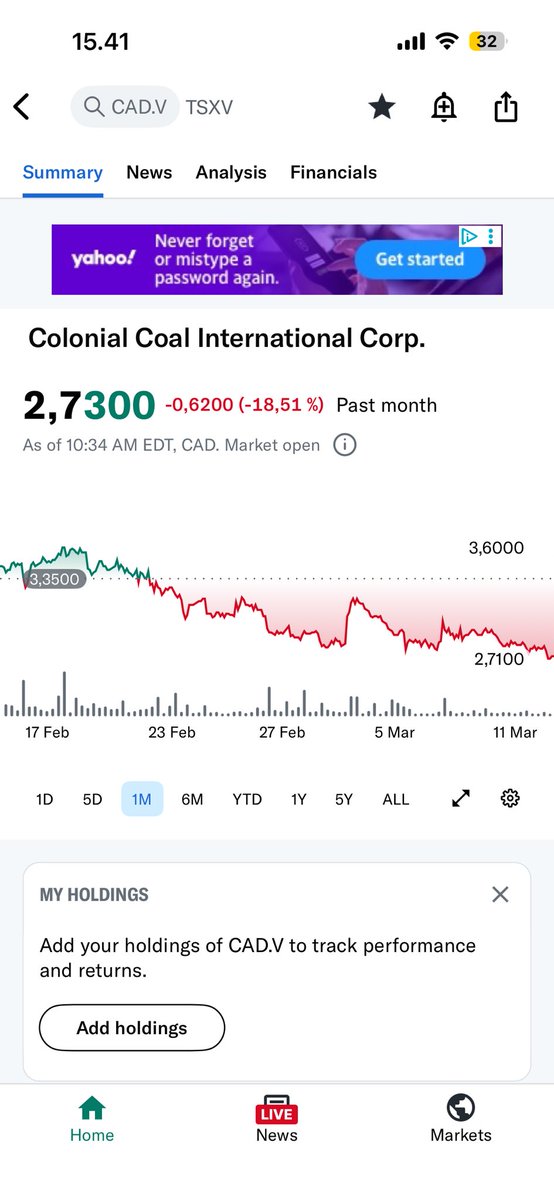
Fascinating how quickly sentiment can change. Colonial Coal $CAD.V is down 25% from the top and is now slow bleeding daily on close to non-existing volume.
In the meantime, fundamentals haven’t changed a bit unless you believe the Middle East situation is affecting China, India or Glencore’s willingness to buy high quality coking coal.
I think there’s a lot of retail holders that are fearing that we are in the process of seeing the same outcome for the 3rd time with a top at 3.5-3.7 and a setback to $1.
However, the situation is fundamentally different this time. You have Indian government officials and PSUs publicly stating they are in the market to acquire coking coal assets in Canada. You are having Colonial management traveling to meet with management representatives and bankers/lawyers of both Chinese and Indian suitors - several times.
The nerves are kicking in it seems - once again.
I’m still a buyer at these levels.
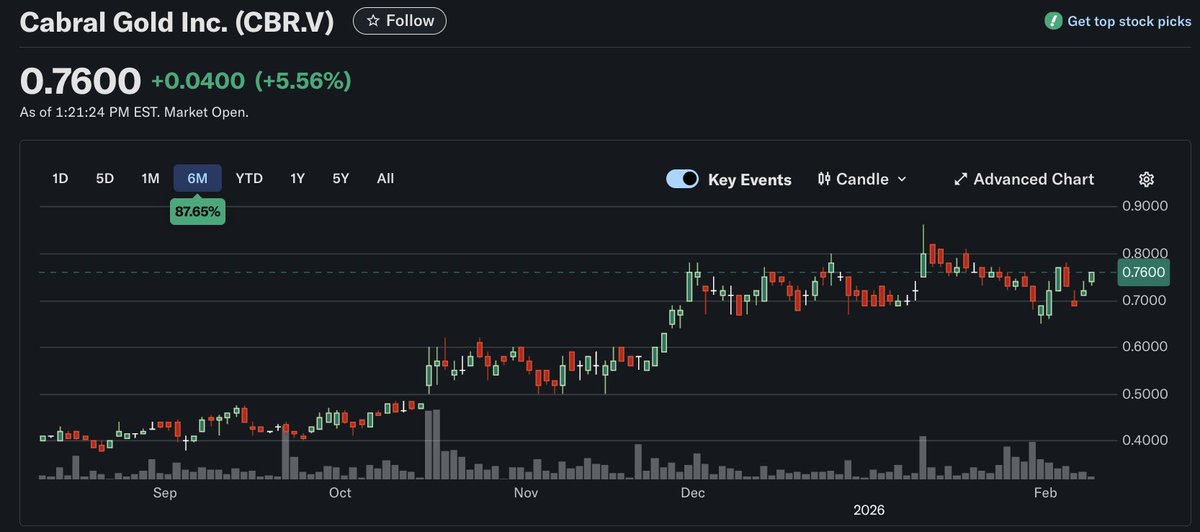
$CBR.V up 9% this morning after a major permitting milestone at Cuiú Cuiú.
They received the LP for the full mining license, one of the bigger steps in Brazil’s process.
It covers both Phase 1 (heap leach build) and the larger Phase 2 hard rock plan.🔥
https://t.co/I1VYQvbwRV
"...The LP not only allows for the expansion of our Phase 1 #gold-in-oxide project, which is currently under construction, but it also applies to the much larger Phase 2 project which will involve the development of the hard rock resources at Cuiú Cuiú.
The granting of the LP dramatically reduces the risk profile for both phases of development of the project. With the most complex and time-intensive stage of the Brazilian permitting process now complete, we have materially de-risked the project and enhanced its long-term value potential..."
https://t.co/hancOiGuN3
$CBR.v $CBGZF
China just made coking coal a national security asset.
Yesterday, the new 5-year plan of China was published at the National People’s Congress and while there was a lot of focus on defence and budgets, there was also a “little” nugget in there for Colonial Coal $CAD.V.
The headline number: 1.3 trillion yuan (~$188.5B) in Ultra-Long Special Treasury Bonds, earmarked explicitly for “major national strategies” and “security capacity building.”
That’s not infrastructure spending. That’s a war chest for resource sovereignty.
What’s the link to coking coal specifically?
Thermal coal is being phased down. At the same time, coking coal is being elevated - decoupled from commodity politics and reframed as an industrial security pillar.
The logic is straightforward - and it actually links to the Chinese defence strategy. Military modernization means high-strength steel which automatically means premium hard coking coal.
A 7% defense budget increase (now 1.78T yuan) doesn’t mean much if your blast furnaces depend on spot markets or diplomatic goodwill.
The 15th Five-Year Plan makes the overseas mandate explicit:
- The Chinese wants to Phase down thermal coal
- They want to strengthen the strategic mineral reserves to fight the constraints being put in place by especially US currently
- State-led acquisitions in Tier-1 jurisdictions is being encouraged
China basically just did the same as the Indians - they are just not as vocal about it as the Indians.
British Columbia isn’t just a mining region anymore. It’s on a shopping list. And in the meantime, local politicians and lobbyists in Canada is lobbying hard for the Canadian federal government to make coking coal a strategic mineral in Canada as well. It would make the permitting process for a suitor of $CAD.V much easier.
The shift from China in one line:
Beijing isn’t looking to buy coking coal. It’s looking to own the source.
When sovereign capital meets a supply gap, the bid doesn’t dry up - it gets institutionalized.
This is why this deal is so got damn politically dependent - and why it takes so long (still).
https://t.co/Kw3Q3ZCP6S
https://t.co/914kqa0356
Cabral Gold CEO Alan Carter was just on site at the Cuiu Cuiu Gold District in Brazil, reviewing construction progress of the initial Phase 1 gold-in-oxide operation.
Work continues to advance steadily as the team moves closer to initial production. Phase 1 is designed to generate meaningful free cash flow, creating a strong financial base to support further growth of the resource base across the district.
Cuiu Cuiu is not just a single deposit. It is a large, district-scale #gold system containing multiple deposits with significant exploration upside and expansion potential beyond the initial mine plan.
“We're on schedule and we’re on budget.”
$CBR.v $CBGZF
Fantastic news!
Coal India explores partnerships with Canada for coking coal.
“During the discussions, CIL conveyed its interest in pursuing partnerships in critical mineral assets including coking coal, and the mineral processing sector.”
Happy to see Mark Carney also leaning in to supporting the Canadian coking coal sector.
Ready for deal announcement of Colonial Coal $CAD.V $CCARF
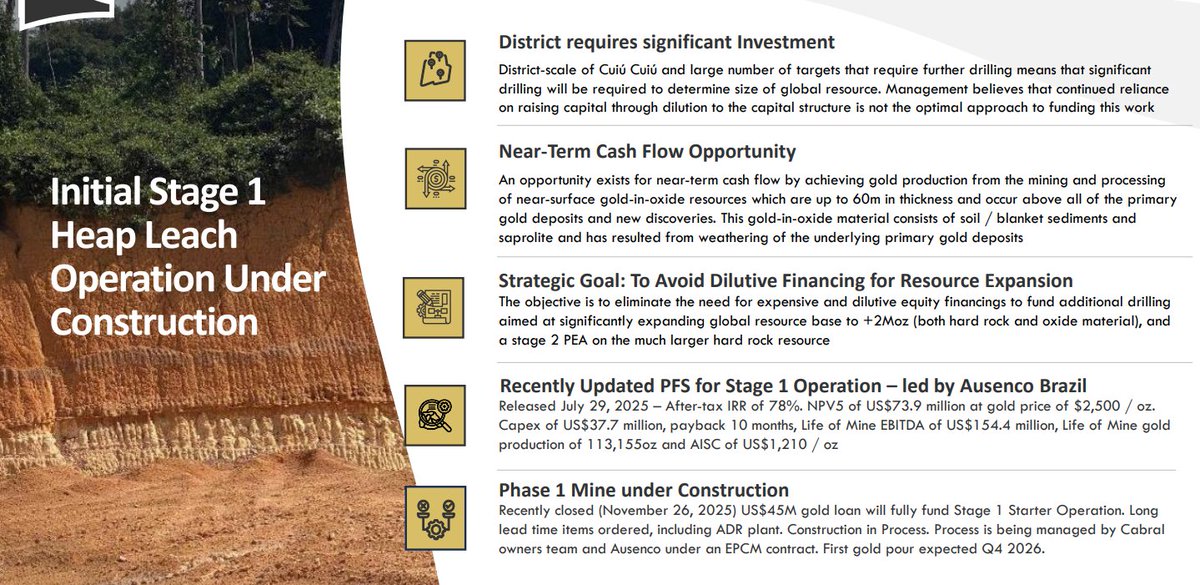
Construction of the Phase 1 operation continues to progress at the Cuiú Cuiú district, where Cabral Gold is advancing the development of its near-surface oxide material. Initial production is planned for Q4 2026.
This Phase 1 operation is designed to generate meaningful cash flow, creating a non-dilutive source of funding to unlock the much larger hard rock #gold resources that sit below the oxide blankets.
It will also allow the Company to drill test more than the 50 peripheral gold targets across the district, many of which have never been drilled, highlighting the broader growth potential beyond Phase 1.
$CBR.v $CBGZF
STARTING IN ONE HOUR!!
Dr. Alan Carter, Founder, President and CEO of Cabral Gold, will be presenting at the Precious Metals & Critical Minerals Virtual Investor Conference.
He’ll will discuss the Company’s progress and outlook for the Cuiu Cuiu #gold district in Brazil.
⏰ Today at 10:30 AM ET
💻 Register here: https://t.co/GQ3U9gTG9w
Last chance to register and join live.
$CBR.v $CBGZF #MiningStocks #PreciousMetals #InvestorConference @RIConferences@OTCMarkets
$CBR.V Cabral Gold has been doing well in the past months. With very conservative #gold prices of $2.500, Cabral will have a payback time of just 12 months for their heap leach operation.
First pour is in Q4 '26 and everything is on schedule.
Gold is $5.000 right now 🤑🤑
1/?
$CBR.V Cabral Gold will soon be producing at their Cuiu Cuiu project in Brazil and Alan Carter has setup the company to profit tremendously from the current #gold price levels. First pour planned in Q4 this year with construction underway.
11/11
The upside potential in $CBR.V Cabral Gold should be clear as day in the current precious metals environment. As a soon to be producing company sitting on a district scale potential project in a very good jurisdiction it is a long term hold in our portfolio. It is great to see a company doing things differently by pursuing phase 1 production in order to eliminate future dilution and fund exploration of a project with such a great potential.