You see, today we're in the SPECULATION stage of #cryptocurrency. Elon is building the APPLICATION stage—at scale.
Think of the applications:
1. Micropayments. Can you pay content creators on @Twitter with Doge?
2. Can you buy a Tesla on https://t.co/uRfVlkV16h with Dogecoin?🤔
EARLY PREDICTION: @elonmusk adopts $DOGE as the only allowed currency on https://t.co/uRfVlkV16h, making its value skyrocket.
Next comes the chess move ♟️👑...
Contrary to common belief, $DOGE doesnt actually need to be more superior technologically than other crypto.
Because if Elon makes it the only accepted currency on the "Twitter platform", then cash is dead.
#TwitterX
Wow, huge praise to @WSJ for putting together this documentary. High-level, but packed with insights 👏 👏 👏 https://t.co/rZqz4Rclbd
The Business Strategies Behind Starbucks, Costco, Chick-fil-A, Home Depot and More
0:00 - @ChickfilA
8:37 - Costco
14:39 - @Starbucks
...
Love to see $RIVN taking a breather before the next leg. Expecting continuation of this beautiful run up.
Targets: 28, 30, 32 🎯
- Huge volume from smart money
- 3 consecutive quarters of improving EPS
- 💪 vehicle delivery forecast
- Gorgeous product & user xp
#stockstowatch
There are multiple paths to positive expectancy.
Avg gain * win % - avg loss * loss %
Large profit factor, low accuracy:
($5 * .3) - ($1 * .7) = $.80
High accuracy, low profit factor:
($1.5 *. 7) - ($1 * .3) = $.75
Mid accuracy, mid profit factor:
($2.5 * .5) - ($1 * .5) = $.75
While these are just hypothetical examples, it's important to understand the trade-offs. Low accuracy system stop out A LOT. In many cases, the profit factor is so skewed because these systems tend to employ very tight stops, so the avg loss is very small, but the 10-20% of runners account for most of the profit. Think Qullamaggie or Zanger with very aggressive stops, looking for those 5, 10, and 20:1 trades. Or the long-term trend traders that try to ride large, multi-month/year trends.
Low profit factor systems, where the average gain vs avg loss isn't much different, make money through high turnover and locking in gains relatively quickly. I've even seen systems where the avg loss was bigger than the average gain, but the accuracy was very high, so overall it was profitable. Scalpers and short-term day traders tend to fall into this category.
Mid-profit factor systems tend to be a balance of both. Think of Minervini's characterization of a 2:1 50% trader. These systems focus a little more on timing, taking partial profits, and tend to use slightly looser stops, which helps keep the BA higher. Swing traders tend to fall in this category.
Personally, I can't stand low batting average methods. It fucks with my head and I start to sabotage my trading. I've tried to force myself to do it a number of times and I just can't handle it mentally. So I widen my stop a bit, which reduces my stopouts and increases my batting average to stay in more trades. Is this optimal? I don't really care, to be honest. What's the point of optimal if I can't stick with it? I'd rather make progress doing something less than optimal than to force something that I do inconsistently just for the sake of optimal. Maybe someday I'll do the work to handle tighter stops and lower BAs, but I'm in a comfortable space where I'm at now and my math works. There's more than one way to skin a cat.
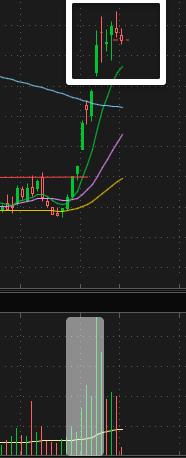
$PLTR is setting up for something big 💪
Target 17, 18, 20 🎯
- gorgeous block of green buying volume
- big players are holding onto their shares (even after the latest run up)
- Sector strength: AI + software. Both SMH & IGV are prepping for a breakout.
#StockToWatch
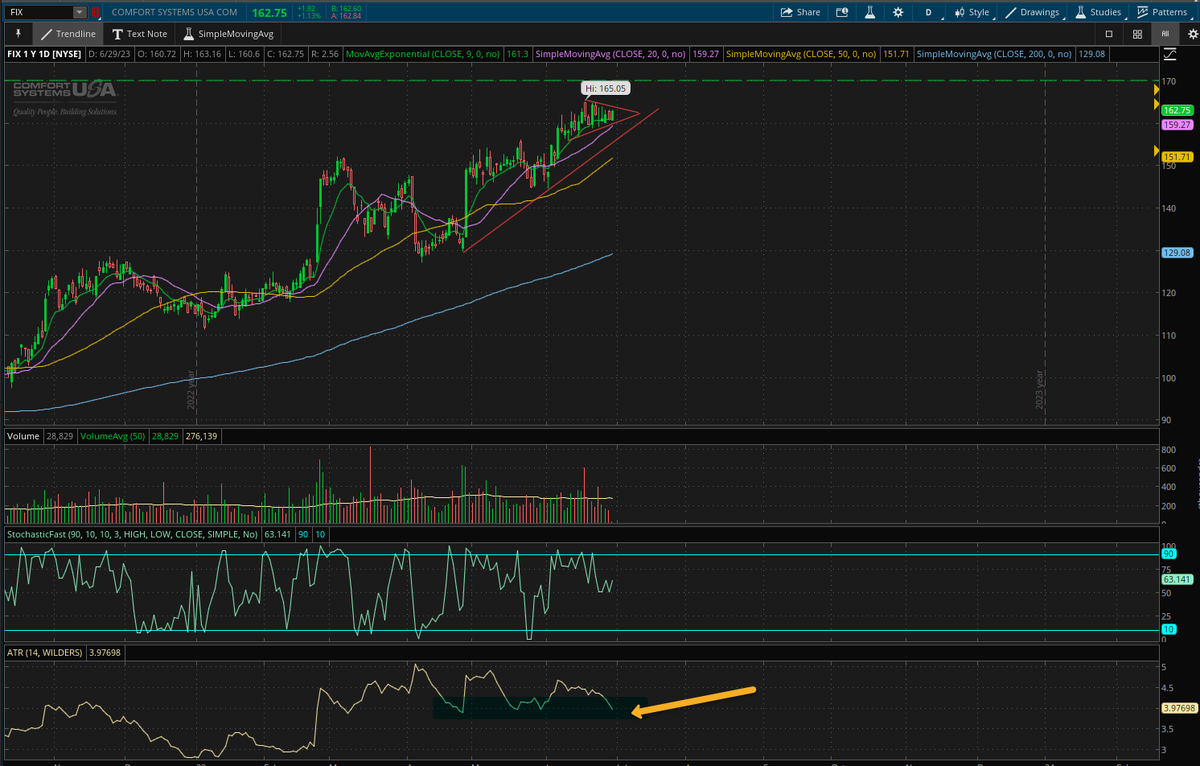
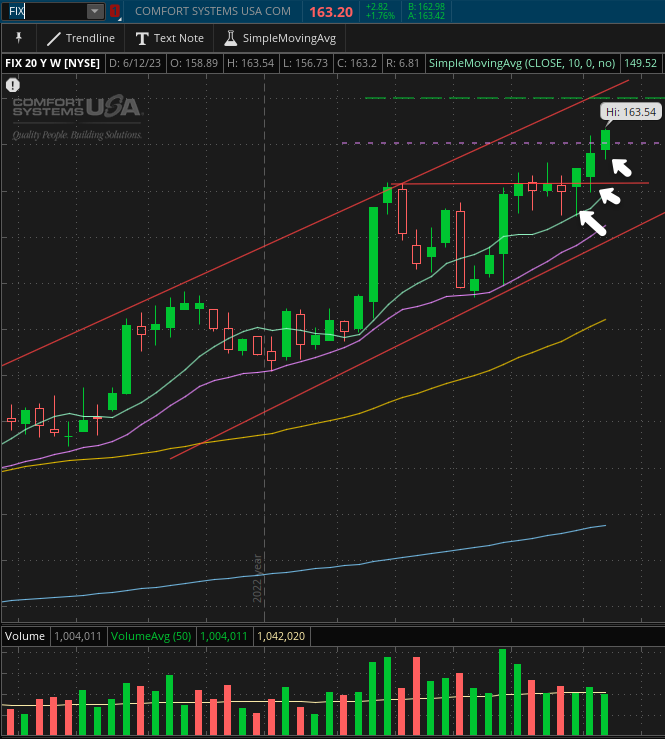
$FIX Average True Range (volatility) has been declining (less volatility = 🐂/🧸 have chosen sides).
- Watching 20MA as it adds pressure from the bottom
Above 164 for a run to 170 🎯
B+ setup
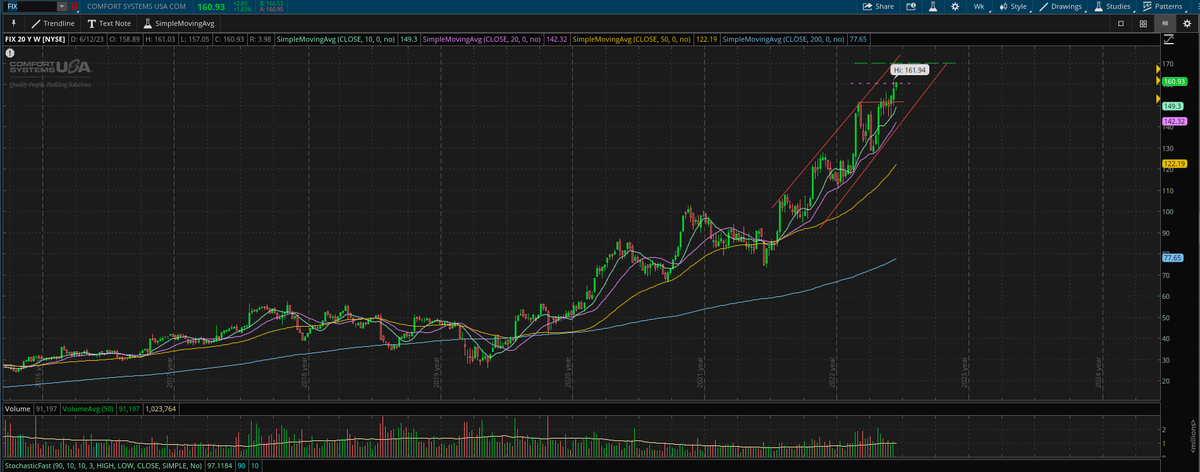
$FIX testing resistance. 165/170 target.
- nice accumulation vol on weekly
- even with short term corrections, the price should break in the direction of it's longer-term uptrend 📈
- benefitting from recent 🔥 in smallcaps
- should catch the wind ⛵️ from homebuilder sector
$SWAV Pressure cooker energy.
- fascinating volume to close off the week.
- candle closing in upper half is a nice touch 👌
- moving average adding pressure from the bottom
So long as houses on the market remains low, $DHI will keep on building more of them.
120 target.
People aren't selling and here's why:
If you have a 3% interest rate, you're not selling just to jump into a 6%.