We are in the early innings of AI. Infrastructure buildout ($NVDA) is Phase 1.
Phase 2 is the killer apps, such as:
1) $TSLA, the robotaxi company. Now worth $600B; will be worth $3T.
2) $PLTR, the operating system for AI in organizations. Now worth $50B; will be worth $300B.
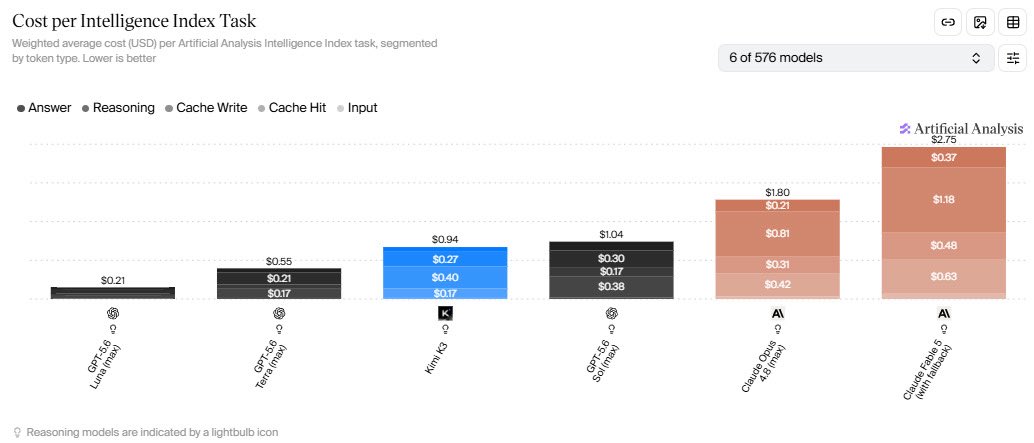
Kimi K3 may be an important inflection point for AI. Potentially negative for Anthropic and OpenAI while being net positive for essentially every other company in the world. I mean that very literally. Although the real “Sputnik moment” would be an open-source frontier model that was also token efficient unlike Kimi K3 which is 50-70% more expensive to run than GPT 5.6 per Artificial Analysis.
Rationale:
A world where there are only 2-3 dominant frontier labs with 90% inference margins is net negative for every other layer while being awesome for those 2-3 labs. Those labs would become monopsonies for power, data centers, semiconductors and hyperscalers and would obviously vertically integrate over time into all those layers while also completely subsuming the application/software layers.
Anything that lowers margins and increases competition at the model layer is good for every other AI layer: power, semiconductors, hyperscalers, neoclouds and yes even software.
This is why Jensen is so supportive of open-source. An open-source model requires the *exact* same amount of compute to run as a closed frontier model of similar size and architecture. Kimi K3 is roughly the same price as GPT 5.6 Terra on a per token basis, which actually suggests that it is less computationally efficient as I am sure that GPT 5.6 is priced to a higher margin than K3. And given that K3 is a token wastrel, i.e. token inefficient, it is significantly more expensive per task than GPT 5.6 and Grok 4.5, which are much more token efficient. Cost per token and token efficiency (i.e. intelligence density per token) are the drivers of intelligence per unit of cost. The winning AI companies will be those that offer the most intelligence per $ over time.
Lower margin % at the model layer = more margin $ at every part of the infrastructure layer and is a godsend for software. This can happen either through open-source models like K3 at the frontier *or* having a vertically integrated model company like Meta, SpaceX or Google at the frontier. Both outcomes result in a lower margin % at the model layer as vertically integrated model companies don’t really care where the margin $ come from. This is why it was so painful for OpenAI and Anthropic when Google was right there with them from a model competitiveness perspective and why Grok 4.5 and Muse 1.1 were just as important as Kimi K3.
The reason Kimi K3 is only *potentially* negative for Anthropic and OpenAI is 1) the @ericvishria point that the Claude and ChatGPT products and harnesses may be more important than their models today and 2) the hypothesis that they have much more advanced model checkpoints internally that are already being used for RSI. In the latter scenario, reaching RSI even a few months ahead of other labs might be enough to cement a permanent lead.
Time will tell on both points. And likely fairly quickly.
Caveat would be that since Kimi K3 is not token efficient and thereby actually more expensive than ChatGPT 5.6, we may need to see a more token efficient open-source model at the frontier or see Grok 5/Composer 4/Muse 2 at multiple points on the Pareto frontier for this potential risk to Anthropic and OpenAI to play out. And I am sure they will both vertically integrate as quickly as possible while continuing the product/harness strength they have shown over the last 8 months.
Aujourd'hui grosse discussion avec mes ingés (chez Argil) sur pourquoi Elon a viré le LIDAR de ses voitures autonomes. Choix radical, moqué pendant des années, et comme d'hab il avait raison depuis le début.
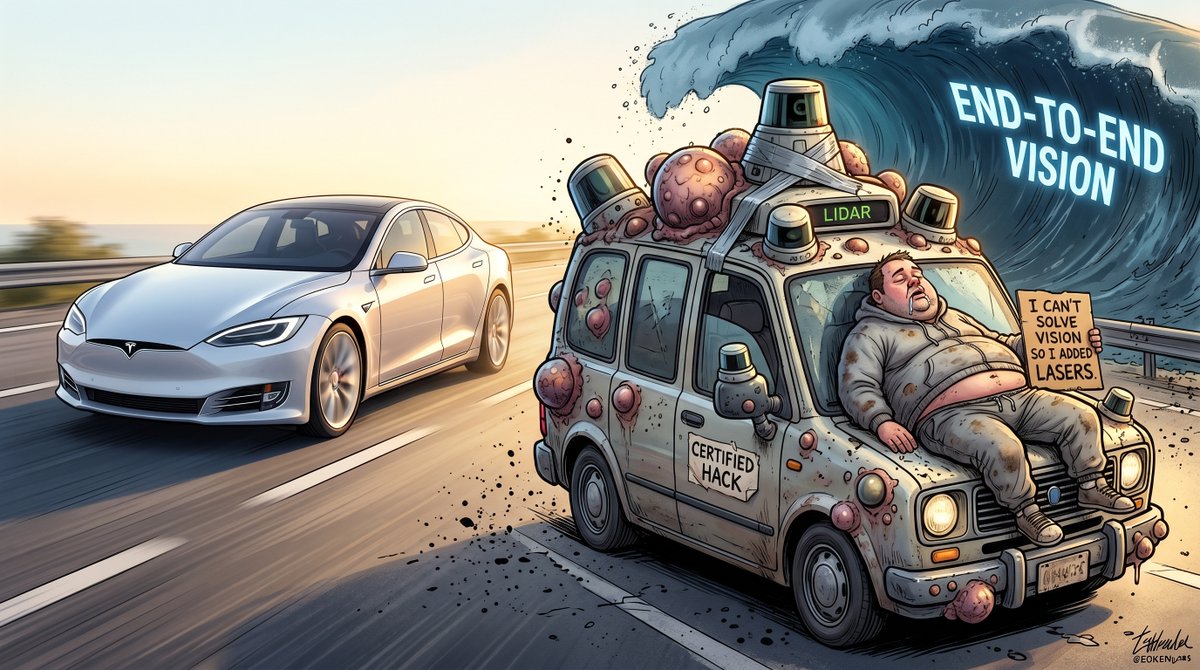
Le LIDAR c'est un laser qui balaye l'environnement et crache un nuage de points 3D. Sur le papier tu obtiens la géométrie exacte du monde. Dans la vraie vie c'est une verrue technologique collée sur le toit parce qu'on sait pas faire mieux avec la vision seule.
Problème numéro un : ça rajoute une modalité dans le training du modèle. Ton réseau doit apprendre à fusionner vision + lidar + radar + ultrasons. Chaque capteur en plus c'est une source de désaccord à arbitrer, pas une source d'info supplémentaire. Sensor fusion artisanale = dette technique permanente.
Problème numéro deux, la bitter lesson de Rich Sutton : scaler le compute sur une seule modalité bat systématiquement les architectures bricolées à la main. Tesla a dropé le radar, puis les ultrasons, est passé full end-to-end vision. Leur courbe sur les edge cases s'est accélérée APRÈS, pas avant. Waymo fait l'inverse et reste stuck en ops géofencée.
Problème numéro trois, le plus fondamental : le LIDAR voit la géométrie, pas la sémantique. Il sait qu'il y a un truc, pas ce que c'est ni ce que ça va faire. Les derniers 9 de fiabilité sont des problèmes de cognition, pas de perception brute. Un capteur de plus résout rien, il ajoute du bruit.
Sébastien Loeb balance une 208 T16 à 180 dans un chemin boueux corse sous la pluie avec zéro LIDAR. Deux yeux, un cerveau. L'évolution a donné des yeux aux prédateurs pendant 500 millions d'années, pas des lasers. Il y a une raison.
Le LIDAR c'est l'équivalent du marxisme appliqué à l'économie. Une solution planifiée, centralisée, qui prétend modéliser explicitement ce qui doit émerger d'un système distribué et adaptatif. Tu remplaces l'intelligence par de la mesure, la compréhension par de la donnée, l'émergence par le contrôle. Ça rassure les ingénieurs qui veulent tout spécifier en amont, exactement comme la planif rassurait les économistes soviétiques. Et ça échoue pour les mêmes raisons : la réalité est trop riche pour être capturée par un capteur, comme elle est trop riche pour être capturée par un plan quinquennal.
La vraie intelligence, celle de Hayek comme celle de Tesla, c'est de faire confiance à un système qui apprend de l'expérience plutôt que de tout pré-encoder. L'élégance d'une solution c'est son rapport signal sur complexité. Le LIDAR explose le dénominateur.
Défendre le LIDAR en 2026 c'est préférer empiler des hacks plutôt que résoudre le vrai problème. C'est de la feignasserie intellectuelle maquillée en rigueur d'ingénieur. Les mêmes gens qui défendaient les systèmes experts en 2012 contre le deep learning. Ils finiront pareil.
Never bet against end-to-end. Never bet against la simplicité. Never bet against Elon.
@BitcoinUndisc The key to the "exclusivity claim" is that Jesus is the word (i.e. voice/teachings) of God became flesh. The people who have never heard the gospel have ancestors who rejected God's voice (i.e. Jesus) in the first place.
the citrini post causing market movements is further proof of a fun truth that's still misunderstood by many
in the short term, everything is a memecoin
that is to say:
-> the internet connected information
-> finance has only recently entered the internet age with crypto, robinhood, and AI
-> in a connected system, the thing that spreads the fastest, dominates
-> memetic narratives spread the fastest (e.g AI doomerism is a meme)
-> in markets, the thing that spreads causes reflexivity, which causes further spread because it validates the meme
-> this leads to increased short-term volatility (see gold/silver trading in the past year)
so your options then:
i) monitor the situation at all times to take advantage of this
ii) become the house
iii) invest only in long-term ideas
iv) set the narrative yourself
@ns123abc Elon is going to run the "round-trip" playbook by having:
1. xAI buy compute from SpaceX
2. SpaceX buy chips/solar/batteries from Tesla
3. Tesla license from xAI
Very bullish for $LMND.
For a long time, a major concern for $LMND investors is autonomous cars reducing the need for car insurance. Instead, Lemonade turned this into an advantage and may even be Tesla's partner for launching robotaxis.
#TeslaFSD is 2X safer than humans, so why are Tesla owners still charged so much to insure their cars?
In the last couple of months, we've been hard at work with the @Tesla team on something that will change that forever.
Announcing: Lemonade Autonomous Car Insurance for FSD
Here’s what’s coming…👇
---
For the full experience, play while reading this thread: https://t.co/Zk2SnhoWwU