I've been working on variants of this problem for my entire career, and have only dreamed of designing molecules on the computer with success rates this high.
Proud of @chaidiscovery for pulling this off, and doing it with the speed, rigor and grace that was only imaginable ✨
Today, we announced the opening of our 70K sq ft CryoEM lab in Andover, Mass – among the largest privately owned labs of its kind in the U.S. – which will help drive faster and more efficient therapeutic development. Take an up-close look at the space:
https://t.co/k6G0TiefjY
ARE YOU SICK OF AI?! BECAUSE WE DID IT AGAIN IN AN EVEN MORE OBSCURE SPACE THAN TEXT OR IMAGES. BUCKLE UP BECAUSE THIS WONT MAKE ANY SENSE UNLESS YOU LIKE PROTEINS 💃💃🧬🧵
This looks super cool. Diffusion with structure AND sequence. Excited to try it.
I also love that it’s simply called “protein generator” 💜
https://t.co/Xy88NVjI0q
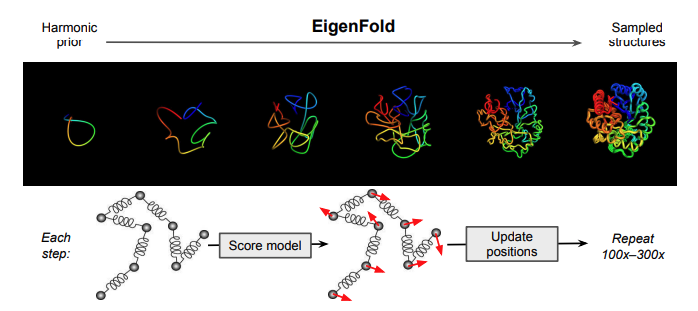
A diffusion model that predicts structural ensembles from protein sequence.
Bowen Jing, Ezra Erives @peterpaohuang@GabriCorso, Bonnie Berger, Tommi Jaakkola
https://t.co/ZLthLX9u38
@jzlegion At first glance I’m not blown away by the wetlab platform either (you can typically screen much more than 400k in a yeast or phage platform), but I haven’t really assessed that part and my critique is really around the computational side.
I agree with Surge here. This preprint is all over my Twitter feed. I don’t normally comment like this, but this paper has made some pretty outrageous claims in the generative AI Ab space, and more care and responsibility needs to be taken with such claims. More work is needed.
I usually let this stuff go, but this is too over the top
In splashy #JPM23 PR, @abscibio claim they can de novo design antibodies from scratch, but they actually design just the CDR3 (of 6 total) of existing Tx antibodies to their orig targets.
That's not de novo design
@joshim5@ForbesTech@VentureBeat I think this is incredibly misleading coverage - and scientists/media need to be more responsible with this type of news release on a paper which has not been peer-reviewed and is sorely missing a number of controls.
@amirshanehsaz Additionally, @abscibio seems to be selling this in headlines as providing the model only with the antigen. So very misleading. Thank you for your response!
@amirshanehsaz Ok thanks. By providing the antibody scaffold of Trastuzumab at all you are almost certainly providing all the info necessary to infill the H3 region and likely the antigen structure isn’t adding anything. But controls would help prove this.
@amirshanehsaz Thanks. It is still genuinely not clear to me from this high level picture. Simple question: Are you providing the model itself with antigen sequence or structure directly or do you provide it only Ab scaffold sequences? What explicitly is the model input?
@amirshanehsaz@abscibio However, the content of the paper shows no antigen is provided to the model. Only the parent Trastuzumab - and the model is asked to make variants. This is a common approach to optimizing existing mAbs and is nice to see LLMs do variant generation but the claims are misleading
@amirshanehsaz The reason I ask is because the paper and
@abscibio
tweets and surrounding media seem to imply that a target is simply provided to the model and a new Ab is de novo generated around it.
@CyrusMaher@SeanRMcClain The library was created by making variants to an existing mAb binder in the H3 region. They were not de novo designed to an antigen. This is what I got from the paper. The claim “target to antibody” is incredibly misleading here and probably shouldn’t be claimed as such.