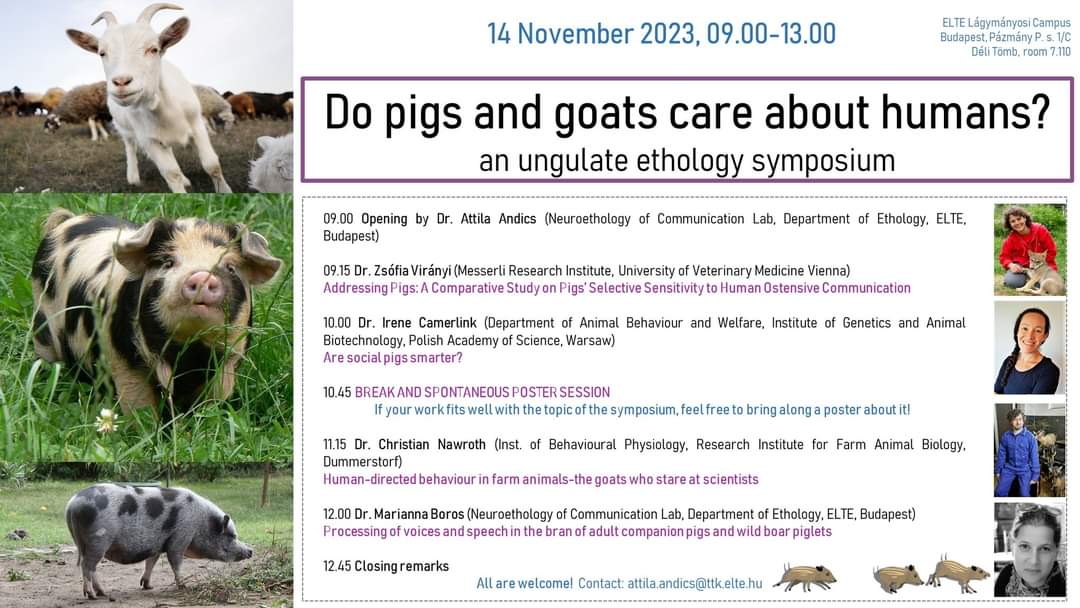
We are organizing a little ungulate ethology symposium on 14 November 2023, Tuesday 9.00-13.00 at ELTE Department of Ethology (room 7.110).
There will be four invited talks, by Zsófia Virányi, Irene Camerlink, Christian Nawroth and Marianna Boros.
@GoatsThatStare@FamDogProject
a tough couple of months behind my back with a lot of preparation, and finally, today I had my #ERCCoG interview. now we just wait... 8)
(thx @DeepLabCut for the modelzoo, so I could make this gif for illustration)
"The stimuli chosen were based upon the work of MAHUT (1958), MELZACK (1952) and SCOTT & FULLER (1965) as well as on the imagination of the investigators." love these gems in old papers! just imagine reviewer 2's response today to such a statement 8)
@ununth@rskcdy exciting! on computer you can use Audacity to cut and save interesting parts. it is free and relatively easy to use. on phone, I assume the sound recorder app also have some editing options like cutting out parts. uploading them to onedrive or google drive might be a way to share
@ununth@rskcdy neighbouring packs, or induced by other noises. these dogs might be overly noise sensitive/reactive, easy to trigger the vocal behaviours. unfortunately I have no good solution how to deal with these things, as there are a lot of factors that you can't control here. sorry 8(
@ununth@rskcdy a greeting bark-howl chorus. can be that the other's barks induce it. but would be easier if we see the dynamics of the behaviour, who starts vocalizing, how, etc. the other thing might be night choruses, part of the territorial behaviour, again probably responding to
@ohambiguity@DeepSqueak_USV Dogs can produce whines with similar patterns. The last four looks like biphonation with a low f0 produced in audible range and a high g0 in ultra range that is the same as the first two calls. Didn't know that rats can do this too (if this is that). Interesting!