@TheAA_UK please do explain why a breakdown called in at 4.30pm to a lone female in a remote location with no facilities (toilets) is given an estimated arrival time of 11.25pm. The phone line to ask where you are takes an hour to get through. #notcustomerservice
@eeyoresmother@MichaelRosenYes I used to do this. But.. Then switched. I wanted shiny freshly cleaned teeth to eat my breakfast with! Bacteria free and ready for food! 🙈
@BladeoftheS How would you manage the harm to children accessing such sites? Have you seen the harm? Do you work with children/safeguarding? How would you manage it? Cigs and booze need id. Let tickets and knives need id. The online world isn't risk free.
‘From what I experienced, the emotional toll [of dementia] is a burden that is unbearable. The weight is unbearable - it gets too big.
Prime Minister Andy Burnham has backed our Dementia Carers Together Appeal with the Daily Mail after revealing how his mother was left “sinking” under the strain of caring for his father, Roy, who had Alzheimer’s disease.
‘I saw it directly - I saw my mum sinking under the size of that weight.‘
‘There was a tendency to focus on the person with dementia and miss some of what was going on around, and particularly the impact of carrying that daily burden on my mum.’
‘We as a family, we had basically worked on the principle for many years that we wouldn’t want to see my dad going into care - that we would find a way [of keeping him at home].
‘And I think because of that feeling that we had - and because perhaps we were looking at my dad all the time, not necessarily looking at my mum - I think it took possibly too long to make that decision.’
Andy believes his family would have benefited from the practical advice and peer support the new Dementia Carers Together service will provide.
‘Often what happens to a family is that the diagnosis is confirmed, and in our case, you get paperwork, you get all kinds of stuff but none of it really helped.’
‘It was all delivered just via pamphlets and it would have helped to have had some more practical advice as to how things will progress and what you need to be ready for.’
‘From experience, just a little bit of help can make something feel bearable or doable that, without it, would all of a sudden just overwhelm somebody.'
‘I can absolutely see that the sessions would have been helpful.’
’The country is dependent upon people who are caring for partners, loved ones, unpaid and we’ve got to see them, recognise them, hear them when they say that I need more to make this sustainable.’
In 1959, doctors in Alberta told a 14-year-old girl they were taking out her appendix.
They were not.
It took her nearly forty years to make the province admit what it had really done.
She was born in Calgary on July 15, 1944.
Her family was poor. They moved constantly. At home, she was unwanted, and she was abused.
When she was eight, her mother placed her in a convent for a month. A year later, her mother applied to have her committed to the Provincial Training School for Mental Defectives in Red Deer.
There was no bed free.
So the girl waited two years.
On July 12, 1955, just before her 11th birthday, she was admitted. No doctor tested her first. The admission rested entirely on what her mother said about her.
She thought she was being sent to an orphanage.
Her name was Leilani Muir.
And a condition of her entry had already been signed. Her mother had given written permission for her to be sterilized.
Think about what that actually meant.
A child walked through those doors, and the decision about whether she would ever have children of her own had already been made by somebody else.
Alberta had passed its Sexual Sterilization Act in 1928. A small government panel, the Eugenics Board, decided who was "fit" to have children. Low test scores, poverty, being Catholic, being an immigrant's daughter, being Indigenous, being in an institution at all. Any of it could put you in front of the Board.
More than two years after she arrived, Leilani was taken to a clinic in Calgary for an intelligence test.
She scored 64.
The Board labelled her a "moron." Her file noted her Irish and Polish background, her Catholic faith, and that she had "shown definite interest in the opposite sex."
They ordered her sterilized.
Nobody told her.
On January 19, 1959, surgeons destroyed both of her fallopian tubes. She was told it was her appendix.
She stayed in the institution until she was 20. She had been taught to about a Grade 5 level.
In 1965, she walked out into the world on her own.
She worked as a waitress. She married. She wanted a baby.
The baby never came.
Fertility tests finally gave her the answer. A doctor told her she had been deliberately sterilized, and that it could never be reversed.
She tried to adopt instead.
She was turned down. Her history as a former inmate of an institution followed her into every office.
Two marriages ended. The years went by. By 1989, living in British Columbia, she was depressed enough to seek professional help.
To see whether she was a good fit for group therapy, a psychologist gave her another intelligence test.
She scored 89.
Normal.
Here is the part that should make people angry.
The number the province had used to justify cutting her open had never measured her mind. It had measured a frightened, neglected child in an institution.
Leilani Muir decided to sue the Province of Alberta.
Nobody had ever done that before.
She had no money and no profile. She had a Grade 5 education and a file that called her mentally defective. Against her stood a provincial government with every resource it needed.
The case took years to reach a courtroom.
The trial opened on June 22, 1995, before Justice Joanne Veit of the Court of Queen's Bench. It ran four weeks.
On January 25, 1996, the judgment came down.
Leilani Muir won.
Justice Veit awarded her $740,780 in damages, plus $230,000 toward her legal costs.
And she wrote, plainly, what had been done: "In 1959, the province wrongfully surgically sterilized Ms. Muir."
The judge went further. She listed what the confinement had cost a young girl: loss of liberty, loss of reputation, humiliation and disgrace, pain and suffering, loss of normal developmental experiences, loss of contact with family and friends.
Thirty-seven years after the surgery.
Forty-one years after she first walked into that school.
Her win opened a door that could not be shut again.
TWO BOYS KNOCKED AND ASKED INSTEAD OF TOUCHING HIS CAR!!
Is this how you raise them, or would you have sent them home?
Doorbell cam in the UK. Two boys walk up nervously and knock to ask the owner about the black Supra in his driveway. Instead of shooing them off, he takes them over, pops the hood and fires it up so they can hear it. According to the narration, they reminded him of how his own love of cars started.
Kids hanging around your car usually means trouble. These two did it the right way: walked up, knocked, asked. And the owner met that respect with a memory those boys will have for the rest of their lives. That's two good decisions back to back, and it's rarer than it should be.
If my boys ever see a car like that, I want them asking first just like these two did, and I hope they meet a guy like Alan.
Manners open doors, and hoods.
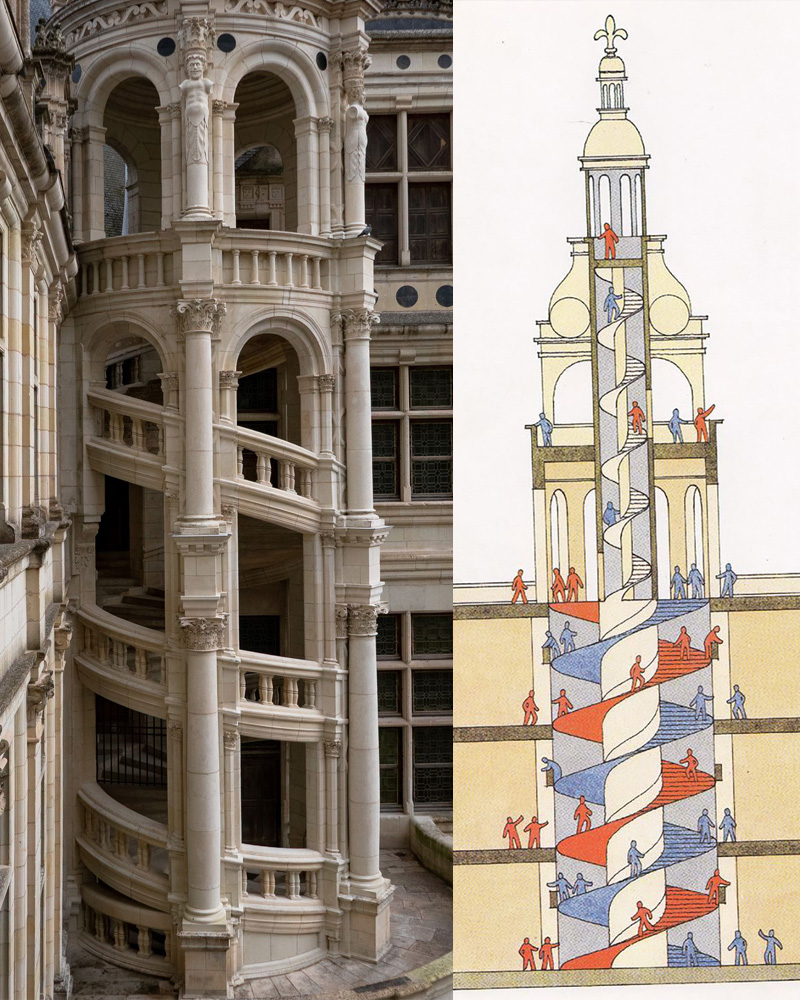
Two people can climb this staircase without ever crossing paths.
Inside France’s Château de Chambord, a remarkable 16th-century staircase consists of two separate spiral stairways winding around the same central axis.
People using different stairways can ascend or descend simultaneously without crossing each other’s paths. They can even see one another through openings in the structure, despite remaining on separate staircases.
Built during the reign of King Francis I, the double-helix staircase is one of the château’s most distinctive architectural features. Its design has long been associated with Leonardo da Vinci, although his direct involvement has never been conclusively established.
Telling an eighty-year-old woman to "check the portal" for serious biopsy results is cruelty disguised as digital efficiency.
My 82-year-old aunt had a lung biopsy done two weeks ago.
The doctor told her they’d have the pathology report ready within five business days.
Friday afternoon rolled around. No call.
She dialed the clinic’s main desk, her voice shaking with anxiety.
The receptionist cut her off before she could finish explaining:
“Doctor doesn’t give results over the phone anymore. All lab findings are automatically released to your MyChart patient portal.”
My aunt said, “Sweetheart, I don’t have a computer. I have a landline on my kitchen wall. Can the doctor just tell me if I have cancer?”
The receptionist sighed into the receiver:
“It’s hospital network policy. We can’t bypass the portal. You’ll have to have a family member create an account and view the file.”
My aunt spent an entire seventy-two-hour weekend sitting in her recliner, gripping her reading glasses, convinced she was dying.
I drove out to her house on Monday morning, set up a profile on my laptop, and pulled up the records.
The result was benign.
The pathology report had been uploaded four days earlier.
A doctor spent three minutes clicking an upload button, and an elderly woman endured four days of sheer psychological terror because the hospital decided a phone call was too expensive.
Since when did delivering medical news become a self-service task?
In Japan, there's a word for the invisible threads that connect people: "en" (縁).
There's an old saying: "Sode furi au mo tasho no en." Even brushing sleeves with a stranger comes from a bond in a past life. In other words, no meeting is just chance.
You can see this idea in everyday life. Many shrines are known for "enmusubi," tying good connections. People often offer a 5-yen coin there, because "go-en" (5 yen) sounds the same as "go-en" (a connection).
I always offer a 5-yen coin at shrines too. I knew the meaning, but it had become just a habit. I never really thought about it. Writing this made me stop and think about it again.
Then there's "ichigo ichie" (一期一会). One time, one meeting. It comes from the tea ceremony and goes back to the tea master Sen no Rikyu. It means a host should treat every gathering as if it will never happen again.
I think these two belong together.
En is about how people come into your life.
Ichigo ichie is about how you treat them once they're there.
Recently I read a story about a woman who gave her extra muffin to an old man at a coffee shop. It became their weekly ritual. Later she learned he was having cancer treatments and had lost his wife.
She thought it was just a muffin. That was en. And she treated every Tuesday like ichigo ichie.
Who came into your life by chance, but turned out not to be chance at all?
Meine Nachbarin ist 81. Sie wollte Strom, Wasser und Internet anmelden. Sie hat es nicht geschafft.
Der Stromanbieter: nur noch online, mit E-Mail-Adresse. Hat sie nicht.
Der Wasserversorger: ein QR-Code auf dem Brief. Sie hat ihn ans Fenster gehalten – sie dachte, er muss ins Licht.
Der Internetanbieter: 40 Minuten Warteschleife, dann die Ansage, es doch bitte übers Kundenportal zu machen.
Ich hab drei Abende gebraucht. Sie saß daneben und hat sich zehnmal entschuldigt. Für Dinge, die nicht ihre Schuld waren.
Sie hat keine Familie mehr. Kein Enkel, der mal eben vorbeikommt.
Ohne einen Nachbarn, der zufällig Zeit hat, hätte sie diese Verträge nicht abschließen können. Punkt.
Jahrzehntelang hat sie alles selbst geregelt. Heute scheitert sie an einem Muster auf Papier.
Wann haben wir eigentlich entschieden, dass Grundversorgung nur noch für die gilt, die ein Smartphone bedienen können?
Here's what happened at The Ocean Cleanup in August:
💠 We announced the expansion of our operations to our 13th country, Colombia. We signed an MoU with the City of Santa Marta to deploy Interceptors in the Río Manzanares and Río Gaira, to stop plastic before it reaches the Caribbean Sea. This is part of our 30 Cities Program, which aims to prevent up to one-third of all river plastic entering the ocean by 2030.
💠 In Panama City, heavy rains brought a huge amount of trash into the waterways. But Interceptors 024 and 025 were there to stop it from reaching Panama Bay.
💠 Similarly, in Jamaica, Interceptors 011, 013, and 015 prevented tons of waste from reaching the Caribbean Sea.
💠 In the Dominican Republic, an upgrade to Interceptor 004 is coming soon, with a new 400-meter barrier to capture more plastic and invasive water hyacinths.
💠 Our team just returned after 6 weeks in the Great Pacific Garbage Patch, testing our Smart Steering Strategy. We’ll be sharing what we learned soon.