@varunneal@jxbz Very nice!
Maybe muon is not needed: since retraction to Stiefel manifold occurs, the condition number is guaranteed anyway so Riemannian SGD may suffice, which may be simpler.
My colleagues Bingyi Cao and Koert Chen are presenting TIPSv2 tomorrow (8AM Pacific Time, 5PM CET) at the @cohere Labs Open Science initiative
The talk is open to everyone
If you're interested in VLMs, don't miss it
Link below
True multimodal AI needs to understand the world spatially 🎯
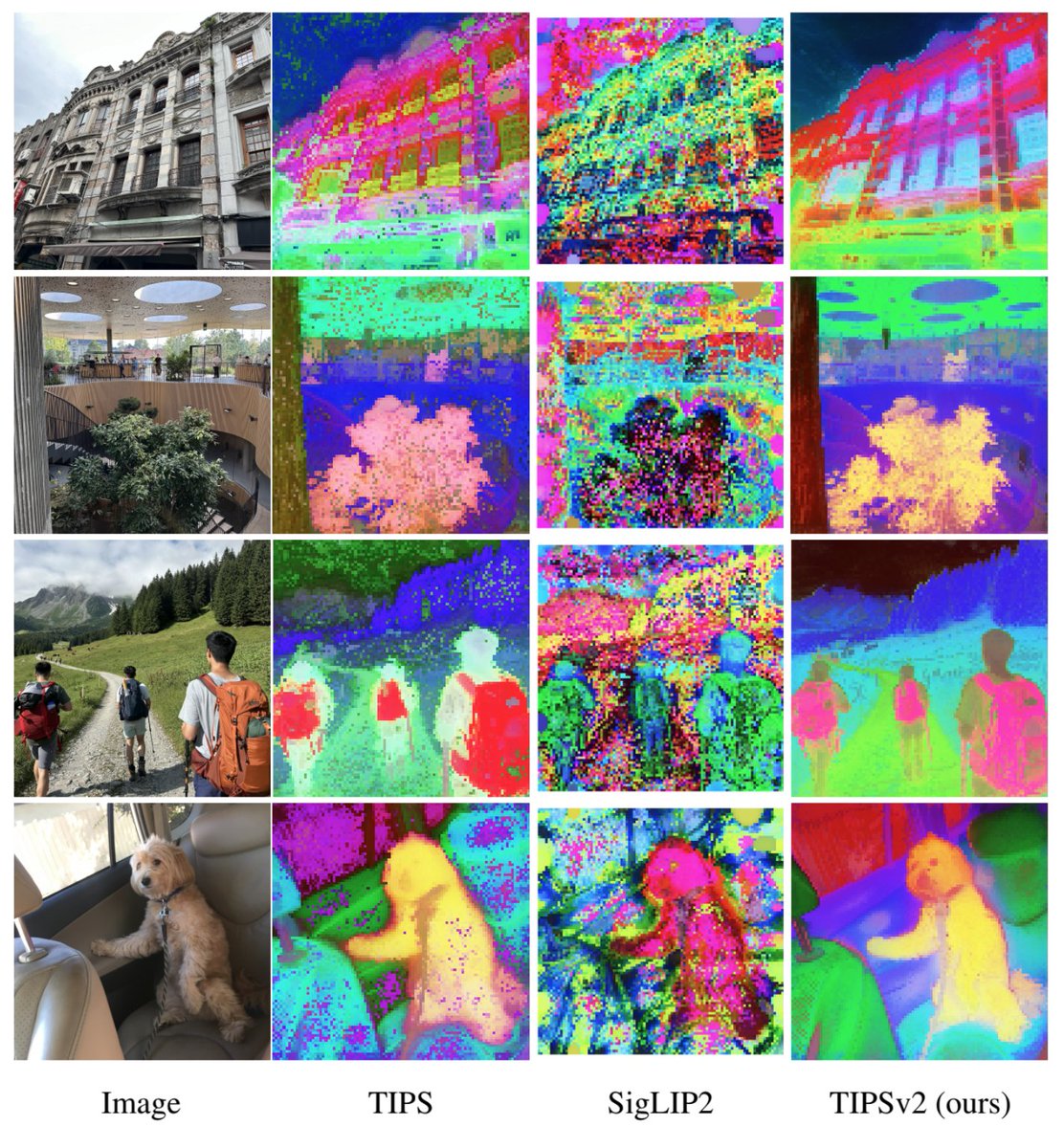
🚀 Excited to release #CVPR2026 TIPSv2 from @GoogleDeepMind, a foundational image-text encoder with spatial awareness, leading to strong overall results and massive gains on patch-text alignment. 🔥
1/N
@randall_balestr I don’t think the bias norm for the coefficient vectors β is comparable across different featurizations even with the constraint on the total energy of the features like how section B.1 has. That is, it doesn’t necessarily say anything about the prediction risk or feature quality
@Jianlin_S Yes, you’re right about the number of steps, but it isn’t immediately clear to me that the fixed point iterations should always converge. Maybe it is okay practically with your init?
@Jianlin_S f(x) = trc(theta^Tmsgn(G+x*theta)). We want x s.t. f(x)=0
x→∞ then msgn term is approx msgn(theta) so f(x) is +ve. Also x→-∞ gives f(x) as -ve.
Start from an interval and exponentially expand till you get different signs at the edges, then use bisection.
@zzlccc@svlevine Yes, that’s mostly it, though sequence level vs token level modeling also has consequences for how the reward is shaped by the KL divergence against the anchor. See vanilla PG (token level) and REINFORCE (seq level) comparisons here: https://t.co/Jo6clXlSFd
@main_horse@deepseek_ai Eq 9 seems off by 2. Ideally it should be full-padding conv on the left and valid on the right (for each block). But we have 2x full on the right and valid on the left. Eq 7 is also off, it doesn’t have the first block. i should start at 0 and num blocks should be ⌊(t-l)/d⌋+1
@kellerjordan0@recurseparadox@karpathy Instead of the loss, perhaps the metric should be the performance on downstream tasks. Though it will be harder to micro-optimize for due to more noise.
@cloneofsimo This paper [https://t.co/NVVNZN4O94] considers such a simplification of Adam and proves that it converges in expectation. See section 2.2. However, this only works if you only remove the corrective term from m; removing it from v may hamper performance (see figure 2).