For Heygen hackathon, I have built RepoReel — Turn any GitHub repo into a video (built with @HeyGen Hyperframes + Avatar IV) check it out
https://t.co/NO6IftzYu7 (RepoReel on RepoReel)
https://t.co/vyX4tejbgp (RepoReel on Hyperframes)
@IamEmily2050 Way too many cases of bench max model now. I have seen very good and bad quality from Happy horse videos. Seedance is still the most performant and consistent
For the past few years, humans have been doing “prompt engineering” to coax the best performance out of different LLMs. In this work, we explored what happens if we train an AI to do that job instead.
By training a Conductor model with RL, we found that it naturally learns to write highly effective, custom instructions for a whole pool of other models. It essentially learns to ‘manage’ them in natural language.
What surprised me most was how it dynamically adapts. For simple factual questions, it just queries one model. But for hard coding problems, it autonomously spins up a whole pipeline of planners, coders, and verifiers.
Really excited to see where this paradigm of “AI managing AI” goes next, especially as we start moving from single-agent chain-of-thought to multi-agent “chain-of-command”.
Link to our #ICLR2026 paper: https://t.co/EwbjjRPLUb
Along with our TRINITY paper which we announced earlier, this work also powers our new multi-agent system: Sakana Fugu (https://t.co/2m8VRdOYqG) 🐡
A decade ago in Korea, AlphaGo showed AI’s potential.
Together with the Korean government, we’re now looking at how this technology can help accelerate scientific discovery and create new opportunities for economic growth across the region. 🇰🇷
Find out more → https://t.co/OKiI9e65aC
We’re launching the beta for our new commercial AI product: Sakana Fugu 🐡, a multi-agent orchestration system!
Blog: https://t.co/36Ud311KCP
Fugu hits SOTA on SWE-Pro, GPQA-D, and ALE-Bench, and has been our internal secret weapon. It dynamically coordinates frontier models, autonomously selecting the optimal agent combinations and roles for each task.
Available as an OpenAI-compatible API, you can seamlessly integrate Fugu into your existing workflows with minimal changes.
🐟 Fugu Mini: High-speed orchestration optimized for latency
🐡 Fugu Ultra: Full model pool utilization for deep, complex reasoning
Apply for the beta test here: https://t.co/1fjuAha7ci
Introducing our new work: “Learning to Orchestrate Agents in Natural Language with the Conductor” accepted at #ICLR2026
https://t.co/Wnh9ZACmLm
What if we trained an AI not to solve problems directly, but to act as a manager that delegates tasks to a diverse team of other AIs?
To solve complex tasks, humans rarely work alone; we form teams, delegate, and communicate. Yet, multi-agent AI systems currently rely heavily on rigid, human-designed workflows or simple routers that just pick a single model. We wanted an AI that could dynamically build its own team.
We trained a 7B Conductor model using Reinforcement Learning to orchestrate a pool of frontier models (including GPT-5, Gemini, Claude, and open-source models available during the period leading up to ICLR 2026).
Instead of executing code, the Conductor outputs a collaborative workflow in natural language. For any given question, the Conductor specifies:
1/ Which agent to call
2/ What specific subtask to give them (acting as an expert prompt engineer)
3/ What previous messages they can see in their context window
Through pure end-to-end reward maximization, amazing behaviors emerged. The Conductor learned to adapt to task difficulty: it 1-shots simple factual questions, but autonomously spins up complex planner-executor-verifier pipelines for hard coding problems.
The results are very promising: The 7B Conductor surpasses the performance of every individual worker model in its pool, setting new records on LiveCodeBench (83.9%) and GPQA-Diamond (87.5%) at the time of publication. It also significantly outperforms expensive multi-agent baselines like Mixture-of-Agents at a fraction of the cost.
One of our favorite features: Recursive Test-Time Scaling! By allowing the Conductor to select itself as a worker, it reads its own team's prior output, realizes if it failed, and spins up a corrective workflow on the fly. This opens a new axis for scaling compute during inference.
This research proves that language models can become elite meta-prompt engineers, dynamically harnessing collective intelligence.
Alongside our TRINITY research which we announced a few days earlier, this foundational research powers our new multi-agent system: Sakana Fugu! (https://t.co/36Ud311KCP) 🐡
OpenReview: https://t.co/e5WqTleQNL (ICLR 2026)
🚀 Just discovered https://t.co/cLs3ikDRzh, an amazing AI creation platform!
✨ Unleash your creativity and generate stunning images and videos.
Join me on this creative journey!
👉 https://t.co/UKgGN9vmK8
#AI#Art#SousakuAI
🚀Lovart GPT Image2.0 Challenge Now Live!
Starting April 27 — experience the professional-grade power of GPT Image 2. We are giving away a massive credit pool -> 30 creators win 5,000 Credits each.
Here’s how to join before it’s too late:
-Unleash your creativity using Lovart GPT Image 2 . Whether it's Next-Gen UI/UX, Game Assets, or Product Concepts, we want to see your vision.
-We highly encourage content that combines GPT Image 2 with other Lovart features. Whether it’s a cinematic masterpiece or a technical tutorial on your workflow—quality content wins.
-Tag @ lovart_ai + # lovartimage2 in your post.
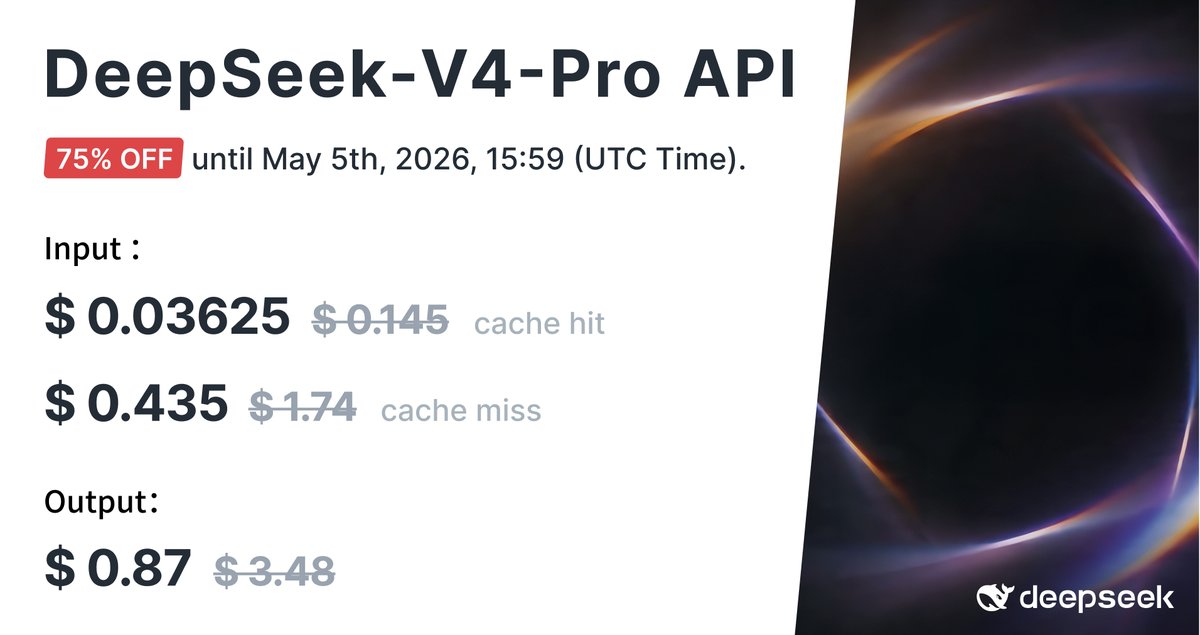
🔥DeepSeek-V4-Pro API is 75% OFF until May 5th, 2026, 15:59 (UTC Time)! Don't miss out on this massive discount.
🛠️Integration Updates:
🔹Claude Code: Set model to deepseek-v4-pro[1m] to unlock 1M context!
🔹OpenCode: Update to v1.14.24+
🔹OpenClaw: Update to v2026.4.24+
Check the latest official API docs for full details: https://t.co/9J9ZedDpyU
Google presents Vision Banana
- SOTA unified model for both image understanding and generation.
- Claims that image generation serves as a universal interface for diverse vision tasks