sim-to-real transfer is still the biggest lie in robotics demos. your policy works perfectly in isaac sim, then the robot touches a real cardboard box and everything falls apart. the companies that close this gap will own physical AI. everyone else is making video games.
Industrial Use Case Robotics must precede Home robotics
- Defined goals and structured tasks have better SOPs and trajectories are more learnable
- less sci-fi fantasy expectation and more immediate value creation
- memory for home robots is unsolved
- industrial robots don’t need to interface with human
Oh you’re trying to sell data to a big lab? You have a data pack right? With an eval right? With pre and post train scaling plots, existing model perf, number of samples, failure case analysis, easy medium hard subsets, ground truth audits, normal and expert human baselines right? You have a target org researcher contact right? Oh you don’t know anybody at the labs and are going to cold email the procurement team? Oh… You have an off the shelf set available immediately and a pipeline with max weekly throughout numbers with scalable QC right? Oh you don’t have adversarial defenses for your outsourced QA team? Oh you don’t even have a ramp target with a dedicated queue manager? Oh…
ORO AI is at Solana Accelerate AI Miami during Consensus 2026.
If you're building AI agents that need more than recycled internet data, reach out to our Head of Ecosystem @markkmii. We’re exploring what teams across this ecosystem are building and where real-world data can unlock better agents.
We’re helping teams train on real-world voice, behavioral, and interaction datasets sourced from live user activity.
On data markets:
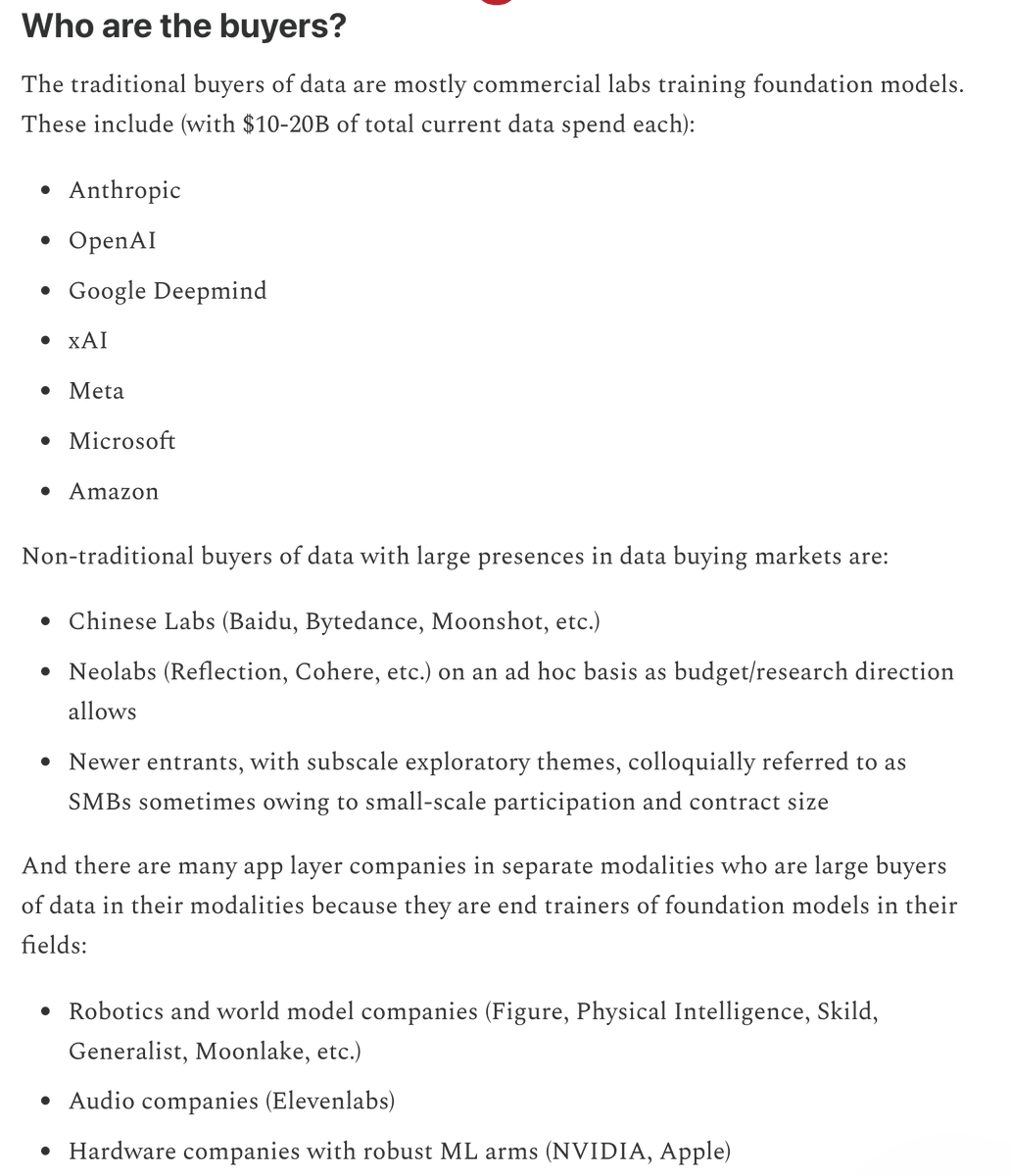
A while ago, Anthropic said that they would be spending a billion dollars this year on RL data. This year, that amount will be far exceeded, with good data rarely being turned down for budget concerns. We can expect OpenAI to be of similar mindset, although the window for banal data projects serviced by the likes of Mercor is rumored to be closing entirely this year. Deepmind, Meta, Microsoft, Amazon, and xAI are known to be N-1 labs who may buy datasets already saturated by the likes of Anthropic, or buy RL environments in light of not having a system like Tundra in Anthropic.
The TAM is still 10s of billions if not more and the raw aggregate spent on data will only continue to increase.
But one must remember what is bought when data is sold, because few today can really differentiate Mercor/Handhshake from a Mechanize/Surge. Data is valuable, to frontier labs, based on how much it can be easily used to improve frontier models. To show this capability, it matters whether teams selling data can show how most directly it can be used to hillclimb models, how much frontier SOTA models struggle on its benchmarks, and how much trouble they can save the frontier lab in its continual acquisition. Data sold is, therefore, very much resembling selling outcomes rather than an actual reusable product, which is why one must obsess about indexing on the scalable means of producing internal systems that can help end model trainers produce outcomes rather than fixating on data itself when evaluating RL environment companies.
In this way, the TAM of data markets is actually extremely greenfield and growing, because few teams have the sophistication for research services and scale for on demand consistently QA’ed data. It is the semblance of this product with which Mercor was able to overtake Scale, the semblance of this product which many newer upstarts are painting as an argument to chip away at Mercor/Handshake/Surge’s lunches.
From my April's edition of State of Data on substack:
we built one of the largest wearable health datasets ever
🔸600k+ contributors
🔸11M+ health data points every month
🔸2500+ structured datasets across sleep, recovery, heart rate from Whoop, Fitbit, Oura, Garmin & more
already being used by frontier labs and developers to train and evaluate real-world AI