If you are mighty, gain respect through knowledge,
And through gentleness of speech.
Don't command except as is fitting.
-- Ptahhotep
#Egypt#Egyptian#quotes
This video brought tears to my eyes...
See how women of Iran resisting the harassers in the streets, some blinded by the regime. See how women are wounded, but unbowed to their oppressors. We are asking the free world to be #UnitedAgainstGenderApartheid
A boy from 'Dinka' tribe in southern Sudan with his family's cattle.
Dinka people are one of the Nilotic tribes that have lived in Sudanese region of Africa since 3000 BC. Also known as Moinjaang or people of the people, Dinka tribe has maintained a unique cultural and linguistic identity separate from other ethnic groups in Sudan and South Sudan. Dinka people maintain a pastoral lifestyle centered around cattle herding, fishing, and agriculture. Dinka society practices polygamy, in which a man is able to marry more than one wife. To secure his relationship with a prospective bride's family, a Dinka groom pays bride wealth in the form of monetary and cultural goods.
Dinka people are monotheistic and believe in a single god called Nhialic, who is known as creator of all life on earth. To contact Nhialic during important occasions, Dinka people conduct rituals associated with birth, death and illness. During initiation ceremonies associated with puberty, for example, diviners and healers often carry out rituals to contact Nhialic in which the adult men are marked with tribal scars indicative of adulthood. Along with other Nilotic peoples, Dinka are amongst tallest people in the world, with many men and women reaching nearly 6ft in height.
According to oral traditions, Dinka originated from Gezira in what became Sudan. In medieval times this region was ruled by the kingdom of Alodia, a Christian, multi-ethnic empire dominated by Nubians. Living in its southern periphery and interacting with the Nubians, Dinka absorbed a sizable amount of Nubian vocabulary. From 13th Century CE, with disintegration of Alodia, Dinka began to migrate out of Gezira, fleeing slave raids, military conflict, and droughts.
Conflict over pastures and cattle raids has been happening between Dinka and Nuer as they battled for grazing land. Dinka's religions, beliefs, and lifestyle have led to conflict with Arab Islamic government in Khartoum. Sudan People's Liberation Army, led by Dinka Dr. John Garang De Mabior, took arms against the government in 1983. During subsequent 21 year civil war, many thousands of Dinka, along with non-Dinka southerners, were massacred by government forces. Since, independence of South Sudan, Dinka, led by Salva Kiir Mayardit, engaged in a civil war with Nuer and other groups, who accuse them of monopolising power.
In 1983, due to Sudan's second civil war, many educated Dinka were forced to flee cities to rural areas. Some were Christians who had been converted by Church Missionary Society. Most Dinka converted to Christianity and are learning to adapt traditional religious practices to Christian teachings. The conversion took place in rural villages and among Dinka refugees country. The Lost Boys of Sudan were converted in significant numbers in the refugee camps of Ethiopia.
On November 15, 1991, event known as "Dinka Bor Masscre" commenced in South Sudan. Forces led by breakaway Riek Machar faction deliberately killed an estimated 2,000 Dinka civilians that included Hol, Nyarweng, Twic east and Bor and wounded several thousand more over two months. Much of their wealth was destroyed, which led to mass starvation deaths. It is estimated that 100,000 people left the area following the attack.
#archaeohistories
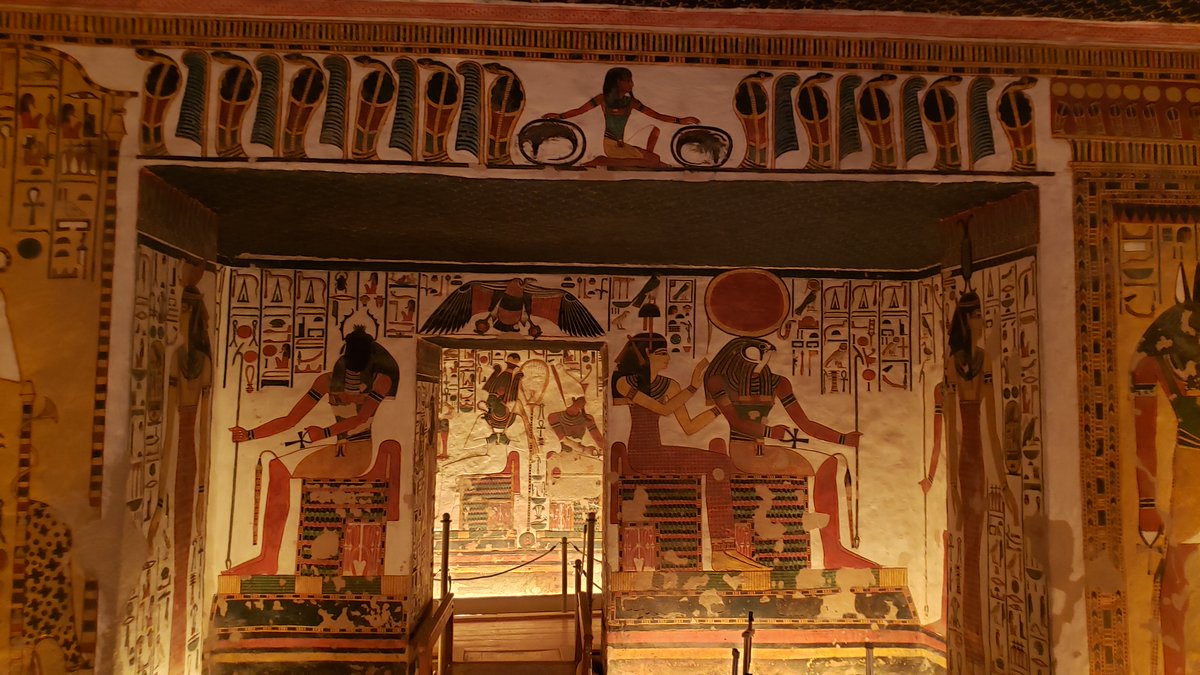
I was lucky enough recently to visit the splendid tomb of Queen #Nefertari (QV66), Ramses II's great royal wife (early dyn. 19), discovered by Schiaparelli in 1904. Conveying its magnificence in just 4 images is impossible, but here we go!
📸 mine
#egyptology#archaeology#egypt
An astounding circular panel portrait of two young men from Roman Egypt – sometimes called the 'Tondo of the Two Brothers', though the identity of the men and nature of their relationship remains unknown. The life-size double portrait was discovered during excavations at Antinoöpolis in 1898. While it was not intended as a 'mummy portrait', the painting is thought to have been displayed in a funerary context, perhaps hanging in the reception hall of a family tomb.
The men are shown with golden statuettes representing syncretic Romano-Egyptian deities, while both wear Roman dress marking them out as members of the Romanised elite of ancient Antinoöpolis. The young man on the left wears a scarlet chlamys cloak, fastened at the shoulder with a glittering gemstone brooch.
c.130-140 AD, Egyptian Museum, Cairo.
A 4,400 year-old ancient Egyptian beadnet dress.
Each of the shells around the fringe are plugged with a small stone which would rattle with the wearer’s movement.
Faience. From Qua, Egypt. Old Kingdom, Dynasty 5.
Petrie Museum. 📷 my own
#Archaeology