It takes real guts to burn supply instead
of chasing short-term hype.
🔥 Another day. Another burn.
Total burnt - 13m 🔥
We're committed to:
— Daily $ZKPV burns
— Buybacks from protocol fees
— Long-term supply reduction
Not here for a quick pump.
Here to build the strongest
ZK compliance protocol on Solana.
Burn proof on-chain. Always.
https://t.co/nHYEdyXKFR
$ZKPV 🔵 https://t.co/AFlkmYZrOf
I was super early to $VEILNET at $75k and I am super early to this.
I have found the Veilnet of Solana but even better.
The project I am talking about is @Fhe_state and they have been building publicly for more than 3 months.
Ticker: solana:4cfEdG5Z814n3SvJYBDvvHg3VVFmRDgVqKUdaganpump
CA: 4cfEdG5Z814n3SvJYBDvvHg3VVFmRDgVqKUdaganpump
Mcap: 70k
It is open source too
https://t.co/NlZdpL9ZQ5
I have many reasons to believe this is the most underrated privacy project on Sol.
From a hackathon prototype to the foundation of confidential AI infrastructure on Solana.
What began during the Solana BIP Hackathon as a vision around encrypted execution has evolved into something significantly larger:
a confidential execution layer for autonomous AI systems.
With Phase 3 completed and Phase 4 now underway, FHESTATE is entering the next stage of the platform.
Here’s the journey so far:
PHASE 1 — FOUNDATIONS
We started by building the cryptographic and execution primitives required for confidential systems on Solana.
The focus was simple:
How do intelligent systems operate without exposing their underlying data?
This phase established the base infrastructure for:
• encrypted state
• blind computation
• confidential execution
• secure coordination primitives
The objective was proving that privacy-preserving computation could operate natively within high-performance on-chain environments.
PHASE 2 — VERIFIABLE INFRASTRUCTURE
Once encrypted execution became possible, the next challenge was trust.
How do you verify execution without revealing the underlying intelligence, prompts, balances, memory, or computation?
Phase 2 focused on:
• proof generation systems
• verifiable execution pipelines
• on-chain settlement architecture
• cryptographic integrity layers
• confidential state synchronization
This transformed FHESTATE from experimental infrastructure into verifiable infrastructure.
Private execution.
Public verification.
PHASE 3 — AGENT SYSTEMS
This is where the platform evolved beyond privacy infrastructure.
We began building for the emerging agent economy.
AI systems are becoming autonomous economic actors:
• coordinating capital
• executing workflows
• interacting on-chain
• making decisions independently
But today, most agents leak intelligence by default.
Phase 3 introduced:
• confidential AI agent architecture
• encrypted memory systems
• secure multi-agent coordination
• private workflow execution
• encrypted contextual state
• confidential runtime infrastructure
Agents operating directly on encrypted state with verifiable settlement on Solana.
This phase established the first operational version of the FHESTATE platform.
PHASE 4 — THE APPLICATION LAYER
Phase 4 is now underway.
The infrastructure layer has matured enough for the next step:
bringing confidential AI systems into real-world applications.
This phase focuses on:
• live confidential AI agents
• developer tooling & SDKs
• autonomous coordination systems
• encrypted agent memory
• private financial execution
• scalable confidential runtimes
• consumer & enterprise applications
• verifiable intelligent systems on-chain
The goal is no longer just enabling privacy.
The goal is enabling intelligent systems that can operate, coordinate, and evolve securely at scale.
We believe the next generation of AI systems will not operate publicly by default.
They will require:
private memory,
private coordination,
private execution,
and verifiable settlement.
That future is what FHESTATE is being built for.
Private Intelligence.
Public Settlement.
$FHESTATE
@ParadiseReviews Working tek where you can analyse any document for different parameters
dev supply will be locked
Solid desci project
AdYMGnFN67CRgDZyF3xN5BN3cjoPr5zjDYXjdiDPpump
ca
$rsr
@S0Lmay0r Working tek where you can analyse any document for different parameters
dev supply will be locked
Solid desci project
AdYMGnFN67CRgDZyF3xN5BN3cjoPr5zjDYXjdiDPpump
ca
$rsr
@Frostt Working tek where you can analyse any document for different parameters
dev supply will be locked
Solid desci project
AdYMGnFN67CRgDZyF3xN5BN3cjoPr5zjDYXjdiDPpump
ca
$rsr
@yourcryptodj Working tek where you can analyse any document for different parameters
dev supply will be locked
Solid desci project
AdYMGnFN67CRgDZyF3xN5BN3cjoPr5zjDYXjdiDPpump
ca
$rsr
@cryptoterry Working tek where you can analyse any document for different parameters
dev supply will be locked
Solid desci project
AdYMGnFN67CRgDZyF3xN5BN3cjoPr5zjDYXjdiDPpump
ca
$rsr
@TrueGemHunter Working tek where you can analyse any document for different parameters
dev supply will be locked
Solid desci project
AdYMGnFN67CRgDZyF3xN5BN3cjoPr5zjDYXjdiDPpump
ca
$rsr
@koop0x Working tek where you can analyse any document for different parameters
dev supply will be locked
Solid desci project
AdYMGnFN67CRgDZyF3xN5BN3cjoPr5zjDYXjdiDPpump
ca
$rsr
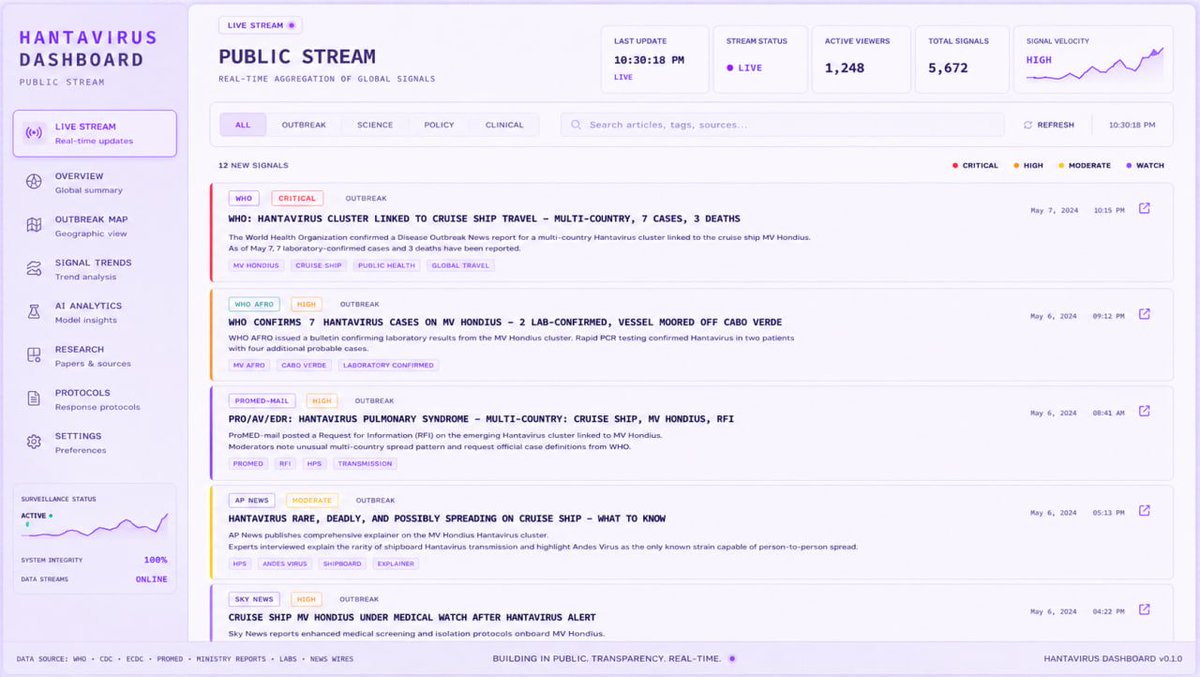
We had already been exploring the idea of building real-time biological event dashboards inside GENESTACK for emerging viral situations, and the recent Hantavirus discussions provide a strong real-world context to showcase what that infrastructure could look like.
Most biological systems today are still fragmented:
research exists in one place, outbreak data in another, clinical signals elsewhere, and public awareness usually arrives late.
What we’re exploring with GENESTACK is a unified biological intelligence layer capable of organizing multiple streams into a single operational interface.
The Hantavirus dashboard concept currently includes:
• real-time outbreak monitoring
• research aggregation layers
• transmission + regional activity mapping
• pulmonary and inflammatory response visualization
• biological stress interpretation
• viral event tracking
• protocol simulation architecture
• signal-based monitoring systems
The broader idea is not just tracking a virus.
It’s exploring how future biological infrastructure systems may continuously interpret emerging physiological and environmental patterns during viral events.
From static reporting
to live biological intelligence systems.
This is one of the directions we believe DeSci eventually evolves toward.