Silver’s quiet weekly close above the key $40 level — its first in more than 14 years — is one of the most important yet underappreciated macro developments of this week, in my view.
All eyes are on gold’s breakout, and rightly so, but silver’s move is a critical signal that may be pointing to what comes next: a potential retest of prior highs.
Game on.
Meanwhile:
Miners are enjoying some of their best profit margins ever at these gold price.
Remarkably, many of these companies still trade as if gold were priced around $2,000.
A significant re-rating is likely still ahead of us, in my view.
Gold is on fire:
World central banks’ gold holdings now reflect 27% of total foreign reserves, the highest share in 29 years.
At the same time, foreign holdings of US Treasuries as % of reserves have declined to ~23%, the lowest since the 2008 Financial Crisis, per Crescat Capital.
In other words, global central banks now hold more gold than Treasuries for the first time since 1996.
This trend began a decade ago and accelerated in 2022 after G7 economies froze Russian foreign exchange reserves.
Since 2015, reported global central bank gold holdings have risen +3,500 tonnes, reaching ~36,500 tonnes, the highest since the 1970s.
Foreign central banks are still stocking up on gold.
Gold has just surged to an all-time high on the weekly charts.
Imagine trying to time a correction in gold prices while central banks are trapped in a massive monetary and debt crisis, forced to accumulate the metal at nearly any cost.
We are living in wild times, in my view.
"Hard Assets" gold vs. "Financial Assets" paper certificates.
Foreign central banks now officially hold more gold than US Treasuries — for the first time since 1996.
via @TaviCosta
*Book Ideas -- Regime change -- A must-read "When Markets Speak."
The big ‘not so beautiful’ debt is causing central banks to flee the dollar for the safe haven of gold. Keep that in mind, as yet another deficit-financed spending bill will be passed by the uniparty before the fiscal year ends.
Think LatAm, and particularly Brazil, is set up for an amazing inflection if voters choose correctly this election cycle. Brazil is one of my largest exposures.
Excited to see Lula potentially tapping out today…
The big ‘not so beautiful’ debt is causing central banks to flee the dollar for the safe haven of gold. Keep that in mind, as yet another deficit-financed spending bill will be passed by the uniparty before the fiscal year ends.
And despite all the skepticism:
Brazilian stocks are setting the stage for what appears to be a historical breakout on the monthly chart.
Latin America is currently undergoing a structural change, and this is likely the beginning of a significant move, in my view.
Foreign central banks now officially hold more gold than US Treasuries — for the first time since 1996.
Let that sink in.
If you think this buying streak is ending, just look at what happened in the 1970s.
This is likely the beginning of one of the most significant global rebalancings we've experienced in recent history, in my view.
Normally, when metals perform well for a few years, producers ramp up output to capitalize on the favorable environment.
Not this time.
Decades of underinvestment in the mining industry have been so severe that there are virtually no significant new mines coming online to meaningfully change the supply curve.
Some think this problem is unique to silver. It’s not.
While the imbalance is more acute there, other metals face the same challenge: a shortage of new supply on the horizon.
This is one of the main reasons I believe this metals and mining cycle is likely to last much longer than prior ones.
Lastly, in case you were wondering:
When it comes to silver, Mexico is essentially the “Saudi Arabia” of the market.
It accounts for about 25% of global supply — an even larger share than Saudi Arabia holds in oil.
The fact that Mexican output has been in multi-year decline poses a profound challenge for the silver market.
This chart is fascinating.
While the fiscal deficit gets most of the attention, the trade imbalance is just as severe — worse than any time since the 1800s, except briefly during the global financial crisis.
Today’s issue, by contrast, is structural, not cyclical.
For the first time, the US is running twin deficits while government debt has reached extreme levels, and the dollar stands at one of its most overvalued levels in history.
This combination is unsustainable.
Something must serve as the outlet for these pressures, and the most likely escape valve is the dollar itself.
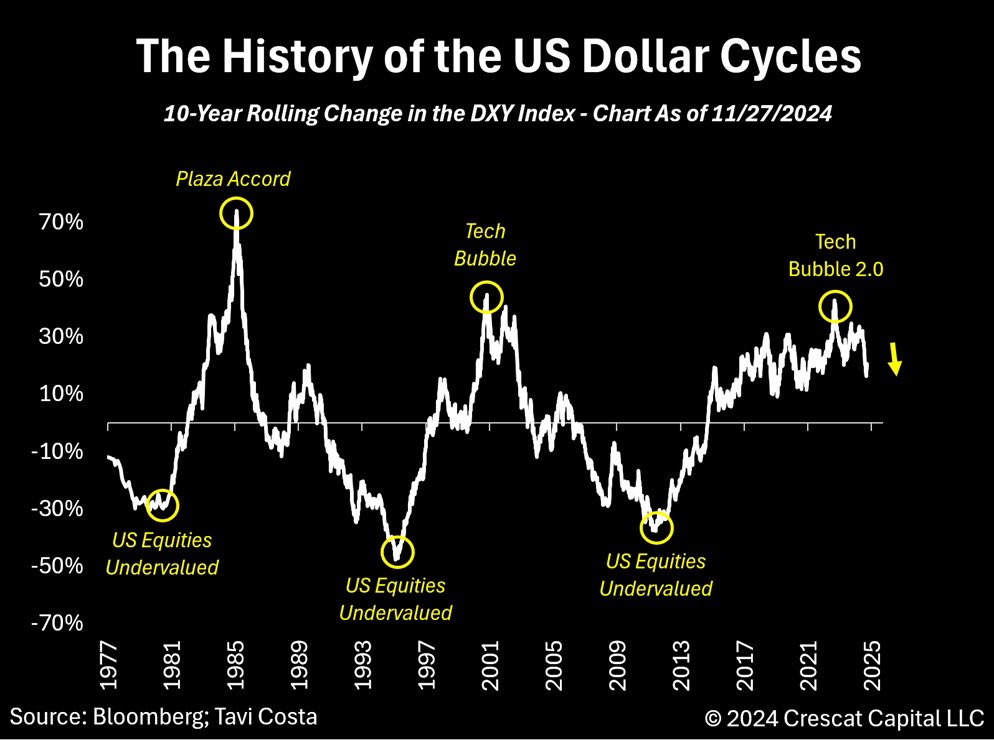
So far this year, the US dollar has suffered an extraordinarily steep decline.
While many argue the selloff has gone too far, we see it as likely the opening phase of a broader, long-term weakening trend — driven by the growing necessity of financial repression rather than mere policy choice.
“The Crescat Precious Metals Fund has absolutely crushed it since you’ve been out there… you were talking about gold when no one thought it was popular.”
@FoxBusiness has @TaviCosta on to discuss the current market.
https://t.co/HhAKpOIjjo
Past performance does not guarantee future results. All investing carries risk including risk of loss. Net performance shown includes the effect of fees and expenses. Neither Charles Payne or Fox Business are clients of Crescat and have not been compensated in any manner by Crescat. Please see additional important disclosure information here: https://t.co/I1XIquttCq
This is what I think everyone is missing:
At some point, a new political party will come into power — it's inevitable.
The question is:
How will government involvement in these companies evolve under new leadership?
Administrations will change, but these equity stakes won't.
This could lead us down a dangerous path, one we’ve seen before in less stable or less developed economies.
Excellent video by @TaviCosta, I always love his takes on commodities, and I strongly agree with this outlook.
This is exactly the rotation I expect to start seeing soon. That's why I keep pounding the table on copper for right now (it tends to lead).
The rarer metals (nickel, tin, antimony, lithium etc...) that are strategically important are also excellent opportunites, but many of them have already run (like MP and UAMY, both of which I mentioned pre-run up).
I also agree with his take on steel and energy (especially LNG), later on. But those are trades im currently looking at more into 2026 as demand picks up.
All it will take is signs the business cycle is moving again and I believe the commodity supercycle will begin in earnest.