@yarbroughcam Critical point. My Kellogg prof @HarryKraemerJr wrote his advice for leading in these times:
“Mantra 2: You’re going to tell people what you know, what you don’t know, and when you’ll get back to them to discuss what you didn’t know before.”
Great read: https://t.co/IjMJJAQ6tI
This might be the most honest thing I’ve read in months.
The idea that your next 5 years will look exactly like your last 5…
is something I’ve been thinking about for a while, but this piece puts it into words I couldn’t fully articulate.
A MUST READ for anyone serious about change.
It challenges the illusion of “eventual progress.”
Now I’m genuinely curious:
Is your future being created… or just replayed?
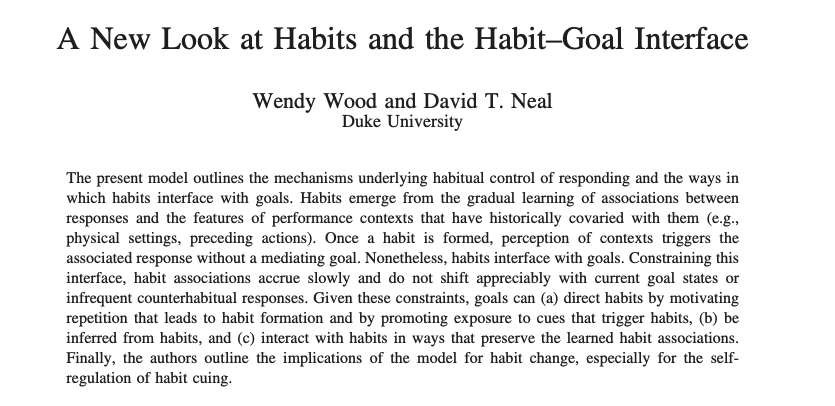
In 2011, researchers David Neal, Wendy Wood, and Jeffrey Quinn conducted an experiment that revealed something disturbing about human behavior change.
They studied students who had recently transferred universities and compared their habits to students who remained at their original schools.
The transfer students showed dramatic shifts in their daily patterns within weeks of arriving in their new environment. Students who had been eating unhealthy food for years suddenly developed better eating habits. Chronic procrastinators became more organized. People who never exercised started going to campus gyms regularly.
The control group of students who stayed at their original universities? Their behaviors remained virtually identical across the same time period, despite many of them having identical goals for personal improvement.
The environmental disruption of transferring schools had accomplished what years of willpower and motivation could not.
Your brain consumes roughly 20% of your body's energy despite being only 2% of your mass. That computational expense means it has developed an obsession with efficiency that overrides almost every other priority, including your conscious goals. Every decision you make, every path you walk, every person you talk to gets filed into pattern recognition algorithms that your brain uses to automate future behavior.
The result is something you experience as life feeling like it's on autopilot.
After about 18 months of living the same routine, your brain begins treating your daily choices not as conscious decisions but as automatic responses to environmental cues. You wake up, check your phone, eat the same breakfast, take the same route to work, have the same conversations, consume the same content, make the same weekend plans. Each repetition strengthens neural pathways that make those patterns easier to execute and harder to deviate from.
Your identity becomes the stories your brain tells about these patterns. "I'm not a morning person." "I'm bad with money." "I'm not the type who goes to the gym." These aren't personality traits. They're behavioral predictions your brain makes based on recent data, and then those predictions become the lens through which you filter future opportunities.
The frightening part is that you don't notice this happening because it feels like personal preference evolving naturally. You're not choosing the same things repeatedly because you're stuck. You're choosing them because they feel increasingly "right" for who you are. Your brain is rewriting your sense of identity to match your behavioral patterns rather than the other way around.
The person you think you want to become is competing against the person your brain has already decided you are.
But the university transfer study reveals something most people miss: the reason your next five years will replicate your last five isn't because change is impossible. It's because you haven't disrupted the environmental cues that trigger your automated behavior patterns.
Your brain doesn't distinguish between "good" and "bad" habits when it automates behavior. It only recognizes efficiency. If checking social media first thing in the morning has become automatic, your brain doesn't evaluate whether that serves your goals. It just notices that the cue leads to the routine leads to the reward, and it strengthens that loop regardless of consequences.
The leverage point for changing your next five years isn't willpower or motivation or better goal setting. It's environmental design that forces new behavioral patterns before your brain can automate the old ones.
People who successfully transform their lives don't do it through gradual improvement. They create what behavioral economists call "discontinuous change" by deliberately disrupting the physical and social environments that trigger their existing patterns. They move to new cities, change friend groups, delete apps, rearrange their living spaces, take different routes to work, wake up at different times.
The disruption breaks the cue-routine-reward loops that have been running their lives and forces their brains to build new neural pathways before the old ones can reassert control.
Most people change 5% to 15% of their environmental cues and wonder why their lives stay the same. They buy gym memberships but keep their existing social circles. They delete one app but keep their phone next to their bed. They try to eat healthier but still grocery shop at the same stores with the same people on the same days.
The students in that university study didn't transform because they suddenly developed superhuman discipline or found the right motivational framework. They transformed because their environment changed so dramatically that their brains couldn't fall back on existing behavioral automation.
The reason your next five years will be an exact copy of your last five is that you're trying to become a different person while preserving the environment that created the person you currently are.
Your brain is not broken.
It's working exactly as designed by hundreds of thousands of years of evolution that prioritized survival over growth, familiarity over possibility, efficiency over transformation.
The question is whether you're going to design a life that works with that reality or spend another five years fighting against it while staying in the exact same place.
We are at a point in history—not nearing it, but here—where everyone is going to have to decide if they are content to numb themselves with an endless stream of fentanyl-like digital slop or if they are going to fight for their humanity and touch grass and challenge themselves and create and contribute and love.
Decades of research shows people are most fulfilled when they care deeply about meaningful projects. When they have mastery and mattering. When they do good work and love good people. Nobody feels or performs their best when they are mindlessly scrolling.
The antidote to algorithmic mass distraction is deep focus and enduring effort on meaningful pursuits.
Making music. Writing. Running. Gardening. Coaching. Dancing. Building tables.
When you work with deep focus on an activity or craft—when you throw yourself into something you care about and give it your all—you experience of the opposite of existential longing. You experience presence, depth, and aliveness.
Perhaps the greatest risk of the modern world is that we go wherever the current takes us, like automatons floating along a pixelated conveyor belt to nowhere. The only thing that separates us from this dystopia is ourselves. Our agency—our attention, our capacity to think, create, and love—must be fought for.
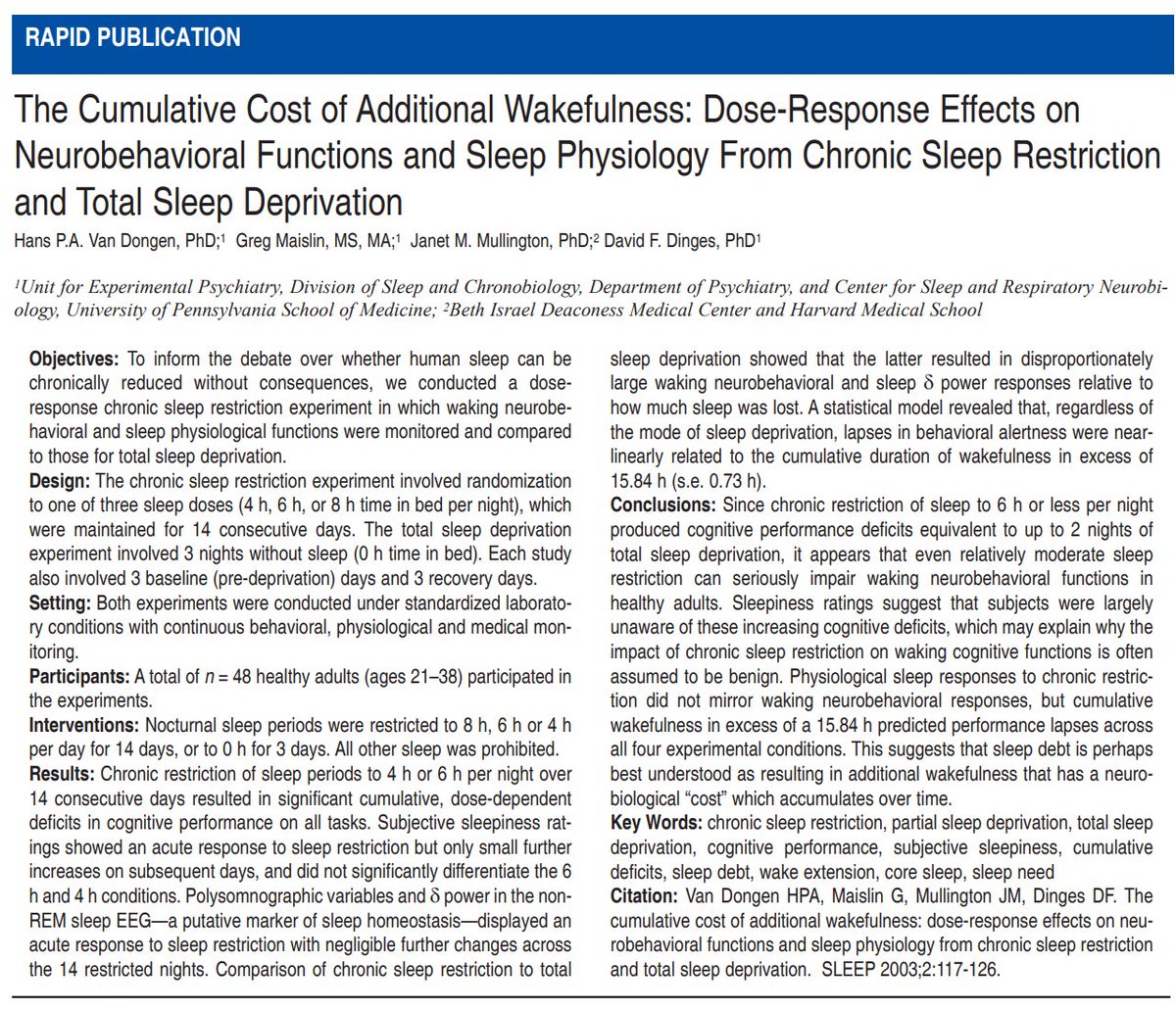
The scariest finding in this paper: the subjects couldn't tell it was happening.
UPenn ran this study on 48 healthy adults. One group slept 8 hours. Another slept 6. Another slept 4. For 14 straight days. They tested cognitive performance every 2 hours from 7:30am to 11:30pm.
The 6-hour group's reaction times, working memory, and sustained attention deteriorated on a near-linear curve. By day 14 they were performing at the same level as someone who hadn't slept at all in 48 hours. The 4-hour group hit that threshold by day 6.
Here's the part that should unsettle everyone who thinks they "do fine" on 6 hours: the subjects' self-reported sleepiness flatlined after the first few days. Their brains kept getting worse. Their perception of how impaired they were stopped updating. The cognitive decline was invisible to the person experiencing it.
The researchers found a hard threshold. Any wakefulness beyond 15.84 hours in a day produces cumulative neurobiological cost. That cost compounds every single day you exceed it and does not reset with a weekend of sleeping in.
About 35% of American adults sleep less than 7 hours a night. 40% of those get 6 hours or less. In 1942 that number was 11%. We built an entire professional culture around a sleep schedule that this paper says is functionally equivalent to pulling consecutive all-nighters.
"I'm fine on 6 hours" is the most common response to sleep research. The first thing chronic sleep debt destroys is your ability to notice chronic sleep debt.
The Olympics banned this technique because it removed the Fear of Failure.
> Long before the modern Olympics,
Greek athletes followed rules that would sound extreme today.
They didn’t only train their bodies.
They trained who they were.
Because to the Greeks,
fear of failure
was the real enemy of performance.
Not weak muscles.
Not missing talent.
Fear.
So they practiced a method
called prokatalēpsis a mental ritual so powerful
it was later banned for giving an “unfair advantage.”
> Athletes described it as:
“the moment the future stopped being threatening.”
Here’s how it worked.
The night before competition,
the athlete did something unusual:
He imagined losing.
Fully.
Clearly.
Painfully.
Without excuses.
Not to discourage himself.
Not to spiral.
But to drain fear of its power.
Because the Greeks believed
you can’t be afraid of
what you’ve already accepted.
Then came the second step the part that made the ritual famous:
After visualizing defeat,
the athlete stood alone in silence
and repeated one sentence
until his body felt it was true:
“What remains after fear
is my true form.”
They believed this revealed
the identity beneath ego,
expectations,
and imagined judgment.
And something strange happened:
Athletes slept deeper,
moved more freely,
and competed with a calm
that felt almost untouchable.
> Modern psychology later confirmed it:
When you vividly face
the worst outcome
and survive it mentally,
your brain reduces the fear response tied to it.
Today it’s called
“exposure reconsolidation.”
The Greeks called it:
“returning to yourself
before the world interferes.”
Try it next time
fear tightens your chest.
Accept the loss
for sixty seconds.
Then say the line.
You may feel
something very old
stirring awake inside you.
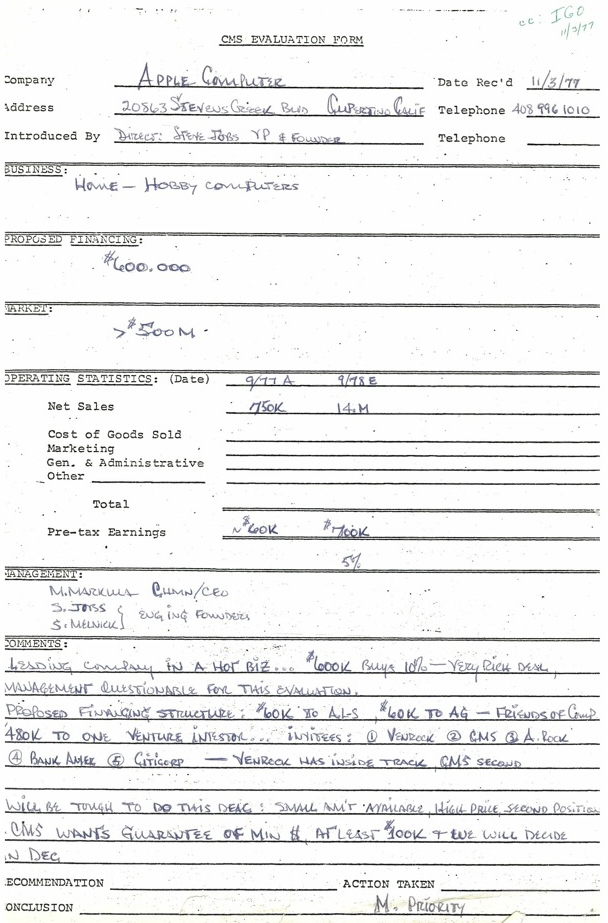
In honor of 50 years of Apple, we're sharing - for the first time ever - Don Valentine's original 1977 memo for Sequoia's investment into Apple Computer. #Apple50
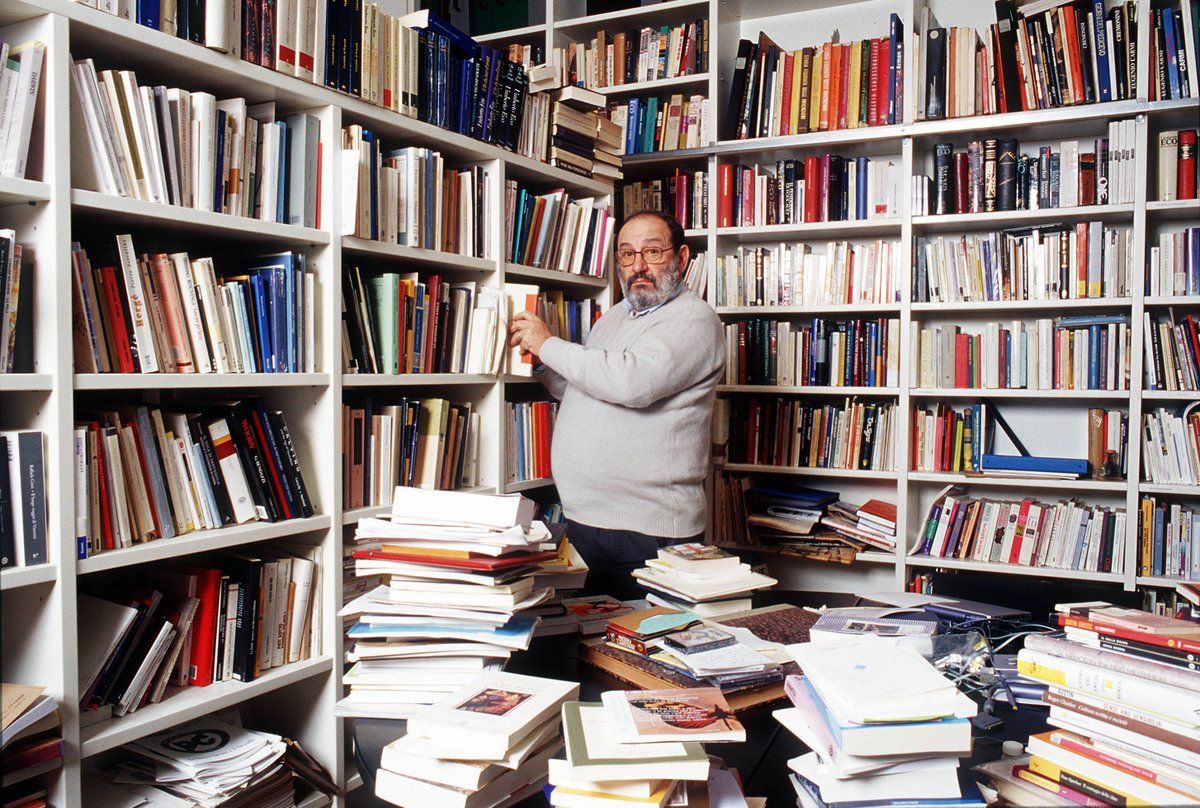
Umberto Eco, who owned 50,000 books, had this to say about home libraries:
"It is foolish to think that you have to read all the books you buy, as it is foolish to criticize those who buy more books than they will ever be able to read.
It would be like saying that you should use all the cutlery or glasses or screwdrivers or drill bits you bought before buying new ones.
There are things in life that we need to always have plenty of supplies, even if we will only use a small portion.
If, for example, we consider books as medicine, we understand that it is good to have many at home rather than a few: when you want to feel better, then you go to the 'medicine closet' and choose a book.
Not a random one, but the right book for that moment. That's why you should always have a nutrition choice!
Those who buy only one book, read only that one and then get rid of it. They simply apply the consumer mentality to books, that is, they consider them a consumer product, a good.
Those who love books know that a book is anything but a commodity."
Luka Doncic says LeBron James has a big influence on on his weight loss:
“I saw how LeBron James takes care of his body every single day, like it’s part of the job, not an option. The discipline, the routine, the sacrifices… it’s on another level. And I realized, if I want to stay great and compete at the highest level for a long time, I have to start treating my body the same way.
Because sometimes, the real wake up call doesn’t come from criticism or losses, it comes from standing next to greatness and seeing the difference in preparation. Talent can take you far, but discipline is what keeps you there. And when you learn from someone who’s done it for decades, you don’t just improve your game… you change your entire mindset.”
We’ve been watching movies about time recently and they’re all telling the same story.
The character has some version of control over time. They can fast-forward, rewind, redo.
And in every single one, the arc is: he uses the power to try to optimize. Get the best outcomes. Avoid the boring parts. Skip to the good stuff.
And in every single one, the realization arrives slowly after a lot of pain and chaos: there are no boring parts. There is no good stuff to skip to. The whole thing IS the good stuff. The only button that matters is play.
I think about this when I notice myself treating the present like a waiting room for the future.
Reminder: just hit play.
Communication expert Jefferson Fisher showed me something I won’t forget...
He calls it the string theory.
When two people are talking, there’s an invisible string between them.
If you check your phone, the string goes slack. Even just having it on the table breaks the connection.
Here’s how he explained it 👇🏾
Sending a gratitude tweet to all of you. It's been an extremely difficult past few days. Feeling really sad about the state of the world. But I am grateful for the good people I am blessed to have in my orbit, who give me a lot of hope.
I haven't shared this publicly before, but I am on an incredible journey of rediscovering my faith in the past 2 years. Believe it or not, what triggered this journey was a conversation I had with my son about quantum physics.
We were learning about the Observer Effect--how just the mere act of observing something can change the quantum nature of that object. (Apologies for actual physicists who probably have a more sophisticated definition of this phenomenon).
As we were studying this together, a conclusion I discovered within myself was that if I treat the world with love and positivity, I am actually making an impact in flipping positive qubits along my path, thereby strumming the vibrations of the universe in a way that can leave a legacy of positivity in the universe. Even beyond my own temporal life.
This to me, is God.
Accepting this has led me down a wonderful path in life, and has meaningfully changed how I think about relationships and how I treat my environment writ large. I also believe in the power of prayer, as an act of intentionally strumming positive vibrations in this universe.
Not sure if any of this makes sense (just typing as I go!), but with all that said, my wish for you is to accept all of my love. And to feel love all around you. I will do all that I can to make a positive environment around me.
I believe your life matters a lot, and that your ability to flip qubits in a positive way has far-reaching consequences that none of us may be capable of truly understanding.
I pray for your peace, our world's peace, and an abundance of love for all of us to share.
As I always say "Product marketing is not just for product..."
Said differently language matters--get it right and unlock impact...
Yes it can be overwrought/overdone but done well it changes not just perception but the game
Forward-deployed Job Titles https://t.co/mHAeSK6ZQW
Excellent post on communication and navigating power dynamics from @cjgustafson
The Life of a Professional Number Two: Communication Tips https://t.co/AkToqcI6h4
A relevant section from Atomic Habits for anyone building a new habit this year:
People often think it's weird to get hyped about reading one page or meditating for one minute or making one sales call. But the point is not to do one thing. The point is to master the habit of showing up. The truth is, a habit must be established before it can be improved. If you can't learn the basic skill of showing up, then you have little hope of mastering the finer details. Instead of trying to engineer a perfect habit from the start, do the easy thing on a more consistent basis. You have to standardize before you can optimize.
Great post as always from @marcrandolph — “How you doing anything is how you do everything.”..are both great words to live by, and to his point, a trap and recipe for stress and poor performance.
Judgement and discernment are earned over time as you experiment towards equilibrium.
One of the most important things I’ve learned as I’ve gotten older is that most things don’t matter.
Whatever you’re trying to accomplish, there are usually just a couple of things on that to-do list that will actually make a difference.
And I’m not saying the rest of the items on your list shouldn’t get done…I’m just saying they probably don’t need to be done well.
There are two big benefits of taking this perspective.
First, it means you can relax. So much of our daily stress comes from the feeling that we’re leaving things undone, or not doing them well, or that we “didn’t put in that extra 10%.”
If you start from the assumption that not much really matters, you can let most things be imperfect.
Second, it allows you to focus a disproportionate amount of time on the one or two things that do matter.
Triage is such an underrated skill.
But if you can correctly determine which one or two things will—if you get them right—make the difference between success and failure, then you can spend your time taking those to a high level of polish rather than wasting your time on everything else.
It’s a power curve.