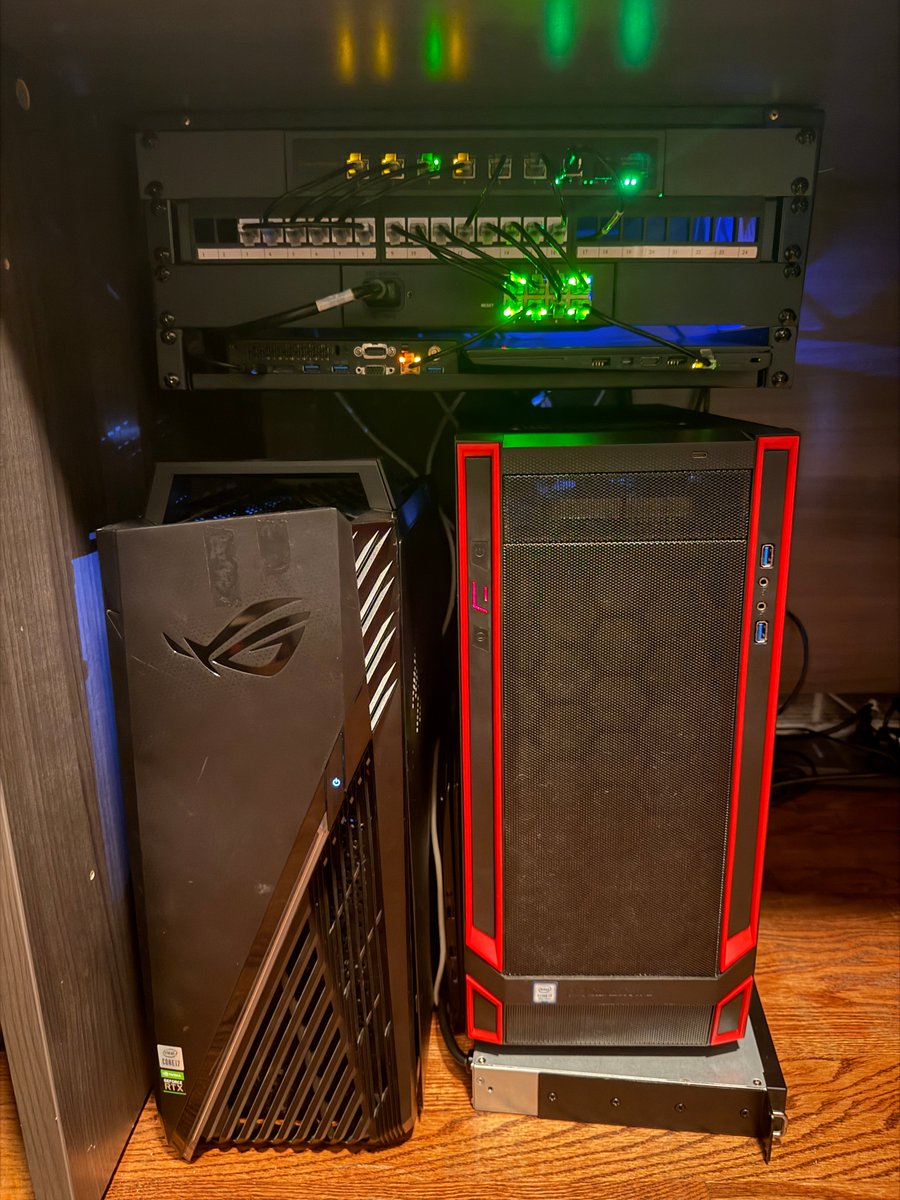
I'm weirdly proud of my very cheap but also very effective homelab. Each machine has a purpose.
Yes, I do have a noctua fan ziptied to the bottom of my desk pushing hot air out of the cable management hole in the top of my desk. I'm proud of my ingenuity.
The ROG desktop is an old recycled PC that is just running linux, it's where all my codex/claude/cli agents live and it's always on, always running.
The red outlined desktop is a nas, running truenas. Yes, it is sitting on top of a rack mountable ups, i just have no rack to mount it too.
There's an old x1 carbon between the two desktops, that is my "browser machine." It runs debian, has 4 Chrome windows on it exposed to my tailscale network that all my agents can use for real actual access to a browser/the internet.
The Lenovo tiny is dns box #1, running adguard, and monitoring all the other machines using grafana/prometheus.
The t460s next to the tiny is dns box #2, running redundant dns/adguard plus monitoring via grafana dns-01.
No pictured - windows machine with 7950x/3090 for running local models (originally my gaming pc) and my macbook pro that is basically just a window into all these machines now.
The top switch is a $165 10GbE switch off Amazon to give me a 10GbE backbone. The bottom switch is 1GbE for other devices.
Jev is multimodal…at least I think it always was but it is now too.
This sounds like a fun update to test!
In my workflows I tested Jev/clev/laya locally and couldn’t find a place to insert it into my workflows where I was confident it was making the right decisions, but another test can be spun up quite quickly.
Anybody out there using Jev still day to day? Or have thoughts on this update and how it could change workflows now?
we announced Jev 1.14 on 10.14 at 1:14pm PT 🔥
a new and improved model, along with experimental features for our dreamers:
• images
• a new box type
• longer context
surprise, Jev was already able to see you! 👁️
BUT our bar for production-grade intelligence is quite high, so builders beware, these are preview features.
enter the ~*~ danger zone ~*~ at your own risk. 🚨
@yafeishi wait how did they overwrite each others plans? they should be on different worktrees, then have an agent reconcile them when they're done to prevent overlap
@contabaiswa hmm. i could use it, give it to claude to monitor 5 hour limits and when it sees it's getting low auto switch over to codex? could be interesting
@davosdodev i have a recommendation for you since you're using T3.
Stop using grok 4.7 that will solve your issues it's not the best hopefully that changes with 4.8 or 5
No seriously though use opus/sonnet/sol
I've posted this a few other places - i think what's happening (read the karpathy post if you haven't) is that OpenAI literally only did what it did in this timeline to compete with Anthropic, like you said.
Currently what's happening is that OpenAI is building out foundations and ecosystems to capture the first two groups from Karapthy's post (https://t.co/tcceH2W9JF)
They're concerned about being set up to capture the 6B people who haven't heard of AI, and the 1-2B who are currently just playing around with chatbots (which openai already has a dramatic lead in over anthropic).
Alot of what Anthropic is doing right now is catering to the 20M.
People on X are mad at OpenAI because they want OpenAI to cater to the 20M...and they aren't. The only reason they do anything is so that Anthropic doesn't get too far ahead.
Dusting off this tweet from April because this gap in shared understanding of LLM capability is *widening*. It's now less "two groups of people speaking past each other" and more a sharp funnel.
- Napkin math somewhere around 6B people (~75% of the population) have barely come in contact with LLMs at all.
- Around 1-2B (~20%) are casual and infrequent users of free-tier ChatGPT-like products. This group sees derpy chatbots and treats them a bit like a better Google search, a writing aid, or etc. Maybe an agent tries to book you a flight. I have non-tech friends who (reasonably, imo) say they have not much use for it at all. Even many professionals outside of math&code are in this tier. For example, execs and many other functions spend a lot of their time talking to other people, so while they understand what is happening intellectually, it is still second-hand and a bit abstract.
- Now we get to professional use of frontier-grade LLMs in math&code. Somewhere around 20M people (0.2%) see first-hand that large, complex projects that used to take them weeks/months can now be completed by agents with a prompt. Building apps, copying apps, translating apps, decompiling apps from binaries... This has all happened very quickly and recently - less than 1 year ago, I was writing code manually by hand, typing memorized computer code commands into a code editor character by character, occasionally pressing Tab to autocomplete a little chunk of code.
- And finally we get to the ~5,000 people (~0.00006%) with access to frontier-grade systems internally. The external world has seen the preview. It looks like swarms of thousands of agents collaborating over weeks on software mega projects: minting zero days, running cyber attacks and defenses at machine speeds, discovering new science, advancing the frontier of mathematics. Things that would have taken top professionals in the industry years of work. Meanwhile, human review and comprehension are starting to fall behind. For example, people are still involved in the "archeology" of the OpenAI-HF incident from many months ago. Mathematicians may be poring over the 722 manuscripts on frontier mathematics for a while.
The funnel is driven by a combination of factors:
1. The impact scales with ambition, problem size, and horizon. A question with a paragraph answer barely stresses the system. You need a reservoir of big, difficult problems that you really care about. This aspect drives the consumer / professional dimension of the funnel.
2. The jaggedness of the system (which I have written about a lot separately). Capability peaks in domains that are digital, verifiable and economically valuable. This is because LLM capability emerges from reinforcement learning on verifiable rewards on a curated environment mixture driven by revenue potential. This aspect primarily drives the area (e.g. math&code) dimension of the funnel.
3. Access. Free-tier, paid-tier, internal.
So this is the weirdness of the moment. The general public has mostly not interacted with these systems. When they have, it looks like a derpy chatbot. The majority of professionals still see only a modest uplift. And a small sliver of professionals are experiencing the vertigo of the curve going vertical. And it is all happening at the same time.
Hey I’ve got a question, been digging into pstack for a few days - is there a reason why you just use these all as skills instead of building them as like scripts or tool calls that run?
My biggest issue honestly I’m trying to work thru is efficiency - I assume you have all the usage in the world for grok/grokbot/models and I’m trying to shape them to fit the models and subscriptions I have and just trying to figure out of there is a more efficient way of running them
I’m going thru and open sourcing a ton of skills/scripts/tools I’ve built for me for a variety of use cases and honestly I’m not really expecting any of them to blow up or get stars or have users use a ton of them now - but I am learning a ton.
Diving into @poteto ‘s pstack has literally been invaluable, if you haven’t looked at it she’s open sourced her entire workflow.
The step I was missing was verification - having agents verify that their work actually works, and giving them the tools to do so.
One of the ways I’ve started doing this is using the “lowest models” aka haiku low/luna low and telling those agents to follow the readme/instruction of these open sourced repos, download and install it, and prove that it does what it says it does and the setup is fluid and easy and the operation is fluid and easy. It does this in a sandbox - and when it finds a hard step, or an instruction that doesn’t make sense, or gets stuck then it gets fixed, pushed, then re-tested/verified.
At this point I’m learning more about how the tools work then I did just using the tools before they were open sourced. Honestly excited to learn and get better and maybe on day I’ll have something that a bunch of people find useful
Because it is a hobby for 99% of people.
You have to spend so much money that’s out of reach for a lot of people to have even remotely close to the performance of frontier models that people can pay $20 a month to access.
Ease of access is a huge part of something moving into mass adoption daily life vs it being a hobby.
Timed my Claude usage almost perfectly.
I did use ALOT of Sonnet though. Upgrading to the $200 Max plan seems to be the way to go so I can shift all of that to Opus.
I think I haven’t done it yet because somehow I’m still hoping OpenAI pulls a model out of their hat but it really really doesn’t look likely
@IndependentEco Soooo I haven’t figured out how to get grok bot to use my opus usage lol, but my grokbot can and 100% does use opus/claude. Download it on your machine, and it can view and use and see Claude cli.