🚨 Important Point: Bitcoin
Let me remind you again, like I said two months ago.
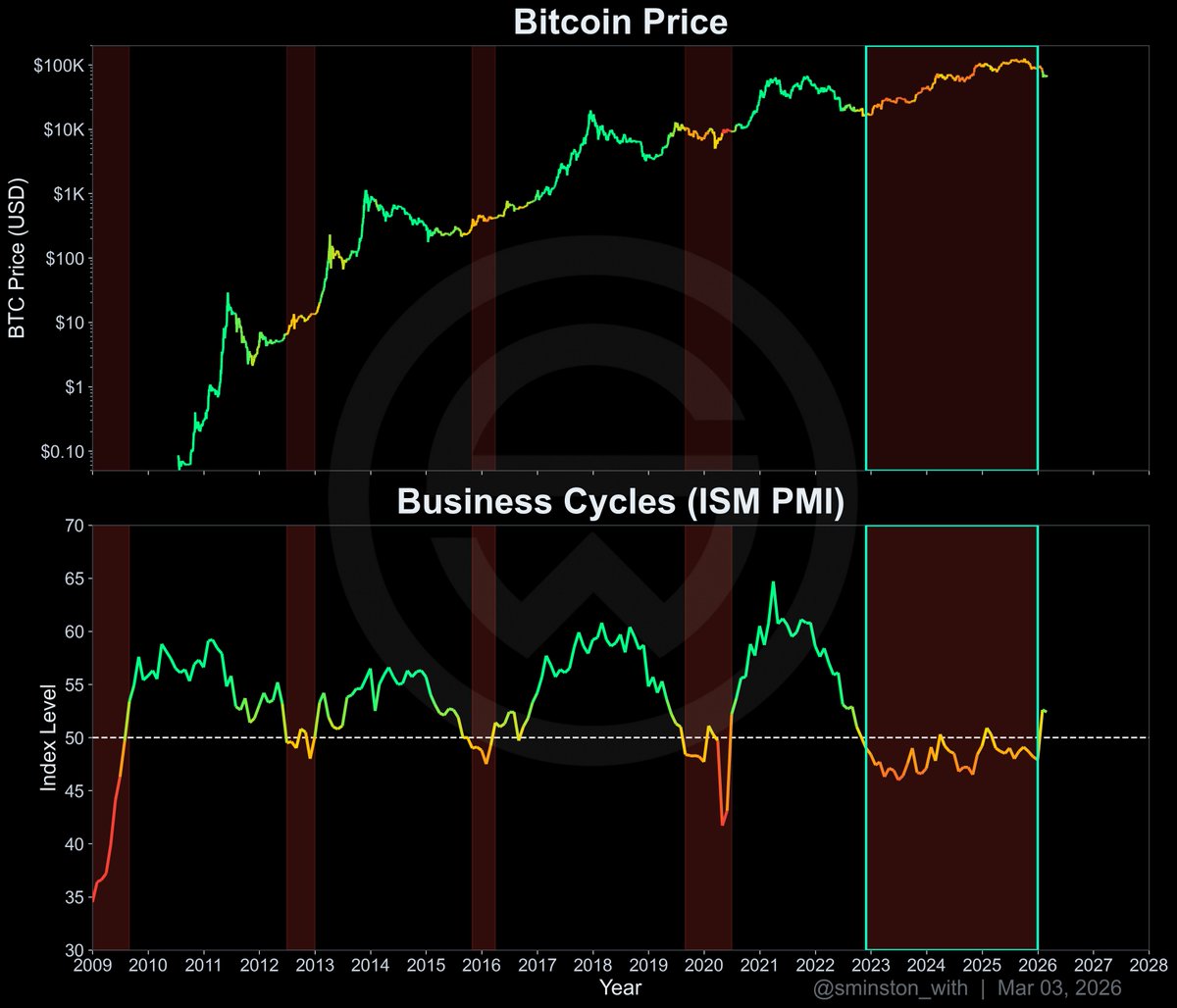
Bitcoin has NEVER had its FULL, complete bull market EVER while the PMI was below 50 the whole time.
It's wild that people honestly think Bitcoin will correct 50% from here...
It's not 2015, people. We're talking about a completely different asset.
Bitcoin also doesn't follow the 4-year cycle. It never has. It has always followed the business cycle, and once again it is.
Like clockwork.
I may look very stupid but here goes
DeFi is dead - the way it is today is going to lead to a slow bleed of TVL, loss of trust, and massive loss of capital from users
There are no simple but effective safeguards for users. Hell, even some teams don't enforce basic rules when they have hundreds of millions of TVL.
You don't have to give up decentralization to protect users
I brainstormed a bit, most ideas are probably awful and not possible but hopefully can lead to smarter people coming up with better ones:
TO PREVENT WALLET COMPROMISES
— Idle mode: allows users to freeze their account for X period of time, to unfreeze requires a password/code/face or finger ID
— Safeguards: when creating an account, allow user to select between fast/slow account, where fast means immediate withdrawals and slow means timelocked withdrawals. This would allow users to have Hot/Cold accounts individually like we have cold wallets and hot wallets.
— Whitelist: user defines 1-3 addresses where funds can go to. Changing whitelist has a 72h timelock. This would mean that even if the wallet is exploited, the funds can only go to accounts the user added himself.
— Limits: On Cold account mode, don't allow more than X% of funds to be withdrawn in a period smaller than 24-48 hours
FOR DEFI PROTOCOLS
— Transparency: Show Multisig/Timelock and other safety transparency details at all times in the page, through either a clickable popup or other way that works with the UI - projects should be proud to show their safety standards and by doing so, force unsafe ones to improve.
— Oversight: Create a task force with FNDN oversight & members from each DeFi protocol with over $X00M TVL to create best practices and keep and open line of communication on ecosystem security.
— Funds Flows: Have an easily accessible tab/dashboard/tooltip, where I can see where my money is going to: how many protocols, which ones, etc.
I think Wallets also should provide a button in the main wallet page to revoke all permissions so that the user is motivated to do it often.
Jó tanács narancstáliboknak...
Azt mondta Orbán, hogy 2,2M szavazójuk még van.
Amit éreztek, a csalódás az azért ilyen nagy mert a saját pártotok és pármproaganda médiumok hazudtak nektek...végig
Itt az idő, hogy új hírforrások után nézzetek! Akik eddig sem hazudtak, mondjuk...
Meg fogtok lepődni!
És az a 2,2M nagyon gyorsan csökkenni fog...
Megkezdődött a sorsdöntő választás, amelyen hosszú időre eldől a szeretett hazánk sorsa. Váltsunk közösen, békésen rendszert, és írjuk be a mai napot a történelemkönyvekbe!
Kérlek szavazz, és biztasd ugyanerre az ismerőseidet, barátaidat és minden családtagodat, mert nem lesz még egy esély!
Nézz a fiadra, nézz a lányodra, gondolj a hazádra és szavazz a TISZA-ra!
Talán soha nem volt ennyire fontos és egyben egyszerű a választás:
Kelet vagy nyugat?
További lemaradás és széteső állam vagy egy működő és emberséges ország?
Korrupció vagy tiszta közélet?
Megélhetési válság vagy tisztességes megélhetés?
Propaganda vagy a valóság?
Megosztás és gyűlöletkeltés vagy nemzeti minimumok és megbékélés?
Háborús őrület vagy valódi béke?
“Talpra magyar, hí a haza!
Itt az idő, most vagy soha!
Rabok legyünk, vagy szabadok?
Ez a kérdés, válasszatok! -
A magyarok istenére
Esküszünk,
Esküszünk, hogy rabok tovább
Nem leszünk!”
i can't stop thinking about the drift protocol hack.
not because of the $280m. we've seen big numbers before. i can't stop thinking about how it happened. and what it says about everything we're building.
on april 1st, while people were posting jokes, an attacker drained $280 million from drift protocol in minutes. the team had to literally tweet "this is not an april fools joke."
but this didn't start on april 1st. it started on march 23rd.
that's when the attacker created four durable nonce accounts. two tied to drift's own security council multisig members. two controlled by the attacker. quietly. no alarms. no flags.
on march 27th, drift migrated their security council due to a routine member change. by march 30th, the attacker had already compromised a signer on the new multisig too.
then on april 1st, they executed.
a test transaction first. then one minute later, two pre-signed transactions fired four slots apart. admin takeover. withdrawal limits removed. a malicious asset introduced. every vault drained. jlp. sol. btc. usdc. over 15 tokens gone.
the entire thing took minutes.
this wasn't a bug. this wasn't a smart contract exploit. this wasn't a flash loan or an oracle manipulation. drift's own report confirms it (you can check @DriftProtocol's latest to confirm). no compromised seed phrases. no code vulnerability.
this was social engineering.
the attacker got 2 out of 5 multisig signers to approve transactions they didn't fully understand. used durable nonces to pre-sign them. then waited. patiently. for over a week.
two signatures out of five. that was the security standing between users and $280 million.
two out of five.
i keep coming back to that number because this is the part that should make everyone uncomfortable. not the hack itself. the architecture that made it possible.
we've seen this before. we've seen this so many times.
bybit. $1.4 billion. the attacker compromised the signing infrastructure and tricked signers into authorizing malicious transactions. same concept. social engineering. not code.
ronin bridge. $625 million. compromised validator keys. same story.
cetus protocol. $223 million. different method but same result. hundreds of millions gone.
in 2025 alone, $3.4 billion was stolen in crypto. and the pattern is almost always the same. not brilliant code exploits. not zero-day vulnerabilities. someone was tricked. a key was exposed. a human made a mistake.
only 19% of hacked protocols even used multi-sig wallets. and the ones that did, like drift, got beaten anyway. because the weakest link was never the code. it was always the person holding the key.
now here's what makes me angry.
i've seen people dunking on solana over this. blaming svm. questioning the entire chain. the same thing happened after bybit when people started questioning evm and ethereum's security model.
this is not a solana problem. this is not an ethereum problem. this is not chain-specific at all.
drift's own report says it clearly. the programs and smart contracts worked exactly as designed. the chain did what it was supposed to do. a human was tricked into signing something they shouldn't have. that can happen on any chain. any protocol. any ecosystem.
pointing fingers at solana is a deflection. and it's net negative for the entire space because it distracts from the real conversation we need to have.
which brings me to circle.
nine days before the drift hack, circle froze 16 business wallets overnight. legitimate companies. crypto exchanges. forex platforms. payment processors. no criminal charges. a sealed civil lawsuit that nobody could even read. no advance warning. businesses woke up and couldn't process payments, couldn't settle trades, couldn't serve their customers.
zachxbt called it "potentially the single most incompetent freeze" he'd seen in over five years of investigations. one of the frozen wallets wasn't even a business. it was a dfinity bridge contract used by thousands of users who had nothing to do with the case.
then nine days later, $280 million is being drained from drift in real time. the attacker is converting stolen tokens through jupiter, bridging them to ethereum, moving funds through circle's own cross-chain transfer protocol.
and the freeze didn't come fast enough.
so circle can shut down 16 legitimate businesses overnight for a civil case. but a quarter billion being actively stolen through their own infrastructure? different speed.
i'm not saying circle is the villain here. i'm saying the system is broken in ways that should concern everyone.
now think about who's actually affected by drift.
it's not just traders. protocols are built on top of drift. neobanks integrate with defi infrastructure. real customers with no idea what a multisig even is woke up and saw they couldn't access their money. some platforms said user funds are safe. but nobody could withdraw.
your money is "safe" but you can't touch it. think about what that feels like for someone who just wanted a better savings rate.
i know what it feels like on a smaller scale. i lost $5,000 to social engineering. it's nothing compared to $280 million. but the feeling is the same. that moment when you realize the funds are gone and there's nothing you can do. it doesn't scale with the dollar amount. it's the same pit in your stomach whether it's $5k or $280m.
and here's the question i keep circling back to.
we say defi is the future. we say we're going to onboard the next billion users. we say this technology will replace traditional finance and bank the unbanked and give people financial sovereignty.
but how do we onboard millions of people into a system where a social engineering attack can drain a quarter billion dollars in minutes? where 2 out of 5 signatures is considered security for $280m? where the attacker sets up wallets two weeks early, runs a test transaction, and nobody notices? where circle can freeze legitimate businesses overnight but can't stop a live heist fast enough? where the same attack, the same playbook, the same human error keeps happening year after year after year?
ronin. bybit. cetus. now drift. same cause. different name. different chain. same result.
defi doesn't have a code problem. it has a people problem. and we keep solving for the code.
i haven't interacted with a protocol in a while. i like money. but i love safety more. and right now this space is asking me to choose between the two.
security can't keep being the last conversation. it can't keep being the thing we talk about after the hack and forget about before the next one. it has to be the first priority. not the last.
because right now we're not ready for the next billion users. we're barely keeping the ones we have safe.
Everyone is covering Terafab as a chip factory.
It is not a chip factory.
Last night in Austin, Elon unveiled a facility that makes masks, fabricates chips, and tests them inside a single building with a nine-month recursive improvement cadence. No such loop exists anywhere else on Earth. Then he told you 80% of the output goes to space. Then he showed you a 100-kilowatt AI satellite with solar panels and radiators, scaling to megawatt range. Then he said Optimus plus photovoltaics will be the first von Neumann probe, a machine capable of replicating itself from raw materials found in space.
Nobody connected the sequence.
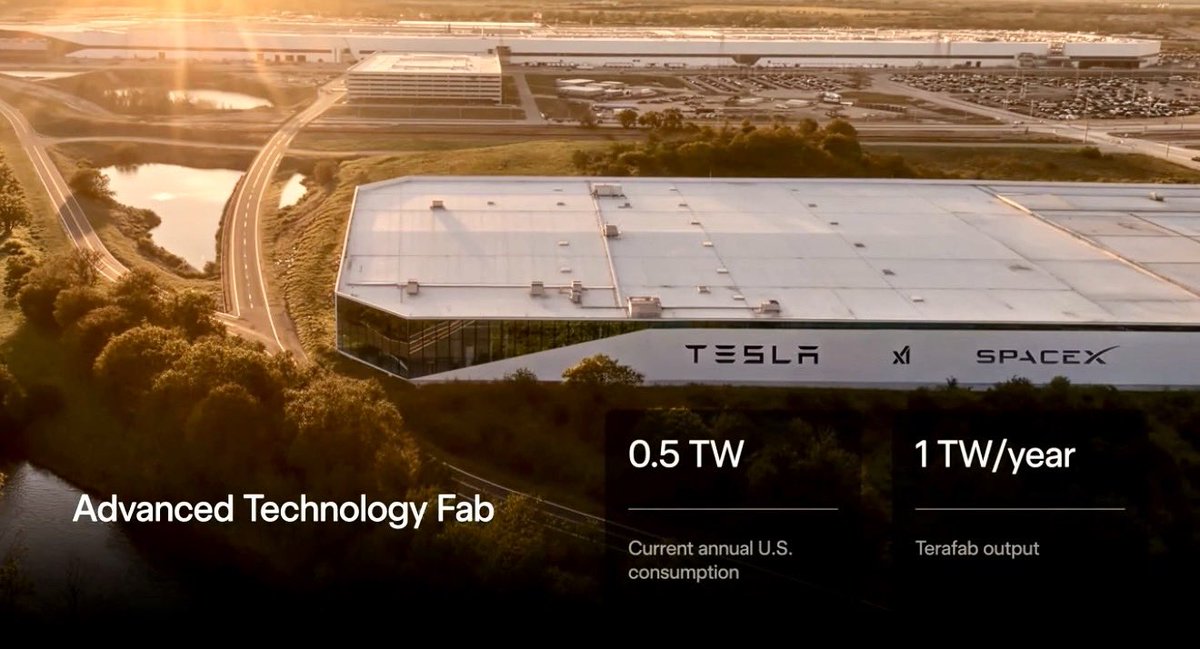
Terafab produces 1 terawatt per year of compute. The entire United States consumes 0.5 terawatts of electricity. Musk is building a single factory whose output in AI silicon exceeds twice the power consumption of the country it sits in. And he is sending 80% of it off-planet because Earth literally cannot power what he is building.
Follow the mechanism. Terafab seeds the chips. Starship launches Optimus robots and solar arrays at 100 million tons per year. The robots mine lunar and asteroid regolith for silicon, iron, and nickel. They 3D-print more robots. They fabricate more solar panels. They assemble more AI satellites. Each satellite runs hotter-burning D3 chips designed specifically for vacuum, where free radiative cooling eliminates the thermal constraints that strangle every terrestrial data center on the planet. The nodes replicate. The replication is exponential.
This is a Dyson Swarm bootstrap hidden inside a semiconductor announcement.
The math is public. The Sun outputs 3.828 times 10 to the 26th watts. A 2022 paper in Physica Scripta calculated that 5.5 billion satellites at 290 kilograms each, robotically manufactured from Mars resources, capture enough solar energy to meet all of Earth’s power needs within 50 years. A 2025 paper in Solar Energy Materials calculated a partial swarm capturing 4% of solar output yields 15.6 yottawatts, roughly a billion times current human civilization’s total energy budget. Musk just announced the factory that builds the chips that go inside the satellites that replicate themselves forever.
92% of advanced logic chips are fabricated in Taiwan. One factory in Austin does not fix that. But one self-replicating system seeded by that factory, launched by the only company with reusable heavy-lift rockets, assembled by the only humanoid robot in mass production, and powered by the only star within reach, does not fix a supply chain. It obsoletes the concept of supply chains entirely.
The market priced this as a $20 billion capex story about semiconductor independence.
The actual announcement was the engineering blueprint for Kardashev Type II.
Humanity sits at 0.73 on the Kardashev scale. 18 terawatts. The distance between here and harnessing a star is not a technology gap. It is a recursion gap. And recursion is exactly what a single building in Austin that makes its own masks, builds its own chips, tests its own chips, and launches the output into orbit on its own rockets was designed to close.
Every civilization that makes it past this point never looks back.
We're giving away a COLDCARD Mk5 🔥
The Mk5 is built for serious Bitcoiners. Fully Airgapped, Mechanical keyboard, Gorilla Glass screen and much more.
Enter to win:
🔸Like
🔸Repost
🔸Comment which color of Mk5 you want to win
Elon Musk just said the most important economic sentence of the decade.
Wall Street still hasn’t processed it.
Musk: “At a very high level, I’d say that autonomy is an insanely fundamental breakthrough. And no one is even close to Tesla.”
Not slightly ahead. No one is even close.
While the entire automotive industry spent a century perfecting a machine that sits parked 95% of its life, Musk was asking a different question.
What if the car was just the beginning?
Musk: “With self-driving, the car becomes roughly five times more useful, but it costs the same to build.”
Same factory. Same steel. Five times the utility.
Musk: “Can you imagine what would happen if a company were doing 25% to 30% gross margins, but suddenly that same thing was five times more valuable. It boggles the mind, actually.”
That is not a product upgrade.
That is the most violent repricing of a physical asset in modern economic history.
But the car was never the real product.
Musk: “We will leverage our manufacturing expertise and the intelligence we’ve developed for self-driving to have a useful humanoid robot.”
The neural network that absorbed every edge case, every near-miss, every chaotic road condition at a scale no research program on earth could replicate.
Now gets a body.
Musk: “The economy is fundamentally GDP per capita times capita.”
In every civilization that has ever existed, output had one hard ceiling.
The number of human bodies available to work.
Musk: “If you no longer have a constraint on capita because of a useful humanoid robot, it’s not clear that there’s any limit to the size of the economy.”
Not a new market cycle.
The permanent demolition of the only ceiling every economy in human history has ever shared.
Every mile a Tesla drives is a training rep.
No simulation. No research grant. No government contract.
A self-funding intelligence machine built on public roads, financed by the largest crowdsourced real-world training program in history.
The competitors still selling traditional vehicles are not losing market share.
They are being made mathematically obsolete by a man who used the car industry as a vessel to build something that has never existed before.
The car was never the destination.
It was the most ambitious laboratory ever built, hiding in plain sight on every road on earth.
A neural network forged in real traffic, real weather, real consequences at global scale.
Ready to walk into every factory, every hospital, every warehouse on earth.
The highway was never the ceiling.
It was the floor.
In November 2025, AI coding tools crossed a threshold. The shift was real and it happened fast.
To make it visible, I ran 22 models on the same prompt, five times each: build a working analog clock from scratch using HTML, CSS, and JavaScript. Oldest models to newest. Same prompt. Same conditions.
That image shows GPT-4o vs. Claude Opus 4.5. The difference speaks for itself.
A working analog clock is a surprisingly good benchmark. The model has to understand what "analog" means, render a proper clock face, position three hands correctly, and animate them every second. Getting that right consistently across five independent runs is a real bar to clear.
Scroll through all 22 models at the link below. You can see exactly where the shift happens.
https://t.co/6OUI5hSorR
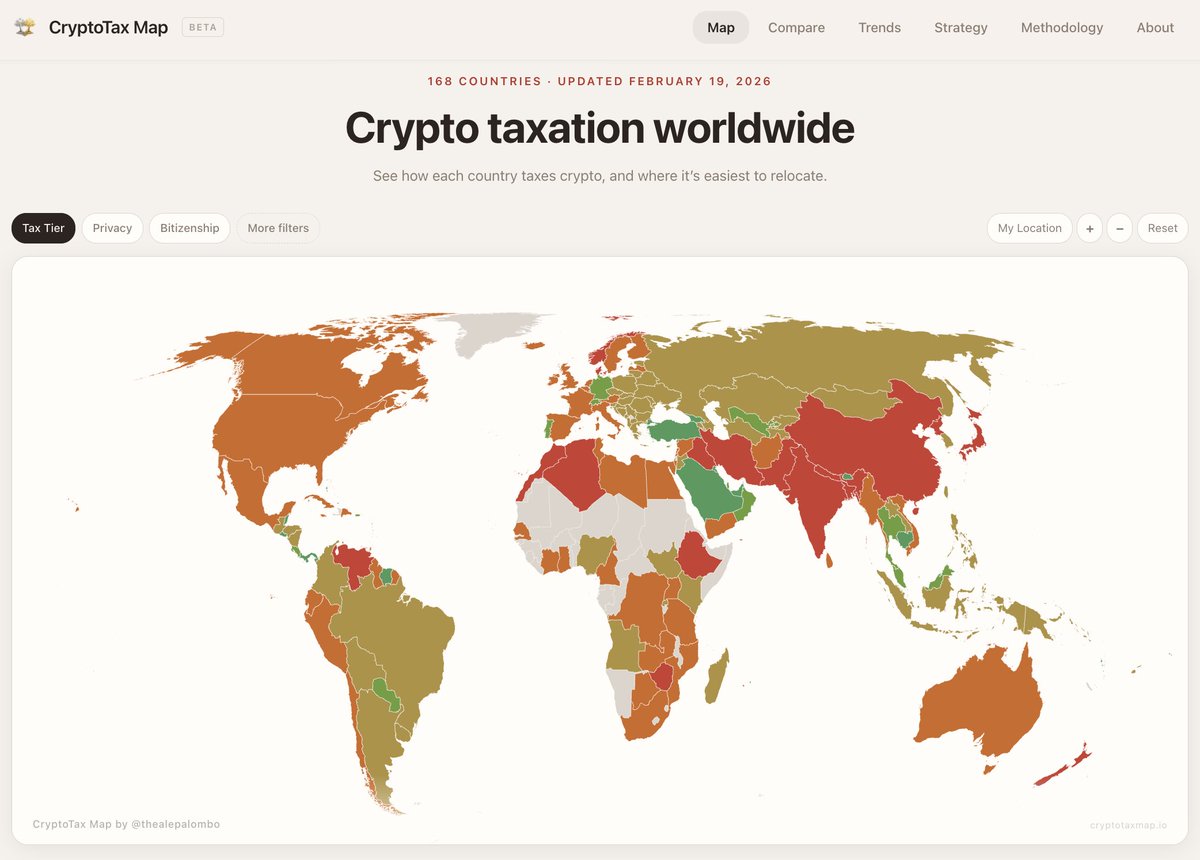
There are 32+ countries with 0% crypto tax. Most people can't name three.
So I built CryptoTax Map.
168 countries. All tax rates. Regulatory trends. Planning tools. One place.
→ See every country's crypto tax rate at a glance
→ Compare up to 3 countries side by side
→ Plan your second residency with the Strategy tool
→ Track which countries are getting friendlier (or worse) since 2020
→ Filter by what matters: 0% tax, privacy, Bitizenship, FATCA, CARF
I built it because I needed it myself.
What feature would you find most useful?
👇