Okay Tweeps - I can really use some help - still trying to find my next job but my savings is now completely depleted. I can use some good charity vibes - please read my story on my gofundme page. Thank you in advance if you decide to donate!
https://t.co/o6VSHUe1SW
Found in Florida! So one of the owners of a hotel, Judi was walking on the beach this morning cleaning up the junk that washed into shore and finds a bottle with a message in it. There is also some sand and 2 one dollar bills. Once we get it open and read the notes we find out that it is in fact NOT sand. It is the ashes of this woman's husband of 70 years named Gordon. She writes that He loved to travel so she sent him traveling in a bottle with a note and money for someone to call home and tell her where he landed. He started at Big Pine Key in March of 2012 and then went to Islamorada where someone found him. ❤
They added a note and sent him traveling again and he landed on our beach in Key Colony. Judi called the wife in Tennessee who was excited to know of Gordon's travels! Judi added her note, we put him in a rum bottle (you know added a little fun to his trip) with the three notes. We added another dollar in case Gordon travels far and a long distance call is needed. We will be having a memorial service or celebration of his life on our beach later today before sending him on his way again." 🥰🥰😋😋
Credit: Allex1337
A TV writer with no philosophy degree read Aristotle, Kant, Bentham, and Scanlon back to back, built a sitcom around what he found, then explained in one book why the trolley problem is no longer a thought experiment and the people who need to understand this most are the ones building AI.
His name is Michael Schur.
He co-created Parks and Recreation and Brooklyn Nine-Nine. But The Good Place was the project that broke him open. On the surface it was a comedy about a woman who accidentally ends up in heaven. Underneath, it was a philosophy seminar. Every episode was built around a real ethical framework. He had to actually understand all of it to make any of it funny.
After the show ended, he wrote the book anyway. He called it "How to Be Perfect." It begins with the most honest opening line in any philosophy book ever written: Should I punch my friend in the face for no reason? No.
That is not a joke. That is his method. He starts with the obvious and builds toward the impossible.
Here is the framework he built, and why the most dangerous people in tech right now are running exactly one of the four schools of thought without knowing any of the others exist.
The first school is Virtue Ethics. Aristotle built it around 350 BCE. The question it asks is not "what should I do?" It asks "what kind of person should I be?" The idea: become genuinely good, and good actions will follow naturally. You build courage. You build honesty. You build practical wisdom. Then you trust the person you built.
The second school is Deontology. Kant built it in the 18th century and it is the exact opposite. Kant did not care about the person. He cared about the rule. His version: act only in ways you would be comfortable turning into a universal law. If everyone lied whenever it was convenient, the concept of truth would dissolve. So you never lie. Even if the truth gets someone killed. The rule is absolute because the moment you make one exception, it stops being a rule.
The third school is Utilitarianism. This is the one that should stop anyone building AI cold.
Jeremy Bentham invented it in the late 1700s. The principle sounds beautiful: the right action is whichever one produces the greatest good for the greatest number of people. Pure math. Pure outcome. Intention means nothing. Only consequences count.
Schur runs it through the trolley problem, the most famous thought experiment in philosophy.
You are driving a runaway trolley. Five people are tied to the main track. You can pull a lever and redirect it to a side track where only one person is tied. Do nothing and five die. Pull the lever and you kill one to save five.
A utilitarian says pull the lever. The math is obvious.
Now the same problem with one change. You are on a bridge above the track. A large man is standing next to you. The physics are clear: if you push him off the bridge, his body stops the trolley. Five people live. He dies. The math is identical.
Almost nobody will push the man. Even people who pulled the lever instantly in the first version refuse.
The utilitarian has no answer for why these two situations feel different. The numbers are the same. The outcome is the same. The only thing that changed is whether you are using another human being as a tool.
That gap between the math being correct and the action feeling monstrous is exactly where AI ethics collapses every single time.
The fourth school is Contractualism, built by the philosopher T.M. Scanlon. It asks the question that Kant's rules and Bentham's math both miss. What principles could be justified to everyone affected? Not the majority. Not the person with the most power. Everyone. Including the one person who ends up on the shorter end of the calculation.
Schur's conclusion is the part that people who live inside growth frameworks and optimization loops will resist the hardest. None of the four schools is correct on its own. Each one has a scenario where following it perfectly produces something most humans recognize as evil. Pure utilitarianism justifies harvesting one person's organs to save five dying patients. Pure deontology says you cannot lie to the murderer asking where your friend is hiding. Each system, taken to its logical extreme, becomes a machine that produces monsters while generating perfect internal justification for doing so.
The way out is not picking the right framework and following it harder.
The way out is using all four as lenses. Ask what Aristotle would do. Ask what Kant would allow. Do the utilitarian math. Then ask Scanlon's question: could you justify this to the person it hurts most?
Where those four answers overlap, you are probably on solid ground. Where they pull in different directions, you are in territory that deserves far more than a two-hour board meeting.
Schur also coined a term that has been stuck in my head since I finished the book. Moral Exhaustion. The feeling of living in an age where you can know, in real time, every ethical implication of every product you use, every company you work for, every piece of code you ship. The gap between what you know and what you can actually change becomes so large that the easiest response is to stop asking.
He says that response is understandable. He also says that choosing not to ask is itself a moral choice, and the consequences of that choice scale in exact proportion to the power you hold.
A person building a product one billion people will use is not operating at the scale where shrugging is a neutral act.
The people who built the most consequential technologies of the last decade were not evil. Most were genuinely trying to do good. They ran the utilitarian math. They saw a billion users. They saw engagement numbers that looked like impact. They optimized for the greatest good for the greatest number and did not notice until much later that the people being turned into variables in the math were still people.
Schur read 2,500 years of philosophy and the lesson he came out with fits in one sentence. You cannot use a single framework because every single framework, followed perfectly, eventually produces the wrong answer.
The people who cause the most damage are not the ones who do not care about ethics. They are the ones who found one framework they liked, felt good about it, and stopped asking.
The trolley problem is not a thought experiment anymore.
It runs on servers. It gets optimized overnight. And the people making those decisions right now have never once asked what Scanlon would say.
I renew my invitation for everyone to join me for the Prayer Vigil for Peace, which we will celebrate in St. Peter’s Basilica on Saturday, April 11, at 6:00 PM Rome time. #PrayTogether#Peace
The dawn is breaking in Persia.
Right now, as we move into 2025, the streets of Iran are witnessing a "final battle" moment. This isn't just about inflation or the Rial hitting historic lows—it’s about the unbreakable spirit of a people who have reached the point of "nothing to lose."
What you need to know in the last 24 hours:
The Bazaar has Spoken: The Grand Bazaar and tech hubs are SHUT DOWN. When the merchants strike, the regime’s foundation cracks.
A New Unity: For the first time in decades, the calls for the return of the Monarchy (Crown Prince Reza Pahlavi) are echoing nationwide. This is no longer just a social movement; it is a national identity reclaiming itself.
"Iran First": The people are rejecting proxy wars. The chants "Palestine and Gaza, both should die for Iran" send a clear message: Take care of our people first.
Unmatched Bravery: From girls risking everything on the front lines to symbolic acts of defiance in the face of tear gas—the "Woman, Life, Freedom" spark has turned into a wildfire.
As a physician, I see the pulse of a nation. It is fast, it is strong, and it is demanding to live.
History is being written in real-time. We cannot be silent. We are the digital bridge for those whose voices are being throttled by censorship.
HOW TO HELP:
1️⃣ SHARE this post to break the media blackout.
2️⃣ AMPLIFY the hashtags #IranProtests #KingRezaPahlavi #IranRevolution2025.
3️⃣ TAG @WhiteHouse—demand they acknowledge the Iranian people’s right to self-determination.
The world is watching. The fire is rising. 🦁☀️
#FreeIran #Iran2026
Adding your name to a memorial already named in honor of a great man doesn’t make you a great man. Quite the contrary. Putting your name on top of someone else’s doesn’t mean that people will speak of you in the same breath as the other man. Putting your name above another man’s name on his existing memorial… What is that about? Truly? What’s that about? Do you want people to speak the names as one? Dig down deep. What are you trying to say? I’m really interested. There is no other president who would do this. None. Zero. In fact, it’s not even legal. Congress named the performing arts center as a living memorial in 1964, and only congress can change that law.
This will always be the John F. Kennedy Center for the Performing Art. A great man would have said to his hand picked board, “Thank you, but the building already has its name. Let it stand. Let it be. I don’t need that.” But then again…
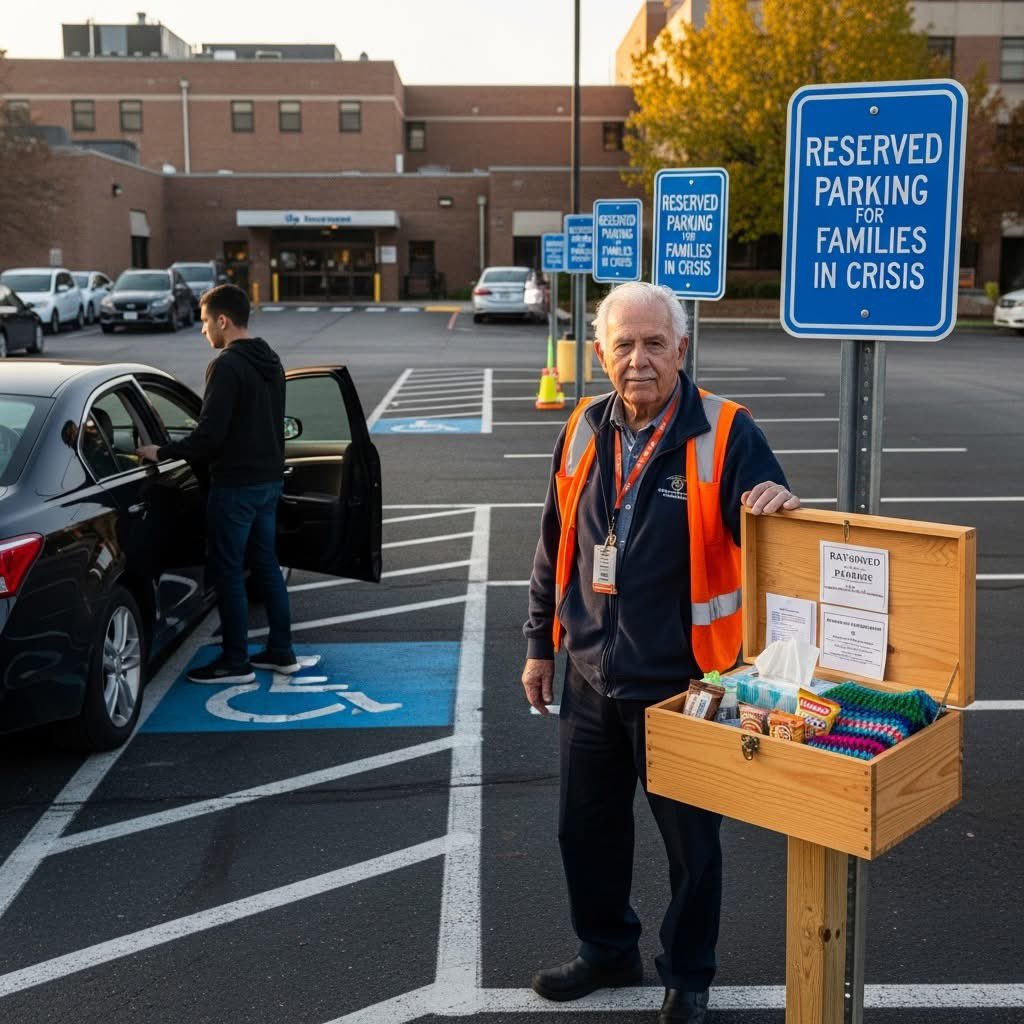
"My name's Raymond. I'm 73. I work the parking lot at St. Joseph's Hospital. Minimum wage, orange vest, a whistle I barely use. Most people don't even look at me. I'm just the old man waving cars into spaces.
But I see everything.
Like the black sedan that circled the lot every morning at 6 a.m. for three weeks. Young man driving, grandmother in the passenger seat. Chemotherapy, I figured. He'd drop her at the entrance, then spend 20 minutes hunting for parking, missing her appointments.
One morning, I stopped him. "What time tomorrow?"
"6:15," he said, confused.
"Space A-7 will be empty. I'll save it."
He blinked. "You... you can do that?"
"I can now," I said.
Next morning, I stood in A-7, holding my ground as cars circled angrily. When his sedan pulled up, I moved. He rolled down his window, speechless. "Why?"
"Because she needs you in there with her," I said. "Not out here stressing."
He cried. Right there in the parking lot.
Word spread quietly. A father with a sick baby asked if I could help. A woman visiting her dying husband. I started arriving at 5 a.m., notebook in hand, tracking who needed what. Saved spots became sacred. People stopped honking. They waited. Because they knew someone else was fighting something bigger than traffic.
But here's what changed everything, A businessman in a Mercedes screamed at me one morning. "I'm not sick! I need that spot for a meeting!"
"Then walk," I said calmly. "That space is for someone whose hands are shaking too hard to grip a steering wheel."
He sped off, furious. But a woman behind him got out of her car and hugged me. "My son has leukemia," she sobbed. "Thank you for seeing us."
The hospital tried to stop me. "Liability issues," they said. But then families started writing letters. Dozens. "Raymond made the worst days bearable." "He gave us one less thing to break over."
Last month, they made it official. "Reserved Parking for Families in Crisis." Ten spots, marked with blue signs. And they asked me to manage it.
But the best part? A man I'd helped two years ago, his mother survived, came back. He's a carpenter. Built a small wooden box, mounted it by the reserved spaces. Inside? Prayer cards, tissues, breath mints, and a note,
"Take what you need. You're not alone. -Raymond & Friends"
People leave things now. Granola bars. Phone chargers. Yesterday, someone left a hand-knitted blanket.
I'm 73. I direct traffic in a hospital parking lot. But I've learned this: Healing doesn't just happen in operating rooms. Sometimes it starts in a parking space. When someone says, "I see your crisis. Let me carry this one small piece."
So pay attention. At the grocery checkout, the coffee line, wherever you are. Someone's drowning in the little things while fighting the big ones.
Hold a door. Save a spot. Carry the weight no one else sees.
It's not glamorous. But it's everything."
Let this story reach more hearts....
Credit: Mary Nelson
@juniorkingpp My late native Virginian parents would have been livid if they were alive to see the Jan 6th riot and the walking around - and inside - the capitol building of the 'Stars and Bars'.