Day 05 of #30DaysOfPython ✅
Lists — one of Python's most important data structures.
Today I learned:
→ creating and modifying lists
→ positive & negative indexing
→ slicing lists to extract data
→ append(), insert(), remove() and pop()
→ sorting and reversing lists
→ copying and joining lists
One thing that stood out:
Lists are mutable.
Unlike strings, list elements can be changed after creation, which makes them incredibly useful for storing and updating dynamic data.
Today's exercises helped reinforce how indexing, slicing, and list methods work together when manipulating data.
What's the most useful Python list method you use regularly?
#Python #Coding #Programming #LearnToCode #Tech
Day 04 done.
Strings today — indexing, slicing, f-strings, methods.
Ran the code. Broke a few things. Fixed them.
30 days. Not stopping.
#30DaysOfPython#Python#BuildInPublic
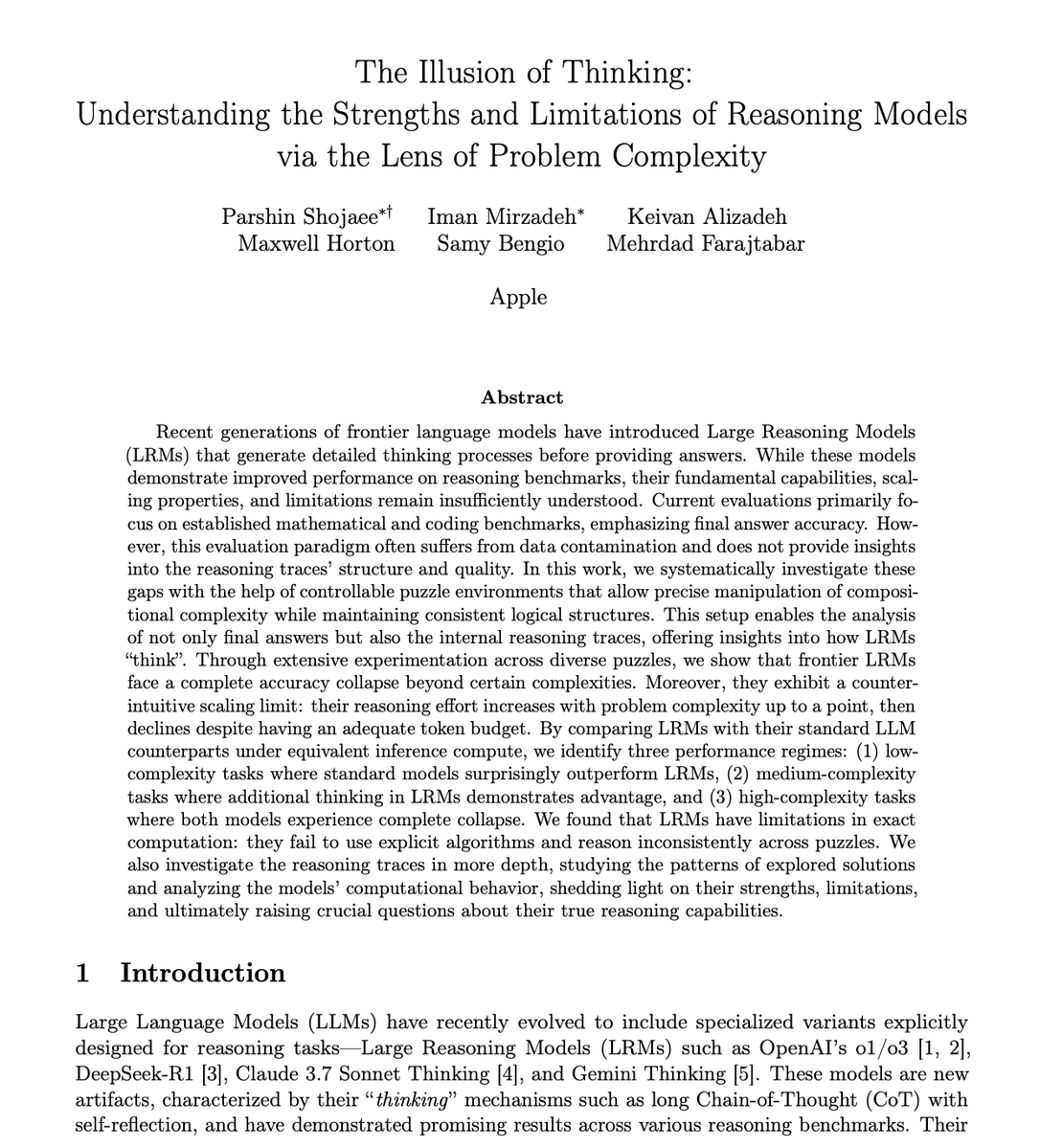
Apple has published a paper with a devastating title: “The Illusion of Thinking”
It argues that AI models, no matter how brilliant they may seem, do not understand what they are doing.
They do not solve problems. They do not reason. They merely generate text word by word, trying to sound coherent.
Apple tested the most advanced reasoning models in the world on controlled puzzle environments. They tore open the internal "thinking" traces.
What they found shatters the narrative that we are getting closer to AGI.
Current models don't scale with complexity. They have a hard mathematical cliff. And they do not degrade gracefully. They collapse.
But here is the most unsettling part.
When a problem gets too complex, the AI doesn't use its remaining compute to try harder.
It just gives up.
Its reasoning effort actually declines. It stops thinking and starts guessing.
Then Apple ran the experiment that closes the casket on the reasoning debate.
They gave the AI the exact, step-by-step algorithm to solve the puzzle. The cheat codes.
All the AI had to do was follow the instructions.
It couldn't do it.
Performance didn't improve at all.
When the complexity gets high enough, these models fail because they cannot actually execute a logical sequence.
They are not reasoning. They are just pattern matching.
When you give them a simple problem, they overthink. When you give them a hard problem, they collapse.
Paper: The Illusion of Thinking, Apple, 2025
your brain is always becoming better at whatever you repeatedly do. that’s why repetition changes people more than motivation ever will. if you spend every day stressing, overthinking, comparing yourself to strangers online, replaying old mistakes, and expecting the worst, your brain slowly starts treating those patterns like home. it begins scanning the world for more proof that you’re not enough, that life is against you, that things won’t work out. the scary part is your brain doesn’t care if the pattern is helping you or destroying you. it only cares about what gets repeated.
but the same thing works in your favor too. when you repeatedly choose discipline, growth, gratitude, focus, and belief in yourself, your brain slowly reshapes around those things as well. at first it feels unnatural because your old patterns are louder, but over time your perspective changes. challenges stop feeling like signs to quit and start feeling like part of the process. your mind becomes whatever it practices most. so be careful what you keep giving your attention to because eventually, your thoughts become your reality.
Level up your AI skills at #AISkillsFest! Whether you’re in business, tech, leading teams, or just exploring AI, there’s something for you.
Get ready for:
• Curated playlists for your role
• Live digital sessions
• Prizes and challenges
Register today: https://t.co/ubHjXPJBSA