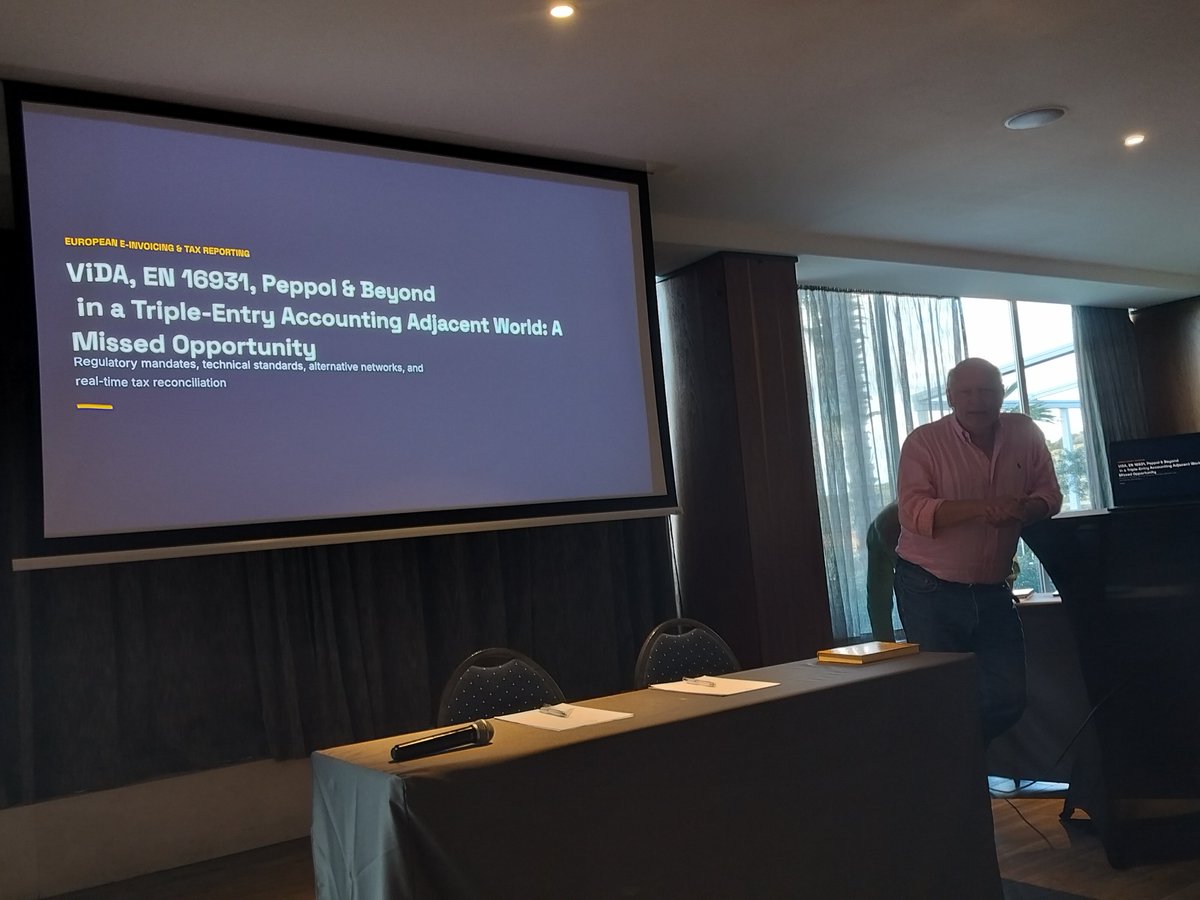
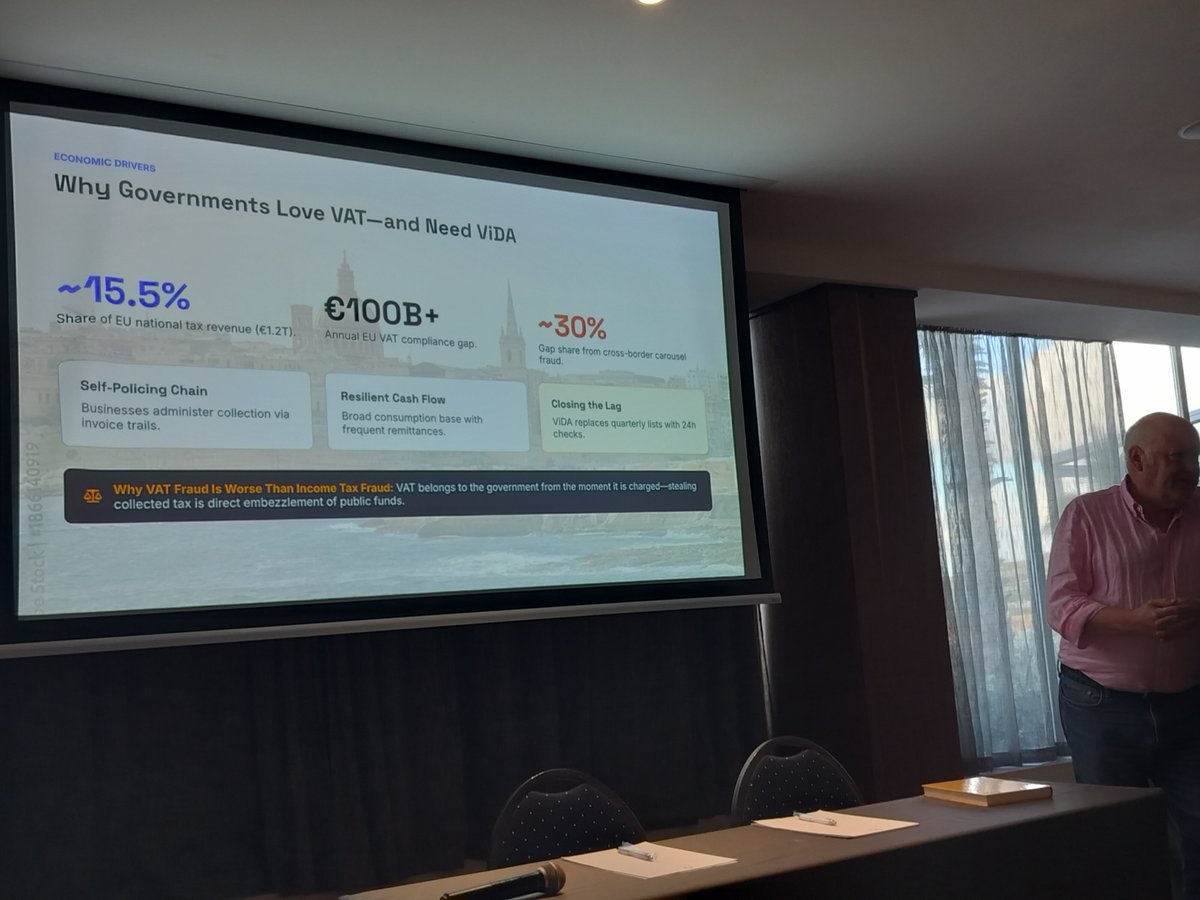
It was an honor and a pleasure to present some of CVE’s research virtually at TEAconf3 over the weekend.
After the Receipt
Triple Entry Accounting, Evidence Discipline Under Stress, and the Measurement of Economic Movement
135 Research / Capital Velocity Economics
Thanks again to all of the peer reviewers, attendees and conference organizers.
Back from the 3rd international TEA conference. We have welcomed 8 scientific presentations, among which our own published paper https://t.co/vhvZNFFdNF
#TEAconf 2026 is a wrap. Thank you to everyone who came to Malta for the third edition. Good conversations, hard questions, real progress. See you at the next one!
The next talk after lunch was a truly incredible talk by Nina who recounted the value and role of @teaconf TEA to support and build solutions to families of persons with rare diseases where treatments and clinical data are often non existent. It was a very moving presentation
Excited to share that I'll be presenting After the Receipt at TEAConf3 on November 21.
I'll be joining virtually from New York to discuss Triple Entry Accounting, evidence discipline, and the measurement of economic movement.
Appreciate Ian Grigg, Arthur Doohan, and everyone involved in putting this together.
https://t.co/8uem4uEF84
Happy to participate in the 3rd TEA conference this year in Malta next week. A great event, many brand-new papers on ideas of a technology that can transform not only finance, but also AI and the world.
"Triple Entry Accounting, in the Grigg style signed receipt lineage, strengthened the evidentiary status of the transaction by binding a digitally signed receipt to the accounting record, moving the transaction from the owner's opinion toward a fact agreed between parties."
Triple Entry Accounting is transparent to authorised parties and private to everyone else.
The encrypted fingerprint goes on the blockchain. The transaction data stays between the parties and their auditors.
https://t.co/YaeJFS837S
#TripleEntryAccounting#TEAconf
Triple Entry Accounting is transparent to authorised parties and private to everyone else.
The encrypted fingerprint goes on the blockchain. The transaction data stays between the parties and their auditors.
https://t.co/YaeJFS837S
#TripleEntryAccounting#TEAconf
TEAtalks E2 — @juan_i_ibanez on how REA, TEA, and blockchain converged on the same answer: the firm-level ledger is the wrong unit of analysis.
https://t.co/voTLbRmSs6
#TripleEntryAccounting#TEAconf
The ugly truth about France and some of the other European countries currently in turmoil - and which none of the politicians want to admit because it'd be political suicide - is that you can't solve the problem by going after immigrants (as the right asserts) or the rich (as the left asserts), but you could solve it by going after the old.
One extraordinary statistic for you: people over 60 in France, a quarter of the population, own 60% of France's wealth, non-financial and financial (https://t.co/IdJ5X7OO12).
And here is another crazy statistic:
that same quarter of the population, those above 60, receive nearly two-thirds of all social spending by the French government (https://t.co/deNRNevIwq) - which is famously among the highest in the world (France's government spending is an insane 57.3% of GDP).
Last statistic: they make up about 40% of voters because they're a third of registered voters (https://t.co/zTa4RnVOmT), and they turn out far more than anyone else (https://t.co/34V2xzs9jH).
Put our 3 statistics together and there's almost a bit of an apartheid situation here: the old own most of the country's wealth, collect most of the social spending and have the political power to keep it that way.
Which makes them a de-facto rentier class, living off assets and transfers paid for by younger generations.
And, of course, at the risk of stating a truism, the future is built by the young. Yet France keeps effectively taking money away from them to give it to those whose working lives are already behind them - and need the money far less since they already own the country's wealth.
What about inheritance, I hear you ask? That's the funniest/saddest aspect: given that life expectancy has kept rising, the French now inherit a home at 54 on average. The most common case is someone in their 80s leaving it to heirs in their 50s, in effect the very old transferring wealth to the about-to-be old (https://t.co/d2RPAqLJGR).
You can add this to our earlier apartheid statement: on top of all the rest, even when the old finally let go of their wealth, it stays within their own "camp".
That's my personal situation, incidentally: I'm 42, my father is 71 and he is starting to look at ways to pass things on to me and my siblings, when our professional lives are already well settled, so it'll arrive when it changes things the least, which is pretty much the French system in a nutshell.
Now, I get that there'd be some unfairness in going after them: they paid into the system their entire working lives, playing by the rules of a social contract that told them if they paid up they'd collect at the end. Changing the rules now means breaking that promise, which is admittedly unfair.
But there's no magic wealth tree in any society: you can only take it where it is. That's the way most major societal transformations end up happening. They're often triggered by a catastrophic event (the so-called "four horsemen": mass-mobilisation war, revolution, state collapse, plague) BUT what really drives change is a transfer: wealth gets pried from the privileged class who've been sitting on it and handed to those who'll build what comes next.
So, in theory and in an ideal world, you can do without the catastrophic event and directly proceed with the transfer...
The fact that in France, and elsewhere in Europe, it's the youth protesting is probably no coincidence - even though they don't frame it as a generational fight. And even though, cruel irony, the left politicians many of them march behind promise to bring the retirement age back to 60 (https://t.co/WrJOhpWqYR), which would make the situation even worse.
Let's say they understand intuitively that the system is stacked against them, even if they haven't yet figured out how. And politicians are obviously doing what politicians do, meaning pandering to the people who actually vote, while pointing the young towards easier - and politically convenient - scapegoats.
To be clear I'm not saying it's the only problem in France, VERY far from it. I'm also not saying that all old people in France live a lavish lifestyle at the expense of younger generations: there are also plenty of very poor retirees who, if anything, would deserve more.
What I am saying is that it's probably the biggest elephant in the room: everyone can see it, nobody dares mention it - no politician, from any side, wants to run on cutting grandma's pension - and it makes every other problem harder to fix.