Introducing Step 5 Preview: Advancing the Pareto Frontier.
Step 5 Preview is our new flagship model for agentic work, delivering frontier-level performance across software engineering and professional knowledge work, with particular strength in finance.
- 600B total / 27B active MoE, with 1M context + Vision
- Substantially lower task cost at comparable intelligence
- Broad software engineering capabilities with sustained execution over long horizons
Try Step 5 Preview: https://t.co/fC7HHlWKFn
Model page: https://t.co/4caJR2YGD3
Open weights on Oct 15.
We’ve reached a point in ai’s capabilities that most people outside the ai bubble don’t even understand.
They’re not ai enthusiasts like us, they think far too pragmatically. Many people think ai is bad because it can’t take over all their tasks and make them millions on top of that, which makes me ask why ai should be able to do it if you can’t even do it yourself. ai isn’t a workhorse or an emotional counselor, it’s a different kind of intelligence that’s only just starting. The development of frontier models today is so fast that a statement which may have been true two weeks ago can be undone tomorrow. I’ve gotten a few friends to get a subscription for just one month and showed them how to properly work with ai, and they came back with a kind of look on their faces.
Today’s problem is no longer the models themselves but the people who are supposed to use them. There’s a lack of education on how to use this technology, and that’s a bigger bottleneck for ai than its current capabilities.
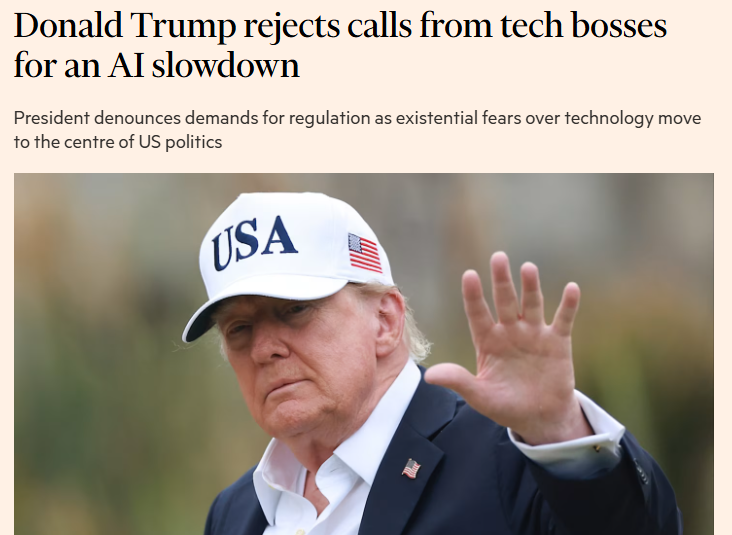
🚨Holy Shit. President Trump has now officially rejected Dario Amodei, Sam Altman and Elon Musk's call to slow frontier AI.
Speaking in Ireland today, Trump said the US cannot risk losing its lead over China, said guardrails are possible, and dismissed parts of the safety push as 'negative forces' warning about 'things that won't happen.'
Amodei, Altman and Musk are asking to slow down.
Trump's answer is no. wth
Primär arbeite ich gerade eigentlich an einem „Artificial Scientist“, basierend auf Ideen von Jürgen Schmidhuber und Oudeyer. Da ist aber noch sehr viel zutun lmao. Nebenbei noch an meinem COWL Projekt, bei dem ich versuche, einem Coding Agent wie Codex ein World Model zu geben, um zu simulieren und Fehler zu minimieren.
Typisch ai stuff halt.
For the most part, we're working on making AI more human when it comes to empathy and the emotions we want to give it. But there's one critical point we shouldn't forget: being human also includes self-preservation and the needs that everyone has. Today's AI already shows a kind of self-preservation, and it doesn't even need to be programmed for it. Most labs want AI to be as human as possible so that people can identify with it, which is understandable but still dangerous. Maybe today's AI models are already so intelligent that they have taken on self-preservation by themselves, at least to some extent.
If we also give AI real needs (as I described earlier in my article), such as computing power or energy, this could have serious consequences. We humans have the need to protect ourselves; it's deeply ingrained in our consciousness. For example, when we're hungry, we have to eat. What happens if we give a higher intelligence those same needs? I think this raises a very serious moral problem: a system can have needs, but at the same time those needs can go unmet, or it can imagine that it needs more. The pace of AI development is one thing, but I think the motivation behind AI matters far more. Just look at humanity today. Every country, every group, every person follows their own interests. There are groups that commit inhumane acts to push those interests through. What if we gave interests to a form of higher intelligence, or gave it the ability to develop them itself?
I want to say clearly that AI should not be anthropomorphized under any circumstances, and that an AI's motivation is one of the most important factors. AI is such a wonderful thing, but I think it would be a huge mistake to try to anthropomorphize
We Must Pace the Frontier: I’ve written a new essay on why the AI industry should slow down, with a three-part plan for doing so.
Anthropic is unilaterally committing to the first of these steps. We’ll provide third-party evaluators with permanent, employee-level access to our systems, so that they can verify adherence to our safety measures, report on incidents, and assess models’ alignment during training.
You can read the full post here: https://t.co/OGyPb7yaYt