I've tried plenty of tools to manage my creator business 🤯
But none of them work exactly the way I want.
So I built my own with @EazoAI . No coding needed.
It tracks brand deals, payments, deadlines, earnings, and upcoming X and LinkedIn posts.
I even added a deal tracker and content calendar to test how everything works.
All I did was describe what I wanted in plain English.
Here's how:
You don’t always need to reinvent your content strategy. Sometimes you need to change the production process so you can keep delivering what your audience already values.
Chat works when you know what to ask, but dedicated interfaces simplify repeated tasks.
I want to test if Eazo can turn one simple description into an app I’d actually keep using.
@dominicy0 I’ll see what works and what doesn’t.
https://t.co/Sr4tnyDyZk
#eazo#qoni
Finding your next customer shouldn’t start with signing up for 10 data tools.
Treg gives your AI agent 3,800+ data endpoints from 110 providers through one API token.
Pay per call. Provider prices. Zero markup.
Try it with $1 in free credit.
🚨 You're using Claude like a chatbot when it's an entire AI ecosystem.
Most people only use https://t.co/PAStTWfBwQ to ask questions and write content.
They're missing the bigger picture. 👇
🧠 Chat & Reasoning → Write, learn and solve complex problems.
🎨 Artifacts → Build interactive tools, dashboards and prototypes.
💻 Claude Code → Build, debug and improve software.
⚡ Skills → Create reusable instructions and workflows.
📁 Projects → Organize files, knowledge and context.
🌐 Claude in Chrome → Get AI assistance while working in your browser.
🔗 Connectors → Connect supported apps and data sources.
🤖 Cowork → Delegate supported multi-step tasks.
🛠️ API → Build Claude-powered applications.
🔥 The real skill isn't knowing every feature.
It's knowing which capability to use, when to use it, and how to combine them to solve real problems.
Start with Chat + Projects + Artifacts.
Then explore Skills, automation, Claude Code and the API as your needs grow.
📌 Save this Claude roadmap.
♻️ Repost it to help someone learn faster.
Follow @Origin_AI_01 for more Claude guides, AI tools and workflows.
#ClaudeAI #Claude #ArtificialIntelligence #AITools #ClaudeCode #Automation #AIProductivity
AI agents are becoming more powerful, and payments could be the next piece of the puzzle.
With @oobit, AI can handle purchases while keeping users in control.
We’re moving closer to a world where AI doesn’t just recommend things it can actually get things done.
A robot can't learn from a video it can't measure.
@Maniformer , the world’s leading physical AI data platform. Its new paper scores a person's hands to 4.29 mm of finger error and their head to between 0.65 and 2.83 mm, checked against a 26-camera motion capture lab.
Teaching a robot on a real robot is slow, because every hour of teleoperation uses a machine, an operator and an environment reset. Putting a camera on a person scales with the number of people instead, which is why egocentric datasets have grown from hundreds of hours to thousands.
But video only shows what someone did. To turn it into robot actions, you need the hand's 3D position in real units. The wrist path goes through inverse kinematics and the fingers get retargeted to the robot's hand, so supervision is only as good as the hand pose underneath it. The paper's complaint is that datasets carrying those labels were shot in studios or on prepared tabletops, and where labels are released, the accuracy is asserted from hardware specs instead of measured.
When I toured Maniformer's headquarters, the data collection centre showed the same problem from the other side. One room runs more than a hundred robots at once, and right beside them people in motion-capture suits perform the same tasks by hand so the robots can learn how a human moves. Maniformer's bet is to take the robot out of that loop.
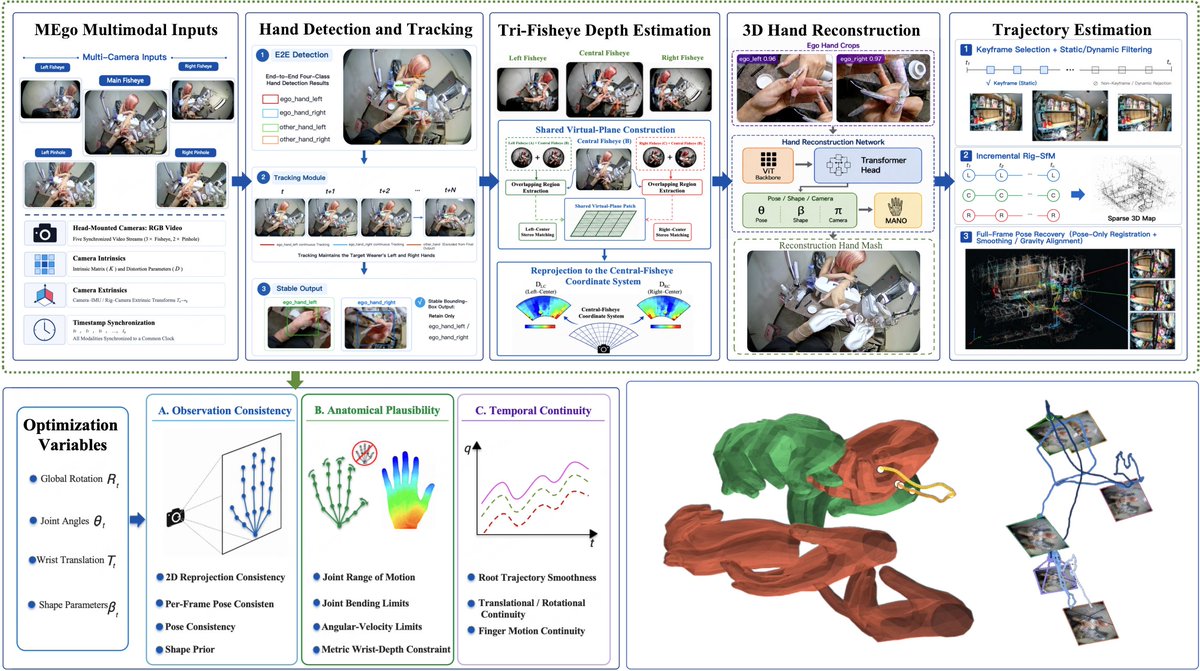
The system is called MEgoVista, and it runs on MEgo View, a head-mounted rig with fisheye cameras at 60 fps and an IMU sampled at 500 Hz. One unprepared recording goes in. Both hands and the head come out in a single gravity-aligned world frame. Three design choices carry it.
First, depth is measured instead of guessed. Most existing methods get depth from a single camera with a learned model, so scale is a prior that shifts from frame to frame, and the error sits along the viewing ray where reprojection can't correct it. Here the central camera pairs with each side camera, stereo runs across the wide baseline, and because that baseline is calibrated, the metre comes from the hardware. Scale is fixed once, at initialisation.
Second, it knows whose hands are whose. A detector decides at detection time whether each hand belongs to the wearer or a bystander. In the manicure clip the wearer's left hand touches another person's left hand, and both Dyn-HaMR and HaWoR credit the bystander's hand to the wearer. HaPTIC produced no valid output on the multi-person scenes at all. Dyn-HaMR's detection precision came out at 0.73, while MEgoVista scored 1.00 precision and 1.00 recall.
Third, it solves the whole sequence instead of frame by frame. A per-frame estimate can look plausible alone and still jitter, drift in depth, or pass through a pose a real hand can't make. MEgoVista optimises one hand trajectory across the full episode with limits on joint range and angular velocity, and lands at 1.11 mm/frame² of jitter against 3.50 for the smoothest baseline.
Then comes the scoring, which is the part I found most interesting. Everything was measured against a 26-camera, 120 Hz Chingmu motion-capture system. The protocol charges the method for any hand it declines to predict, and it screens the reference data itself for solver glitches before trusting it.
Finger articulation error is 4.2 mm, against 16.30 mm for HaWoR and 49.18 mm for Dyn-HaMR. Absolute wrist position error is 14.30 mm against 46.70 and 184.38. On head tracking, DROID-W suffered severe scale failures on 4 of 22 episodes and MASt3R-SLAM underestimated scale on 21 of the 22, while MEgoVista stayed within a few millimetres and ran about 3x and 3.5x faster on roughly 40 second episodes.
One honest note on that last comparison. ORB-SLAM3 was more accurate on one of the two capture sessions, 2.12 mm against 2.83 mm. On the other session MEgoVista won, 0.65 mm against 0.92 mm. The paper reports both, so I will too.
The other limit is where the millimetres were measured. They come from inside a motion-capture lab. In the wild there is no ground truth, so the evidence is visual: milk tea preparation with heavy hand occlusion, washing a pet with soiled hands, mold maintenance in industrial gloves, and a working restaurant. The authors also say any error left in the mocap hand reference is charged to their own system, and that slow drift in that reference would slip past their checks.
Maniformer says it has collected over 1 million hours of data and delivered the 20,000th MEgo device on August 31. If that scale holds, labels measured against a reference matter more than hours alone. The paper ends by saying it is undecided whether the next millimetre needs a better estimator or a better reference, which is a rare sentence for a company to publish about its own system.
Full paper: https://t.co/CWQxcWsmLj
The best Al tools don't just save time. They create room for higher-value work. Craig can maintain his content presence while spending more time with clients.
Craig went from struggling to find a suitable filming space to publishing two Reels daily. That’s a meaningful example of AI turning a production constraint into a new workflow.
🚨 URGENT: If you use Gmail, read this immediately.
Google’s AI is quietly scanning your private emails, bank statements, and medical docs. It was turned on by default, sparking a massive class-action lawsuit.
Here is how to find the hidden kill switches to stop it: 👇👇👇
Losing access to a filming space could have stalled Craig’s entire content strategy. Instead, he found a way to keep showing up. That’s the real power of adaptable technology.
AI avatars are especially interesting for professionals whose audiences value their expertise. Craig can share timely information without making every update a full production project.
GOOGLE Free Courses With Certificates 🎓
• Cybersecurity
https://t.co/guyzRC2mnS…
• Business Intelligence
https://t.co/bVfLpl7dyK…
• Advanced Data Analytics
https://t.co/bVfLpl7dyK…
• Digital Marketing
https://t.co/JyoQ2SHbvj…
• AI & Machine Learning
https://t.co/DGSF1V8He2…
• Data Analytics
https://t.co/boTrLd26qO…
• Project Management
https://t.co/Oo8JxTdIsO…
• UX Design
https://t.co/1a5I0euefu…
• IT Automation
https://t.co/bVfLpl7dyK…
• IT Support
https://t.co/bVfLpl7dyK…
🚀 Get certified and boost your career with Google courses.
Follow @ethan_x_ai for more AI & tech content.