The Temple team has made a breakthrough.
We have discovered (literally discovered) a biomarker, only readable on the temple region, and nowhere else, that measures the real-time cost of you being alive.
We are calling it Entropy™.
It's a live number on Temple's home screen, updating every second, on an index from 1 to 250.
1 is the deepest rest we've ever recorded. We've only seen fit, experienced meditators touch it, for fleeting moments deep in practice. 250 is the highest we've seen in elite athletes at the peak of their output and flow.
Everything moves Entropy. Sleep, stress, a sprint, coffee, a meal, a cold plunge, meditation, strength training... everything moves your metabolism, your cost of being alive. And Entropy tracks it, live.
Heart Rate doesn’t come even close to this level of precision in calculating the cost of being alive. We benchmarked Entropy and Heart Rate against a standard metabolic cart (calorimeter). Over a hundred cardio sessions, Entropy tracked the calorimeter's curve at r=0.93 and p <0.001. Heart Rate managed a meagre r=0.55.
Here's why Entropy should matter to you –
Your Entropy Maxima is the highest your body can reach when you push it hard. A high peak is the signature of a capable body, one that can rise to meet effort and recover from it. As we age, that ceiling naturally falls, so this is the number to push upwards.
Your Entropy Minima is the lowest your body settles to at rest. Across the animal world, a lower cost of being alive at rest tends to go with a longer life. Your Entropy Minima is the number to bring down, every single day.
Living with Entropy is magical. It teaches you so much about yourself, that no other metric ever has. We are looking forward to you trying out Temple. But not before it’s perfect.
Apply for early access at https://t.co/XxGR9Hpq58
Follow @temple for updates.
Just crossed 100k applications for the 100 introductory Temple devices.
To the 100 who get one: you're the founding cohort. We'll be grateful for what you teach us.
To the rest: we're building as fast as we can without compromising what @temple needs to be.
Follow @temple for updates.
Hello world. The first 100 Temples are ready to ship. We're now inviting athletes, scientists, founders, doctors, creators, and individuals who care deeply about their physical and cognitive health to be the founding users of Temple.
Apply for early access at https://t.co/XxGR9Hpq58
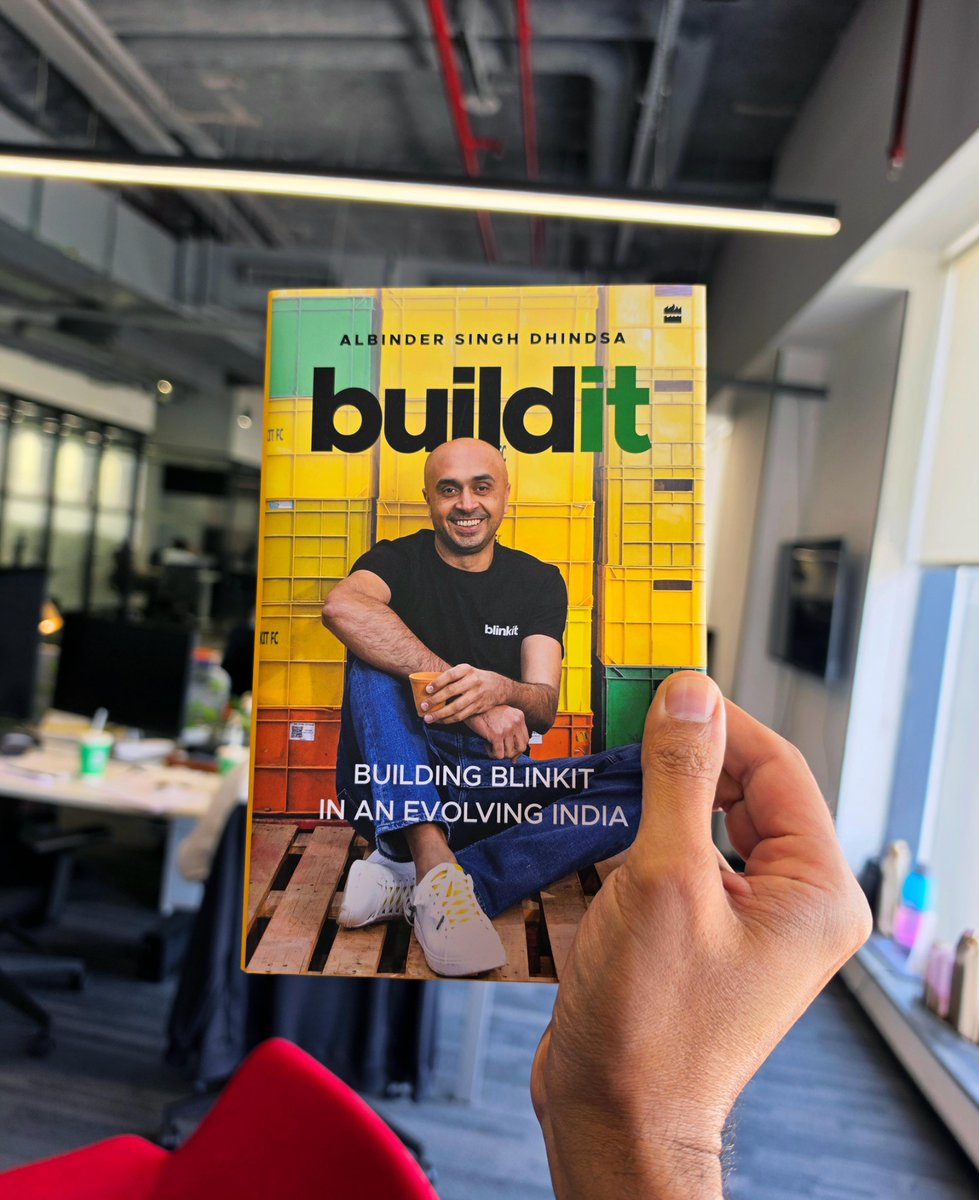
A book about Blinkit, now on Blinkit.
I have no idea how @albinder finds time for writing books alongside all that he has to do, but this is an excellent read about the challenges of starting up, building, breaking, and rebuilding for retail in India.
A few hundred signed copies available on Blinkit.
Peter Thiel: "The value is never a premium on the past. It's always a discount to the future."
Most founders walk into a fundraising negotiation anchored to the wrong number.
They point to the last round, list everything built since then, and argue for a premium on that progress. Investors push back.
The whole conversation becomes a fight over the past.
Thiel thinks this framing is conceptually completely wrong.
Investors aren't buying your history. They're buying your trajectory. And the moment you understand that, your entire approach to pitching valuation changes.
"The way I always think one should try to pitch a company or the value of a company is by explaining why it will be worth a lot more in the future. The investors are getting to invest at a point that's a lot cheaper than it will be for the share price a year, two, three years from now."
He learned this firsthand at PayPal.
In late 1999, PayPal closed a round at $45 million. Three months later, they raised again at a $500 million valuation. A 5x jump in a single quarter.
The obvious question: how do you convince anyone to accept that?
"The way we presented the round was: this is going to be the last round before the IPO."
That single reframe changed everything. Investors stopped looking backward and started looking forward.
"It doesn't matter what happened three months ago. You're getting in at a discount to the IPO."
The founder who can paint a compelling picture of where the company is going will always negotiate from a stronger position than one defending where it's been.
the "AI wrapper" critique assumes the wrapper is the easy part
But being the wrapper also includes figuring out:
- getting distribution without paying infinite CAC
- creating an amazing UX that's AI native, not derivative
- building a brand, trust in a very noisy landscape
- creating an ecosystem/community
- generating network effects
- making customer service great
- ... plus pricing, hiring, raising money, and everything else
these are not easy!
We just completed a successful flight for our tech demonstrator, Lat One v0.2.
Lat Aerospace is building ultra-short takeoff and landing aircraft using blown wing technology. Think fixed-wing performance with near-helicopter access.
A couple of months ago, v0.1 achieved uSTOL but crashed shortly after. That was expected. v0.2 was about completing the full mission, and it did. The blown wing concept worked in reality. Closed-loop control got validated. We'd predicted a cruise speed of 30-32 m/s and cruised comfortably at 33. No thermal issues despite a burning afternoon. The quick-detach wings held through aggressive turns. Was in the air for over 6 minutes. Smooth touchdown, and ready to fly again.
But the thing that makes me the happiest isn't any of that. It's that our CFD studies, aerodynamic models, SIL simulations, and flight logs all match, almost perfectly. That's what real engineering looks like. I am so proud of our team.
A long way to go, and we are getting there.
@lataerospace@surobhidas
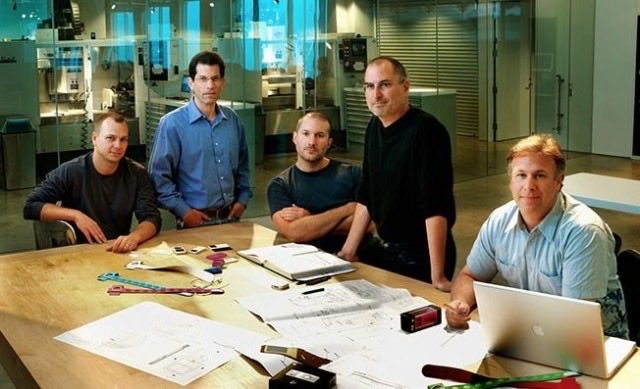
50 years of @Apple
From the early days of the #iPod to bringing the #iPhone into the world, some of the most formative years of my career were spent there. The products and teams stay with you. But more importantly so does how Apple thinks.
A few lessons that have held true for decades:
1) Start with the user, not the tech. The question isn’t “what can we build?” but “what problem actually matters?”
2) Focus is everything. Apple is defined as much by what it says no to as what it builds.
3) End-to-end matters. Hardware, software, services. It all has to work together.
4) Details are the product. What feels small is what users remember.
5) Debate hard. Commit fully.
6) Build for the long term.
We’re in another moment of massive technological change. The fundamentals haven’t changed.
The companies that win build things people actually use and can’t imagine living without.
Congrats to everyone who has been part of Apple’s first 50 years! 🙌
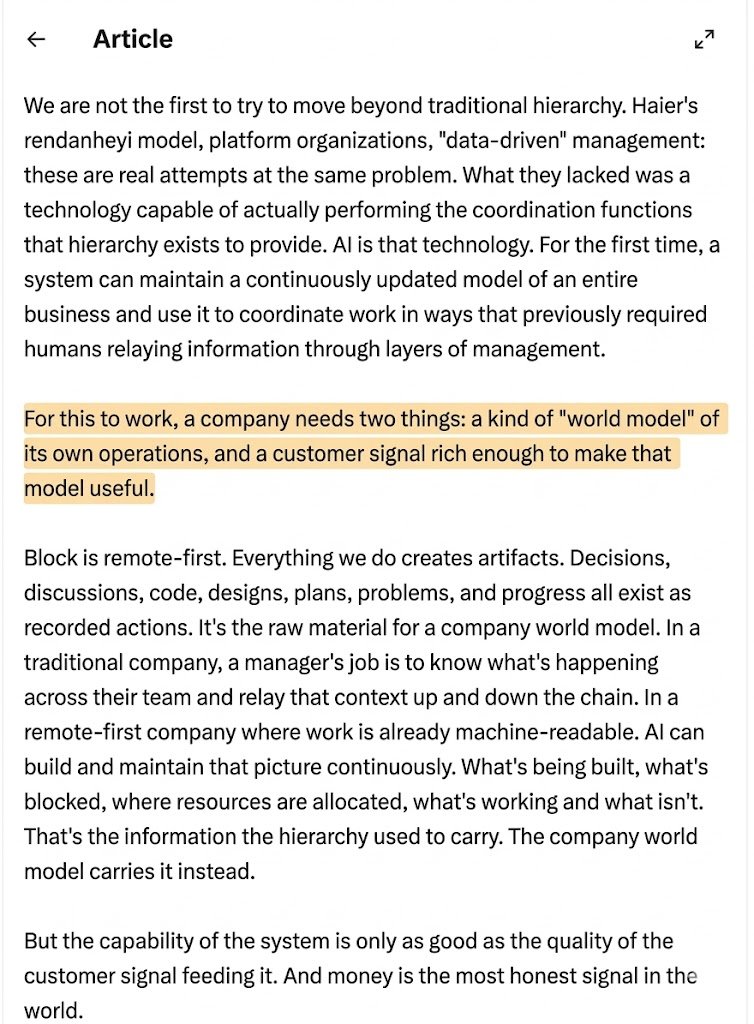
Context graphs will be to the 2030s what databases were to the 2000s.
Within a year, every frontier lab will be building one and here's why:
At 10 people, coordination is free. Everyone knows what everyone else is doing. You never hold a meeting to "align."
At 100 people, you spend maybe 20% of your payroll on coordination. Managers, syncs, standups, planning sessions, status reports.
At 10,000 people, that number approaches 60%. The majority of your headcount exists not to produce anything but to make sure the people who produce things are producing the right things in the right order.
This is the dirty secret of large organizations: output scales linearly with headcount, but coordination cost scales exponentially. Every person you add creates new information pathways that must be maintained. The hierarchy is the protocol that manages this, and it's brutally expensive.
Hierarchy is a compression algorithm for organizational knowledge. At every layer, a manager compresses the reality of their team into a summary that fits in a 30-minute meeting with their boss. Their boss compresses eight of those summaries into one for their boss. By the time information reaches the CEO, it's been lossy-compressed through five or six layers of human interpretation.
This is why CEOs make bad decisions. The information they receive has been compressed, filtered, and distorted at every layer. The hierarchy is high-latency, low-bandwidth, and lossy.
Jack didn't fire 4,000 producers but cut 4,000 compression nodes. Block's "world model" is a replacement algorithm. Zero latency, high bandwidth, lossless. Every person at the edge gets the full picture without waiting for information to travel through human relays.
The infrastructure that makes this possible is the context graph. A living, continuously updated representation of how the organization actually works. Not just data, but decision traces: the reasoning connecting observations to actions. Not what's true now, but why it became true.
The shift from "give agents memory" to "give agents organizational judgment" will define the next platform war
Final reminder - last week to apply:
A16Z SPEEDRUN ALPHA is for recent grads and college students who want to start a company but are pre-idea / pre-product
details:
- $20K equity-free upfront to start building
- up to $250K investment when you finalize
- automatic final interview for a16z speedrun, with up to $1M investment
- 8-week, in-person experience with a kickoff retreat, founder AMAs, and small-group dinners alongside the a16z speedrun community
- targeted to early-career highly technical founders
We stayed Alpha bc its a time of great change in the startup community and in the job market. And we know that most of the best founders don’t start with a perfect idea. They start with curiosity, talent, and the willingness to build things until something clicks.
Some of the most important companies of the last decade started this way:
- tinkering with side projects
- hacking on open source
- building weird prototypes with friends
- exploring a space before the opportunity was obvious
The goal of Speedrun Alpha is simple:
find exceptional builders before the idea is fully formed.
Instead of asking you to show up with a polished pitch deck, we give you:
- time
- community
- mentorship
- and just enough capital to start experimenting.
Just show up with technical ambition and curiosity. You spend the summer with us on the a16z Speedrun team exploring ideas, building prototypes, and talking to users. By the end, if something interesting emerges, we help you turn it into a real company.
The kinds of founders we’re looking for tend to look like this:
- engineers who can ship fast
- builders who have shipped side projects before
- hackers who like learning new systems quickly
- people who would probably start companies eventually anyway
We’re intentionally targeting recent grads and college students as a bet on the future.
If that sounds like you — or someone you know — this is the last call.
Thank you so so much sir. Means a lot coming from you.
We are proud to continue building Zomato in the service of our nation.
We aim to make profit to build better services, not build services to make profit.
#MadeInIndia
📝 How to win at CORS! Not just how CORS works, but also the history and reasons behind it.
Includes the hot new app everyone's talking about: The CORS playground!
https://t.co/EFGu3JeCq6