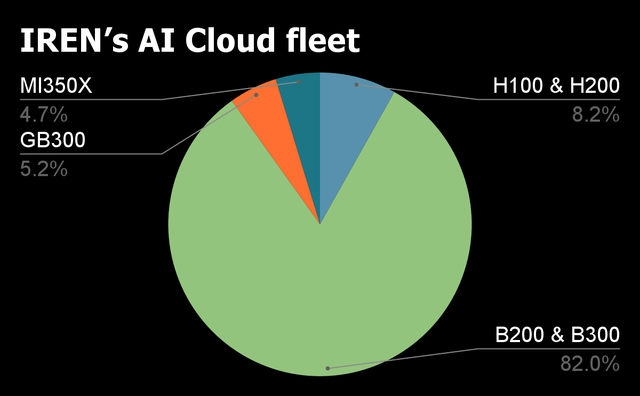
$IREN = massively underrated opportunity
thanks for the repost @FransBakker9812 - more people need to diversify to these kind of AI plays instead of the overcrowded worn-out ones
$IREN rated a buy by @techstockpros on SA
- IREN Limited doubled its AI GPU fleet to 23,000 GPUs, more than doubling its target of 10,900 by year's end.
- IREN's expansion primarily leverages Blackwell series Nvidia GPUs, giving it a pricing edge and making us expect a fast-paced ARR growth for the AI Cloud business, now estimated to be +$500M.
- There’s little margin of safety at current levels if GPU deployment or utilization faces any hiccups; however, we think any IREN stock pullback is a buying opportunity.
- We are bullish about IREN stock in the near-to-mid term, as we see more good news on leasing the capacity coming out into the year's end.
- IREN should have more upside now, sitting on 23K AI GPUs, and thus makes it to our Buy-list.
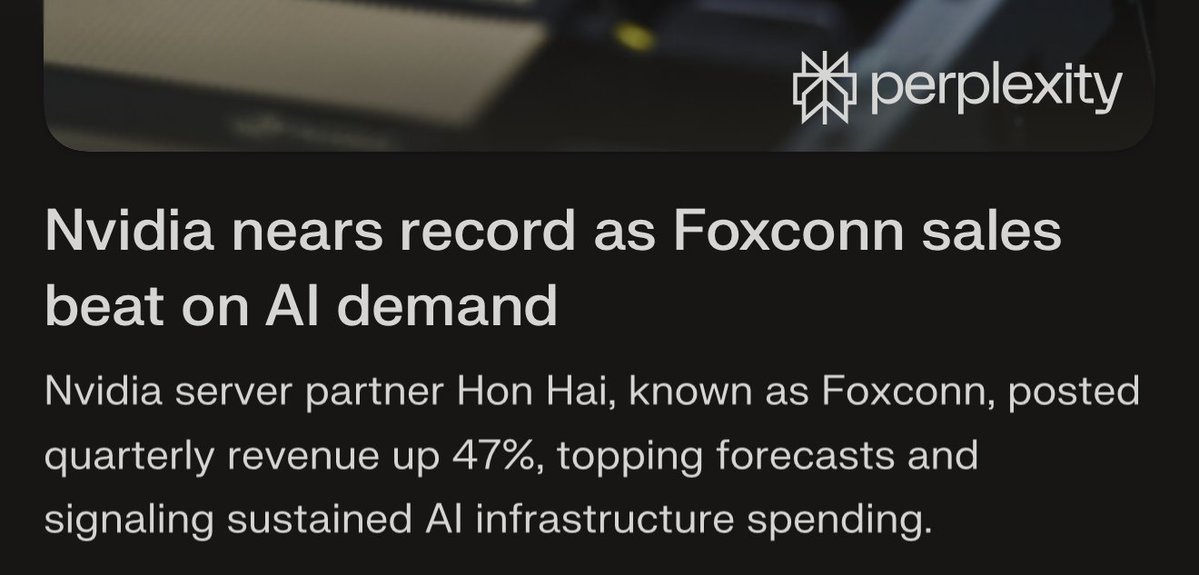
Foxconn, Nvidia’s biggest server maker, reported Q3 revenue of $95.4B, up 47% YoY and above estimates, driven by AI server demand.
September revenue rose 38%, and Foxconn expects AI-related operations to keep growing in Q4.
BREAKING: Anthropic is planning to launch its IPO in November despite AI safety concerns, per WSJ.
The company is expected to IPO at a $2 trillion valuation and raise up to $100 billion in the offering.
Anthropic is expected to reach more than $110 billion in annualized revenue by year-end.
Bessent must be furious...
Warsh’s speech sent the yen straight back toward 160.
It also highlights another reason Warsh can’t hike rates:
Higher US rates would strengthen the dollar and push the yen even lower.
That would increase pressure on the BoJ to sell USTs to defend the yen, forcing the Fed to print dollars to absorb the selling.
The Fed is trapped and can’t effectively fight inflation.
We all don’t own enough hard assets.
LEGENDARY INVESTOR STANLEY DRUCKENMILLER JUST WROTE AN OP-ED FOR THE WSJ ABOUT BOND YIELDS.
He is not happy with what the Treasury is doing, thinks that it’s effectively a gimmick, and wants the Bond Market to freely determine where yields should go.
His op-ed summarized below:
- The Treasury’s decision to double long-dated bond buybacks from $2B to at least $4B per operation looks less like liquidity management and more like an effort to push down long-term yields after the 30-year yield reached a 19-year high.
- There was no clear market dysfunction forcing intervention. Auctions were functioning, volatility was contained, and trading remained orderly. With inflation still above target, unemployment near full employment, deficits around 6% of GDP, and debt above $40T, higher yields can be viewed as the market pricing fiscal risk appropriately.
- Suppressing those yields risks weakening one of the few remaining forms of fiscal discipline on Washington. Lower borrowing costs reduce the pressure to deal with deficits, entitlement spending, and the broader debt trajectory.
- Buying long-duration Treasuries while funding the purchases with short-term bills effectively removes duration risk from the market, making it resemble a small form of quantitative easing conducted by Treasury rather than the Fed. The concern is that once markets believe officials are defending a certain yield level, they may keep testing that commitment.
- The better solution is to let the bond market set the price of government borrowing and address the underlying fiscal problem directly: reduce the primary deficit, reform entitlements gradually, and manage debt more responsibly. Liquidity tools can delay a fiscal problem, but they can’t solve it.
These yields are becoming an issue.
When someone like Drucks has to write an op-ed, you know he’s getting annoyed. Either we cut back on spending and get fiscal policy in order (no party will do that) or we end the Iran war to get yields down. If we don’t do either, this problem isn’t going away.
Railroads were once 63% of the entire US stock market.
Not 63% of transport stocks. 63% of everything listed.
The history of concentration, in order:
– Tulips, 1637. A single bulb traded for the price of an Amsterdam canal house.
– South Sea Company, 1720. Shares went from about £128 in January to above £1,000 by summer, then back near £150 by December.
– US railroads, 1840s. 63% of US market cap.
– Utilities, telecom and industrials, 1929. 36%.
– Nifty Fifty, 1972. 40%.
– Japan, 1989. 44% of global equity.
– Dot com, 2000. 41%.
– AI Big 10, today. About 40%.
Every one of them was built on something real. Railroads did compress a continent. The internet did rewire commerce. Being right about the technology was never the thing that protected you.
The tulip story is also less clean than the legend. Modern research found the economic damage was modest and the ruin was mostly literary.
The bubble was never in the idea. It was in how many people decided to own the same idea at the same time.
🚨 THE US IS NOW TRYING EVERYTHING TO BRING THE 30 YEAR TREASURY YIELD BELOW 5%, AT ANY COST.
On August 19, Treasury announced it will at least double buybacks of longer dated debt, raising the maximum from $2 billion to $4 billion per operation, starting September 9 through November 4.
This came two weeks after the normal quarterly refunding schedule was already set, an unusual move outside the normal predictable calendar Treasury has followed for years.
Total US public debt crossed $40 trillion the same day.
The relief lasted less than 2 days. By Thursday, 10 and 30 year yields had erased almost the entire move and traded higher than before the announcement, showing the first attempt was not enough to change the market's mind.
Bessent then went on CNBC and said $4 billion was not a hard cap, and buybacks "could be more than $4 billion per issue."
He also said Treasury is examining fiscal consolidation on both the revenue and cost side, with Trump directing him and OMB Director Russ Vought on the initiative, a sign the pressure is now reaching spending policy, not just debt operations.
Today, sources say Bessent could tap the Treasury General Account, built up to roughly $950 billion, to help fund these buybacks directly.
Using cash reserves instead of only repurchase operations would be a new form of intervention, one Treasury has not needed before.
Treasury has now escalated its response three times in one week after the first attempt failed within a day.
That is the level of effort going into keeping the 30 year below 5%.
🦔The cost of insuring Broadcom's debt just spiked faster than any other AI company. Broadcom is negotiating up to $100 billion in off-balance-sheet debt through special purpose vehicles to finance AI chips for Anthropic, on top of $35 billion it already backstopped in June. The debt doesn't show up on Broadcom's balance sheet but Broadcom guarantees a portion of it.
JPMorgan warned that off-balance-sheet AI commitments across the industry are heading into the trillions and called it "phantom leverage."
My Take
Nvidia guarantees data center leases. Broadcom guarantees chip financing. Both use SPVs to keep the debt off their books so it doesn't show up in the numbers investors normally look at. The bond market is pricing in what the balance sheet doesn't show, which is why Broadcom's credit default swaps spiked 28 basis points in August while the company's earnings still look fine on paper.
The phantom leverage is piling up fast. Leases, purchase commitments, residual value guarantees, chip financing backstops, all off the books, all contingent on AI demand staying hot.
The SEC decided this month that data center securitization falls outside Dodd-Frank risk retention rules, so the safeguards built after 2008 don't apply here. Apollo and Blackstone show up in every one of these deals, arranging the debt, earning the fees, and passing the risk to the bondholders. If Anthropic or any major lessee stumbles, these guarantees come back onto the chipmakers' books, and the CDS market is already moving on that possibility.
Hedgie🤗
INTERESTING: AI agents now consume 5x more tokens than humans and their usage has grown 14x since February, per OpenRouter data via a16z.
Over 85% of agentic token consumption comes from cached prompts as agents iterate toward goals rather than asking single questions.
This is a big reason memory chip demand is surging and Nvidia just told clients to expect 15%+ price increases.
Key Events This Week:
1. August CB Consumer Confidence data - Tuesday
2. July New Home Sales data - Tuesday
3. July PCE Inflation data - Wednesday
4. US Q2 2026 GDP data - Wednesday
5. Nvidia, $NVDA, Reports Earnings - Wednesday
6. August MI Consumer Sentiment data - Friday
7. August MI Inflation Expectations data - Friday
We have a big week ahead of us.
Demand for Chinese chips is skyrocketing:
Chinese integrated circuit industry revenue jumped +22% YoY in 2025, to a record $245 billion.
Since 2020, Chinese chip industry sales have nearly doubled.
As a result, China now accounts for ~6% of the global semiconductor market.
This is roughly in-line with Japan and the European Union, at ~7% each, and Taiwan, at ~6%.
By comparison, North America represents 53% of the market, while South Korea accounts for 21%.
China is rapidly emerging as a major global player in semiconductors.
WSJ reports that hyperscalers have 4x as much in off-balance-sheet commitments as in recognized liabilities
This is the reason:
For leases, recognition occurs when the facility is made available for use. As long as the data center it's in construction, it's not recognized
Purchase commitments also remain off the balance sheet until the goods or services are delivered
For equipment, the companies record the asset and either pays cash or recognizes a payable upon delivery
For energy, cloud capacity, content and other services, the cost is recognized as the service is received rather than as a capital asset
AI spending among US companies is accelerating:
The top 1% of US businesses spent a record median of $7,400 per employee per month on AI in July, according to Ramp.
This compares to a record $650 per employee for the top 10% of businesses and $11.95 per employee for the median firm.
Over the last several months, AI spend per employee has more than tripled for all these groups.
The surge is widening the gap between categories, with the top 1% now spending more than 600 times as much per employee as the typical company.
To put this into perspective, the top 1% of US businesses were spending less than $1,000 per employee per month on AI in early 2024.
AI investment is becoming increasingly concentrated among a handful of companies.
$MSFT reportedly generated $24B in sales from OpenAI during the fiscal year ended June representing ~70% of its AI revenue.
That concentration shows how much of Microsoft’s current AI monetization still depends on a single customer.
Never before have so many Americans been outside the labor force:
The number of Americans who are not in the labor force rose by +832,000 in June, to 105.8 million, an all-time high.
These are people who are neither employed nor actively looking for work.
This is now 2.2 million above the 2020 pandemic peak, when the global economy was shut down.
So far in 2026, 2.5 million Americans have exited the labor force.
By comparison, 68.7 million Americans were not in the labor force at the beginning of this century.
As a % of the population aged 16+, this figure is up to 38.5%, the highest since the 1970s, excluding the pandemic period.
The US job market is weak under the surface.